Resources

Like so many of us, I’ve watched my standard assessments crumble under the assault of AI.I’d been doing a low-stakes writing assignment for years, asking students to very informally summarize and reflect on the reading. It’s been a great assignment, helping me ensure that most students work through the reading before class and come in to class prepared with ideas and questions, and students have generally liked it. But I’m starting to see AI-generated summaries (duh) and I’m sure more are coming. I’m also noticing that my more anxious students treat the assignment as something high stakes, obsessing about the end product in an assignment designed to focus on process. Bad for their stress levels, plus it tempts them to turn to AI which is bad for my stress levels.I’ve spent a lot of time trying to figure out what to do instead. I tried just dropping the assignment, but then my students didn’t do the reading. I don’t want in-class quizzes because they shift the focus to memorization and performance under pressure. I don’t want online quizzes because they seem even less AI-resistant than my current assignment. Some of my colleagues are switching to cold-calling, interrogating students in ways that remind me of law school pedagogy from the movies. I don’t want to cold-call because I have equity concerns and because I don’t want to put my students on the spot. I don’t particularly like it when it’s done to me, and I’m much less anxious than they are. And I don’t care for the atmosphere it creates in the classroom.Instead, I decided to come up with an assignment that supports what I do want:I want my students to read deeply, slowly and carefully, listening to the text as though it was a person they respected but had trouble understanding.I want my students to feel safe in my class, willing to speak honestly and to listen and think deeply.I want the assignment to be a tool that helps them do the reading, not an extra hoop for them to jump through.To get started, I had a long conversation with my first-year honors students early this semester, asking them to describe how they read. The conversation made me very happy. They responded with a wealth of detail. They annotate the book, underlining and writing in the margins (or on sticky notes or in a separate notebook). They mark key passages and put things in their own words. Several had elabrate, and personalized, systems. Some color code with highlighters and different color tabs, others insist on pencil only. In other words, my stronger students already know how to read actively in the way I want them to. And at least some of the time, they read that way for class. Knowing that, I decided to develop an assignment that has them read that way in a more intentional, structured, and consistent way. What I came up with is much like the “show the work” journal that Emily Gravett describes in her blog about teaching Religion and Film.My writing assignment is entirely analog. My students use a paper book, a notebook, and a pen. And the assignment takes them through the process that we know works: marking up the text, taking notes, jotting down questions, turning pages.Here are the instructions:You’ll submit pics of your work on Canvas for every reading assignment. These will be graded credit/no credit.Twice a semester, you’ll submit all the materials as a portfolio and that will be graded. This means you’ll hand in Your book (which will have your notes in it)Your notebook (the notes/reflections that didn’t fit in the margins of the book)I prefer that you write notes directly in the book and that you write by hand in the notebook. If you want to type or don’t want to write in the book, let’s talk about it and make a plan, OK? I’m interested in the process here (seeing your mind and heart at work!) and not in a clean and neat end product. That means that it is ok if your materials look messy. You’re allowed and encouraged to go back and add or revise materials after class. If you do that, don’t erase the original, just cross it out and add the new ideas afterwards.Feel free to use different colors, draw diagrams, cross things out, draw arrows, and so on. Make it work for you!This does not need to be formal writing. Play with it, swear if you need to, and feel free to complain about annoying ideas and confusing writing. Don’t worry about Writing complete sentences – bulleted lists are fine!Writing neatly (but I do need to be able to read most of it)Being rightWhen I grade the portfolio, I’ll be looking for evidence of strong engagement with the text. You should be Summarizing: Mark important points and put them in your own words, identify the thesis, draw diagrams if they help, note confusing areasReflecting: ask questions, articulate issues for the class to discuss, reflect on how the reading connects to your life or to other readingsWe’re 7 weeks in now and it’s going very well. We had to set aside some time for figuring out how to submit pics on Canvas. And some of them still don’t believe me when I say it doesn’t have to be neat. But they are doing good work. They come to class with their books and plenty of notes, they can find the passages that defeated them, and they ask about them. And – oh glory! – they have done the reading and thought about it and as a result they have interesting things to say.I’ll try it with my regular classes in the spring. Fingers crossed!For more visit: “Is This the End of the Take-Home Essay?”

I was asked for pictures of me while teaching in the classroom. An organization I’m part of wanted them for one of their platforms and I obliged. I asked a student to use their phone to take pictures of me during one of our class sessions. I asked them to do it discreetly so the pictures could be as candid as possible. And boy were they candid—and revealing! I was rolling laughing as I saw myself in all kinds of animated postures: down on one knee, face looking upward, arms outstretched toward the sky; all manner of facial expressions and creative hand gestures; nutty drawings of giant circles and spirals on the chalkboard as I tried to explain who-knows-what concept. It was a surprise to me that my teaching style was so animated and a bit dramatic. And while it amused me to see this about myself, it did not make me self-conscious, for even though I had not realized this about myself, my students surely had known me this way the whole time. I got to see what my teaching looked like a little better and know that while there is no single way to teach, I surely had mine. The larger point, of course, is that there is no blueprint to how we embody our teaching, and the more we understand this and understand ourselves, the better we can move into our own. I had received an earlier lesson on embodiment the very first time I presented a paper at the annual meeting of the American Academy of Religion (AAR). I hated every minute of my first paper presentation: I hated the podium—how much it blocked my sense of connection with the listeners and made me feel like I could not see everyone clearly. I hated the microphone because it meant I couldn’t move about and I had to stand on my tiptoes to try and keep it at the right level. I hated reading the paper because it meant I was the only one speaking that whole time. It was a stressful and miserable experience. The following year, then, when I was to take part in a commemorative panel scheduled in one of the very large presentation rooms at AAR, I knew I had to find a way to change my experience of presenting. Through a friend, I received acting coach tips to help me feel more comfortable and confident about presenting. The advice in a nutshell was to experiment and play with the embodiment of the activity: practice being at the podium, around it, in front of it; explore ways to change my spatial relationship with the listeners, the paper, the microphone. Play with time, pauses, moments of possible interactions with the listeners, even if not explicitly verbal. She told me to listen to what my body was telling me through its discomfort—what exactly was not working? —and to explore ways to address and attend to the cause of the experience. I should accept that presenting in the traditional way did not work for me and explore and play with various adjustments and shifts to discover the approach that did work for me. Effectively, she released me from the idea that there was a single blueprint for conference paper presentations and encouraged me to bring myself, mind and body, to discover my own. In my last post I wrote that “we teach humans, not subjects,” and argued that in our teaching it is important to attend to the humans before us first and foremost. It is likewise important to attend to ourselves, to who we are in the wholeness of our mind and body, and to allow ourselves to feel and sink into the embodiment of the teaching relationship. Teaching is relational as much as it is embodied. And it takes some experimenting to find one’s grounding within them both. But before receiving the tips from the acting coach, I received an invaluable tip from a student that has remained with me since my first week as a professor. The Faculty Development team at my university invited students to join the new faculty for lunch and an informal Q & A during the new faculty orientation event. I asked the student sitting at my table, “If you could give one piece of advice to new faculty, what would that be?” He said, “Let us see you as human, sometimes. Be ok showing us your ‘non-professor human side’; it helps us relate to you better.” I always remember that tip—it reminds me that it is okay to bring my peculiar, embodied self to the relational activity of teaching and to give myself permission to sink into it, even with its flair and dramatic gestures. What’s yours?
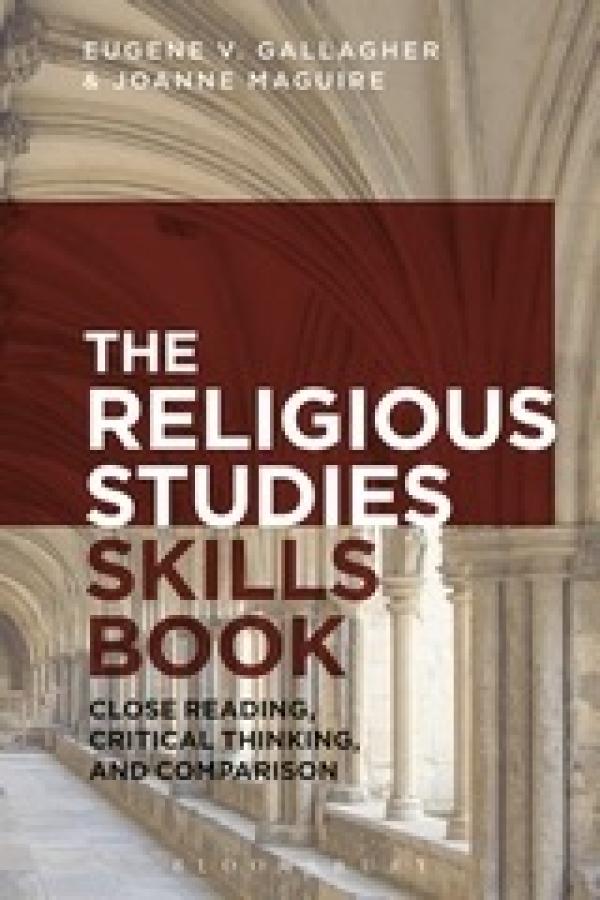
Gallagher and Maguire wrote The Religious Studies Skills Book for undergraduate students taking religious studies courses. Recipients of the American Academy of Religion’s Award for Excellence in Teaching and longtime Wabash Center affiliates, Maguire and Gallagher draw on the breadth of their experiences as scholar-teachers to craft an accessible book that covers the basics – and more. They dispel myths, like the assumption that teaching about religions in public universities is unconstitutional, and they clarify common confusion, including the distinction between studying theology and religious studies. They also offer insights into what makes the study of religion so compelling and worthwhile: Students of religion are in a field unlike any other. The field has interdisciplinary breadth and global and historical depth that can’t be found elsewhere on campus. Many students come to the academic study of religion expecting personal spiritual development. Although that might be an accidental outcome of exposure to ideas in any course, teachers tend to be strongly interested in developing students’ skills and knowledge, goals achieved in part by reading, observation, and discussion that brackets personal judgement and biases . . . If a single introductory course in religious studies teaches nothing else, it will at least show you that there are many other ways to understand the world. (69-70) I quote this passage at length because it exemplifies one of the two most important features of this book: the authors write to and for students. They do this from the first to the last page. I never felt like they overlooked the student to speak to a colleague. Midway through, I flipped back to the title page and wrote, “How many of us write for this audience? They’re taking students seriously!” It’s refreshing, and it is one aspect of the book that would make me want to assign it. The book’s other great strength is how the authors model what they expect students to learn. Most chapters include explicit examples. The chapter on comparison offers lengthy examinations of how comparison works using excerpts from sacred texts (Matthew and Science and Health with Key to the Scriptures) and scholarly ones (definitions of religion). In some places, the authors anticipate students’ observations, and in others, they expand their scope. For example, they note fairly obvious similarities between the gospel and Science and Health, and then they expand the comparison through a series of questions about authorial intent. In addition to the explicit examples, Gallagher and Maguire build an argument through the arrangement of the book’s chapters and draw on evidence from scholarship on teaching and learning. The companion website provides more general information and additional exercises, too. My main concern is how the book can reach its intended audience. Ideally, students in introductory courses would read and absorb the Skills Book. Realistically, the motivated majors in a third-year seminar will be carrying copies with dog-eared pages, and, years from now, graduate students learning how to teach will be lucky to find a copy with some dedicated major’s marginalia.
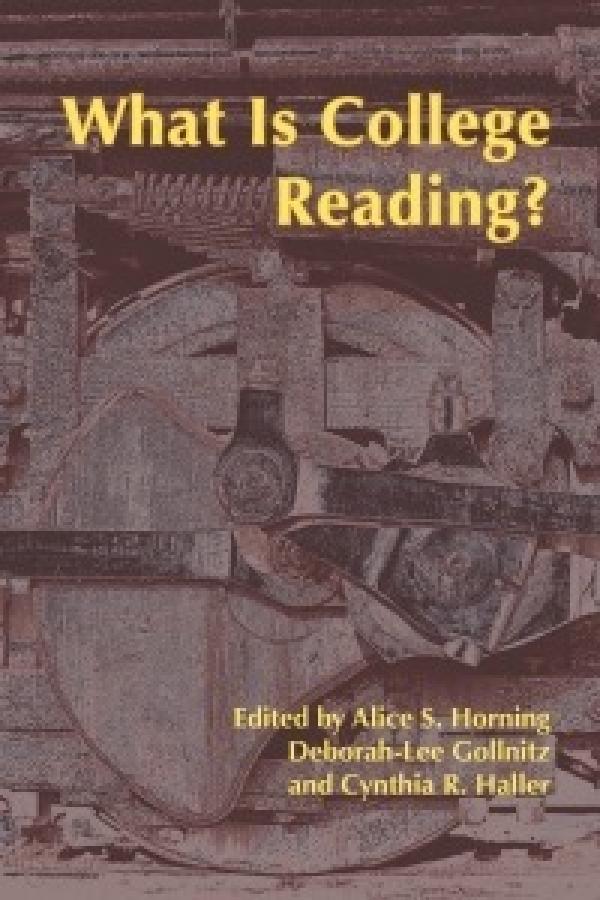
Co-published by CSU Open Press What is college reading? As college teachers we may assume that it is a process of comprehension, analysis, synthesis, and evaluation. But, as this edited volume overwhelmingly demonstrates, that is often not what it is for college students. How then can college teachers help students practice advanced reading skills? The problem is compounded by the fact that even college teachers who actively want to encourage students to read may unwittingly discourage advanced reading skills by, for example, giving reading quizzes in class (as discussed by Mary Lou Odom in this volume). This edited volume is a great resource for anyone wishing to engage questions about how to improve college reading. Some chapters provide useful practical suggestions. For example, Chris Anson shows how to formulate reading log prompts that require students to engage with the underlying ideas in the reading. Other chapters describe exercises such as in-class annotations (Davies) and says-does columns (Huffman). The volume also contains several insightful discussions of other factors influencing college reading that are more difficult to address, but no less important. For example, some of the authors observe that reading, which we may think of as an individual activity, is a “complex sociolinguistic task” (Hollander et al., 59), and “a collective and holistic enterprise” (Maloy et al., 71). Brian Gogan provides a thoughtful reflection on reading in relation to “threshold concepts” (concepts that students need to grasp in order to move forward in a given disciplinary context). College teachers may use these insights to make reading part of building an intellectual community in the class. The chapter by Young and Potter discusses how students are taught to read in K-12, where students are commonly given a decontextualized passage and then tested on their ability to understand inferences at the level of sentences or paragraphs. These students also commonly learn that for each question asked about the text, there is one correct answer in a multiple-choice format. They receive comparably little training in the advanced reading skills required for college, such as learning how to place a particular text into a connected web of texts that make up an ongoing disciplinary conversation, or asking their own higher-order questions and working with others’ questions that do not have a single “correct” answer. When students start college, therefore, they will commonly think of reading as looking for answers in a decontextualized excerpt; they are not accustomed to looking instead for interesting, productive problems in a web of texts (as also discussed in the afterword by Sullivan and Tinberg). Other authors discuss the importance of instructors connecting reading with writing, drawing on both the writing-to-read and reading-to-write conversations (Anson; Freedman). Some chapters refer to the by now widely known finding that the majority of students do not do what their instructors think they do when completing a research paper assignment, and how to address the implications of this for formulating new types of writing assignments (Horning; Young and Potter). Related to this, Laura Davies points out in her chapter that students who write poorly are usually referred to the university’s writing center, rather than asked about their reading skills, which underlie their writing. Several chapters also touch on how reading might be given a stronger institutional footing through, for example, being explicitly incorporated into writing-across-the-curriculum initiatives (Odom), linking courses (Sturtz et al.), or providing a reading-across-the-curriculum community on campus (Hollander et al.). In sum, as Leonora Freedman observes in her chapter, stronger responses to the problem of how to teach college reading skills can lead to increased student engagement as well as increased faculty morale. This edited volume is a very good place to start. It deserves a wide readership among college faculty and administrators, and this goal will no doubt be made easier by the fact that the publishers have made it free to download at wac.colostate.edu.