Resources
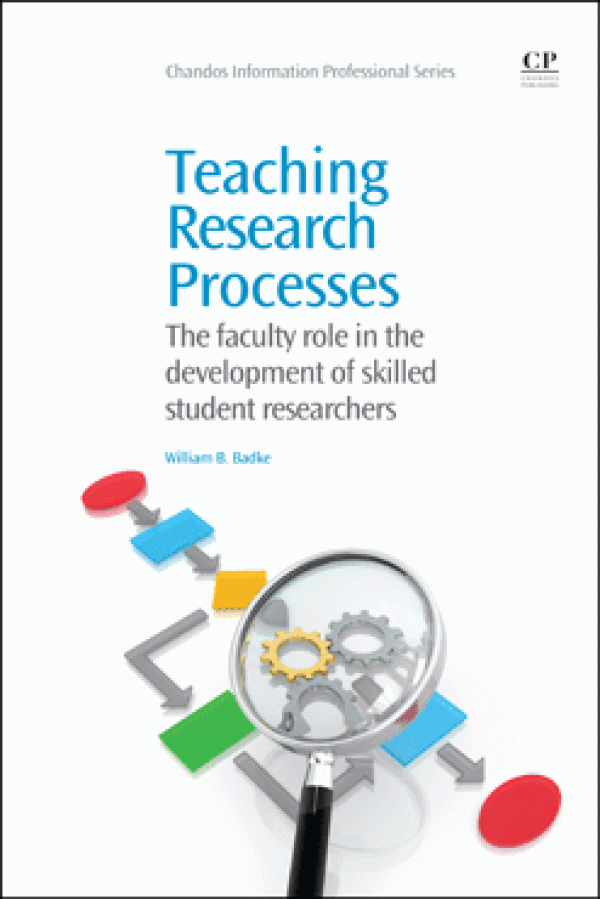
- engages the domain of teaching faculty rather than librarians only  - analyzes the reasons why the research processes concept represents a gap in academia  - focuses on research ability as a process that can be taught within disciplines  -  provides concrete examples to help faculty teach research processes while meeting existing academic goals Information literacy may be defined as the ability to identify a research problem, decide the kinds of information needed to tackle it, find the information efficiently, evaluate the information, and apply it to the problem at hand. Teaching Research Processes suggests a novel way in which information literacy can come within the remit of teaching faculty, supported by librarians, and reconceived as ‘research processes’. The aim is to transform education from what some see as a primarily one-way knowledge communication practice, to an interactive practice involving the core research tasks of subject disciplines. This title is structured into nine chapters, covering: Defining research processes; Research ability inadequacies in higher education; Research processes and faculty understanding; Current initiatives in research processes; The role of disciplinary thinking in research processes; Research processes in the classroom; Tentative case studies in disciplinary research process instruction; Research processes transforming education; and Resourcing the enterprise. The book concludes by encouraging the reader to implement the teaching of research processes. Readership: This book is intended for university professors, academic administrators, academic librarians, and students in library and Information Studies programs (From the Publisher)
Inquiry-driven learners anticipate, embrace, and adapt to disruptive change. Clifton Conrad and Laura Dunek advance a transformative purpose of a college education. They invite stakeholders from across higher education to engage in vigorous dialogue about the aims of a college education—and how to realize those aims. Increasingly influenced by market forces, many universities employ a default purpose of a college education: preparing students for entry into the workforce. As a result, students remain unprepared for a world in which much of the knowledge they acquire will have a shelf life of only a few years. Cultivating Inquiry-Driven Learners charts a new way forward. It proposes that a college education prepare students to be innovative and adaptable by developing four signature capabilities: core qualities of mind, critical thinking skills, expertise in divergent modes of inquiry, and the capacity to express and communicate ideas. In concert, these capabilities empower students to explore and foster ideas that will prepare them to successfully navigate constant change, capitalize on career opportunities, enrich their personal lives, and thoughtfully engage in public life. This innovative book also explores a wide range of initiatives and practices for educating inquiry-driven learners. Examples illustrate possibilities for developing inquiry-driven learners across the curriculum and are drawn from institutions with remarkably different missions and identities—from research universities to liberal arts colleges. "This book revitalizes the notion of a 'well-rounded' education by describing how inquiry-driven learning is critically important for these times. It is the sort of foundational text that invites discussion and debate and describes with clarity and economy of prose the pressures facing colleges and universities and how they ought to respond."—Matthew Hartley, University of Pennsylvania. (From the Publisher)
This book tells the story of building a campus “Learning Garden” over a series of cohorts of student teachers and environmental education students. The garden began with high ideals, no funding, and a strong desire to “do something” about the environment. The result was a transformation in attitude toward nature, community and toward the learning process itself. Described through three metaphors (garden as environment, garden as community, garden as transformation) this book provides a bridge of theory and practice for ecology-centred teaching and learning. As new teachers and teacher educators decide how to include “the environment” and principles of “sustainability” into their lessons, this groundbreaking text provides a bridge between theory and practice and guides the reader into the ways that teaching in the natural world changes how people learn, and, how they teach. (From the Publisher)

Problem-based learning (PBL) is a pedagogical approach that has the capacity to create vibrant and active learning environments in higher education. However, both experienced PBL practitioners and those new to PBL often find themselves looking for guidance on how to engage and energise a PBL curriculum. New Approaches to Problem-based Learning: Revitalising your Practice in Higher Education provides that guidance from a range of different, complementary perspectives. Leading practitioners in the field as well as new voices in PBL teaching and learning have collaborated to produce this text. Each chapter provides practical and experienced accounts of issues and ideas for PBL, as well as a strong theoretical and evidence base. Whether you are an experienced PBL practitioner, or new to the processes and principles of PBL, this book will help you to find ways of revitalising and enriching your practice and of enhancing the learning experience in a range of higher education contexts. (From the Publisher)
Beyond the Classroom (“Taking it to the Streets”): Practicing the Art of Philosophical Conversation”
A 1000 word essay in response to a Call for Papers: “What do you have your students do during a class session when you cannot be present?"
This book is a guide for the development and implementation of problem-based learning (PBL) in college-level courses. It provides practical advice from real professors, includes examples of PBL in action through every stage from problem development to implementation, and integrates cross-disciplinary experiences into the practice of PBL in the college classroom. Its nuts-and-bolts approach makes it valuable to faculty, graduate teaching assistants, and faculty development professionals interested in learning how to do PBL, as well as to those already using PBL who would like to learn more about what other practitioners do in their classrooms. Readers will learn what really is and isn’t PBL and why some choose to use it, what is its effect on the learning landscape, and how to overcome tricky issues such as class size, student resistance, controlling classroom chaos, conservative colleagues, assessment, and student evaluations. Extensive examples and resources for further study are included, making it a concise, yet comprehensive guide to launching a successful problem-based learning course on your own. (From the Publisher)
This article reflects critically on the introduction of a form of problem-based learning into a first-year Hebrew course. It begins by outlining the problems inherent in the way this course had previously been taught, and proceeds to consider the factors that needed to be taken into account in developing a solution. In particular, the need to develop a course that promotes deep rather than surface learning is emphasized. A description is then given of problem-based learning and the advantages it offers. An account of problem-based learning in the context of the Hebrew course is given, followed by critical reflections based on comments put forward by students involved with the course and the teacher's reflective partners. Without ignoring the problems presented by problem-based learning, this article defends this educative strategy on the basis that it stimulates student motivation and promotes deep learning on a number of levels.
In this guide, Bob Hudspith and Herb Jenkins describe an approach to teaching that has been used successfully for many years at McMaster University, and which will be of wide interest to university teachers who wish to encourage critical thinking and self-directed research into their courses. The guide thoroughly documents the philosophy and rationale of inquiry-based learning, describes how the approach works in practice, and offers advice and numerous examples on adapting the technique for a wide range of situations and disciplines.
Problem-based learning is a powerful classroom process, which uses real world problems to motivate students to identify and apply research concepts and information, work collaboratively and communicate effectively. It is a strategy that promotes life-long habits of learning. The University of Delaware is recognized internationally as a center of excellence in the use and development of PBL. This book presents the cumulative knowledge and practical experience acquired over nearly a decade of integrating PBL in courses in a wide range of disciplines. This "how to" book for college and university faculty. It focuses on the practical questions which anyone wishing to embark on PBL will want to know: "Where do I start?" – "How do you find problems?" – "What do I need to know about managing groups?" – "How do you grade in a PBL course?" The book opens by outlining how the PBL program was developed at the University of Delaware -- covering such issues as faculty mentoring and institutional support -- to offer a model for implementation for other institutions. The authors then address the practical questions involved in course transformation and planning for effective problem-based instruction, including writing problems, using the Internet, strategies for using groups, the use of peer tutors and assessment. They conclude with case studies from a variety of disciplines, including biochemistry, pre-law, physics, nursing, chemistry, political science and teacher education. This introduction for faculty, department chairs and faculty developers will assist them to successfully harness this powerful process to improve learning outcomes. (From the Publisher)
Based on the Situational Leadership model of Hersey and Blanchard, the Staged Self-Directed Learning Model proposes that learners advance through stages of increasing self-direction and that teachers can help or hinder that development. Good teaching matches the learner's stage of self-direction and helps the learner advance toward greater self-direction. Specific methods are proposed for teaching students at each stage, although many different teaching styles are good when appropriately applied. Several pedagogical difficulties are explained as mismatches between teacher style and learner stage, especially the mismatch between a student needing direction and a non-directive teacher. The model is applied to a course, a single class, and the overall curriculum.