Home » Resources » Scholarship on Teaching » The Practice of Problem-Based Learning: A Guide to Implementing PBL in the College Classroom
Scholarship
March 29, 2017
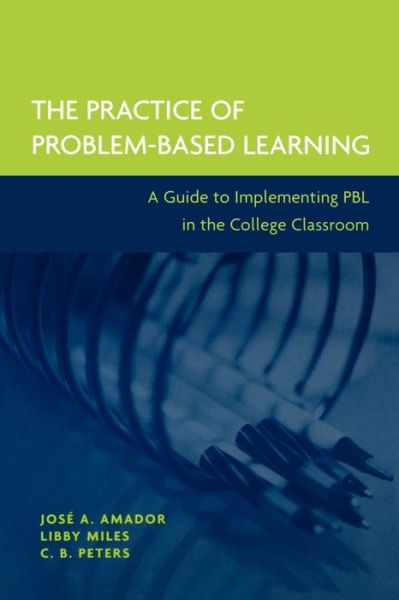
The Practice of Problem-Based Learning: A Guide to Implementing PBL in the College Classroom
- Author
- Amador, Jose A., Libby Miles and C. B. Peters
- Publisher
- Anker Publishing Company, Inc., Bolton, MA
- ISBN
- 9781933371078
- Table of Contents
-
About the Authors
Foreword
Preface
Why (We) Use PBL
Why We Switched
What Is PBL?
Issues
Changing the Landscape
Changing Ourselves
Changing Our Courses
Changing Our Students
No Problems? No Problem
The Basics
Sources for Problems
Designing a Successful Problem
Controlling Chaos in PBL: The Messy Middle
Conducting Class
Our Role
Student Contribution
What Now? Evaluation, Revision, and Reflection
The Students
What Worked-and What Didn't
The Sustainability of PBL
Epilogue
Bibliography
Index
This book is a guide for the development and implementation of problem-based learning (PBL) in college-level courses. It provides practical advice from real professors, includes examples of PBL in action through every stage from problem development to implementation, and integrates cross-disciplinary experiences into the practice of PBL in the college classroom.
Its nuts-and-bolts approach makes it valuable to faculty, graduate teaching assistants, and faculty development professionals interested in learning how to do PBL, as well as to those already using PBL who would like to learn more about what other practitioners do in their classrooms.
Readers will learn what really is and isn’t PBL and why some choose to use it, what is its effect on the learning landscape, and how to overcome tricky issues such as class size, student resistance, controlling classroom chaos, conservative colleagues, assessment, and student evaluations. Extensive examples and resources for further study are included, making it a concise, yet comprehensive guide to launching a successful problem-based learning course on your own. (From the Publisher)
Its nuts-and-bolts approach makes it valuable to faculty, graduate teaching assistants, and faculty development professionals interested in learning how to do PBL, as well as to those already using PBL who would like to learn more about what other practitioners do in their classrooms.
Readers will learn what really is and isn’t PBL and why some choose to use it, what is its effect on the learning landscape, and how to overcome tricky issues such as class size, student resistance, controlling classroom chaos, conservative colleagues, assessment, and student evaluations. Extensive examples and resources for further study are included, making it a concise, yet comprehensive guide to launching a successful problem-based learning course on your own. (From the Publisher)