Resources

In an address at the 1968 International Union for the Conservation of Nature and Natural Resources (IUCN), Senegalese forester Baba Dioum famously declared, “In the end we will conserve only what we love, we will love only what we understand, and we will understand only what we are taught.”[i] We cannot understand what we do not notice, and we will not notice what we cannot name. To love and learn we must first know, and to know, we must name. In my more conventional courses, I continue to assess students on theological and philosophical terms and names. I do so not to determine students’ comprehension and competency in a master discourse, but instead for the sake of calling them to account, to attention, to care, for the uses of variegated, precise language. Because the world is dynamic and changing, and since I hold that God calls human creatures to growth in self-transcendence, we must take seriously the task of stewarding our thoughts and speech.Concepts, ideas, and words, labels, classifications, and names all have dates. Each has a history. But language use is not merely a matter of historical interest, it is a profoundly serious moral task. Through naming, or taxonomy, we learn to navigate the worlds of meaning we have received.[ii] The work of learning, and even creating, new names can be a profoundly liberative, even salvific, activity. But naming can also be used to instrumentalize, enslave, and degrade places, creatures, and persons.Consider the moral difference between labeling fungi, plants, and animals “natural resources,” on the one hand, and “living organisms” on the other. The former risks instrumentalizing such lives economically; the latter might instead help us to recognize their intrinsic value. A third approach might recognize such lives not as resources, or as living things, but instead as “creatures” called into existence, loved, and sustained by God.Whether one uses the language of “natural resources,” “living organisms,” or “creatures,” all three are morally preferable to operating with a mental bestiary or botanical consciousness that ascribes worth, or wrath, to creatures from a narrowly anthropocentric perspective. “Pests” and “weeds” play major roles in our collective cultural psyche, but our distain for such living things does not make them any less loved by God.[iii]In Creaturely Theology we share in the divine work of knowing and caring for other creatures through noticing and naming the lives, even those we might initially despise, that surround us. Each student is tasked with identifying at least one hundred different species of plants, animals, and fungi during the semester. That work requires leaning on scientific and naturalist wisdom gathered in field guides and the living community of iNaturalist experts to get to know the creatures we happen to meet.[iv]Such work has lasting, powerful effects. As one student put it, “The class as a whole showed me how to wonder again. We would go into the woods not knowing what we would find, and then see a plant and not know what it was, and then not know much about it even after identifying it!”We are learning so much about the biodiversity of this place, but such knowledge only increases our appreciation of the mysterious otherness of each creature! We never encounter a generic flower or beetle or bird or snake; each chance meeting is with a unique, unrepeatable individual, known intimately by its Creator. To share such knowledge is a holy privilege, and each time we do we become just a little more like the One who has made us all. Notes & Bibliography[i] See Barbara K. Rodes and Rice Odell, eds., A Dictionary of Environmental Quotations (Johns Hopkins University Press, 1997), 33.[ii] My approach to the related issues of self-transcendence, growth, meaning, and historicity depends upon the work of Bernard Lonergan. See especially Bernard Lonergan, “Natural Right and Historical Mindedness,” in A Third Collection, edited by Robert M. Doran and John Dadosky (University of Toronto Press, 2017), 161–76.[iii] For an important exploration of the risks and deleterious effects of such consciousness on both non-human creatures and on humans, see Bethany Brookshire, Pests: How Human Create Animal Villains (Ecco/HarperCollins, 2022).[iv] See https://www.inaturalist.org/. We also use the apps Seek (https://www.inaturalist.org/pages/seek_app) and Merlin (https://merlin.allaboutbirds.org/). Both are useful but Seek often exhibits the significant limitations of AI technology, while Merlin more regularly shows its promise.

On a day when the National Weather Service issued warnings about severe thunderstorms and cold temperatures accompanied by snow and ice, I received multiple emails from students expressing their emotional distress and difficulty in focusing on their learning within the classroom, attributing their distress to climate change. One student wrote “I have had two severe hives breakouts this semester that seem to have been impacted by the weather/temperature and walking outdoors… and I am very worried that the colder temperature today combined with the snow/ice could trigger another breakout.” She shared that her hive breakouts were related to rapid temperature drops. According to a report by the US federal government, climate change has been identified as the cause of a wide spectrum of mental health challenges, spanning from mild stress and distress symptoms to severe clinical conditions like anxiety, depression, post-traumatic stress disorder, and even thoughts of self-harm.[1] The impact of climate change on students is evident in the classroom, as it leads to extreme temperatures and weather patterns, affecting their learning experience. This winter, in particular, presented significant challenges due to rapid climate shifts, disrupting both students and myself. Consequently, I made the decision to adapt the learning approach or modify the course materials to address and respond to the needs of students who were dealing with ecological distress from climate change. People living in the context of climate change know it is no longer a distant threat but an unavoidable reality. They directly or indirectly experience extreme weather events, the loss of biodiversity, and the degradation of ecosystems. These experiences keep interrupting the learning community by leaving people feeling overwhelmed, powerless, angry, full of grief, and anxious about the future.[2] It requires educators to understand clinical responses of learners when ecological distress becomes visible in the classroom. As theological educators, it is vital to acknowledge and support students’ concerns about climate change, creating a safe space for them to express their fears and emotions while navigating their psychological responses to ecological distress. Establishing a safe and supportive learning environment is crucial, and I strongly recommend prioritizing regular “check-ins.” These check-ins allow students to share their personal experiences, thoughts, and fears related to the climate. By tapping into their lived experiences, we can employ diverse teaching methods to enhance their learning opportunities and address their concerns about the future. Moreover, this practice promotes emotional solidarity within the classroom, validating intense emotions and enabling students to explore coping strategies and productive ways of learning through listening to one another’s experiences. Theological educators with students in the classroom stand at the intersection integrating ecological themes and spiritual practices with a theological reflection of creation. Karen Baker-Fletcher, in A Singing Something: Womanist Reflections on Anna Julia Cooper,[3] highlights a spirituality centered on justice and creation, which invokes a profound perception of a sense of God within nature. The embodiment of God, Spirit, Christ, Creation, and humans emphasizes the interconnectedness of all life and the interrelationality of all creation. By connecting theology and pastoral care and counseling, I relate to the importance of communal care in the classroom. Being sensitive to ecological distress resulting from climate change in the classroom is to create a learning community based on “communal care,” which opens dialogue about climate change and its impact on individuals and communities while instilling hope and resilience. By embracing the learner’s emotional and psychological struggles and demonstrating a positive attitude, the educator’s engagement shows resilience in the face of challenges in the learning process. It establishes a learning community where students motivate themselves in sharing their stories of individuals and communities and participate in offering communal care in the classroom. Cultivating a sense of hope and resilience empowers students to navigate the challenges of climate change and to have a sense of purpose and agency in the learning process. As climate change continues to squeeze into the classroom, theological educators have a significant role to play in addressing the ecological distress experienced by students. Although it can be quite overwhelming, we can recognize the urgency of the environmental crisis, begin working on acknowledging and validating ecological distress, reflect theologically, engage with a justice-oriented spirituality of creation, and build a learning community with communal care to instill hope and resiliency. Theological educators and learners have a collective role in working towards a more sustainable and just future. [1] Daniel Dodgen, Darrin Donato, Nancy Kelly, Annette La Greca, Joshua Marganstein, Joseph Reser, Josef Ruzek, et al. “Chapter 8: Mental Health and Wellbeing” in The Impacts of Climate Change on Human Health in the United States: A Scientific Assessment (Washington, D.C.: US Global Change Research Program, 2016) 217–246. http://dx.doi.org/10.7930/J0TX3C9H. [2] M. Ojala, “Facing Anxiety in Climate Change Education: From Therapeutic Practice to Hopeful Transgressive Learning,” Canadian Journal of Environmental Education 21 (2016): 41–56. [3] K. Baker-Fletcher, A Singing Something: Womanist Reflections on Anna Julia Cooper (New York: Crossroad, 1994).

It was a spectacular morning on Emory’s verdant quad. The early October air was just offering the hint of crispness that announced the imminent arrival of fall. The grass, roped off for re-seeding (a detail some students thought revealed loving care for the soil and others thought revealed a desire to control a manicured landscape), shimmered a dewy electric green. The oak trees’ leaves were beginning to flaunt their autumn gold, offset by an expanse of sky the color of a robin’s egg. But then, I noticed two students were standing off to the side of the rest of the class, whispering to each other, smiling, and almost giggling. All my self-preservation alarm bells hard-earned in junior high started going off. What are they laughing at? Is it me? Am I doing or saying something stupid? It was the “Religious Education and Our Ecological Context” class, and we’d come out to the quad on an October morning to discuss and try to practice Sallie McFague’s use (which she borrows from Marilyn Frye) of the concepts of the “loving eye” and the “arrogant eye” when encountering nature.[1] When beholding nature with an arrogant eye, we look upon it as an object, something separate from ourselves for our use and convenience. When beholding nature with a loving eye, we acknowledge its mystery and relationship to us, appreciating it on its own terms. The students were divided into two groups, each of which assumed the point of view of the arrogant eye or the loving eye and asked to make notes of what they saw or encountered in the quad from that point of view. Some students bounded off in pairs or trios, chatting and pointing out what they saw to their classmates, while others slowly wandered off quietly by themselves, pens and notebooks in hand. A couple of students lingered near me, asking a question about an upcoming assignment, perhaps not entirely comfortable with this task of just being in their bodies outdoors. I often incorporate such embodied and contemplative learning experiences, particularly in this class. In fact, the students also were asked to choose a location, near where they live, to observe for five minutes daily. They were invited to marshal all their senses to make note of all the changes in that place as the semester slid from late summer into fall, and then winter. A few weeks earlier, we visited an art installation by Charmaine Minniefield at Emory’s Carlos Museum, Indigo Prayers: A Creation Story. In that work, Minniefield powerfully uses pigments indigenous to Gambia, where her ancestral roots are found, to visually represent the “ring shout,” a dance of prayer and resistance. In these seven very large paintings, installed in such a way that they move slightly as one walks past, the artist’s own body is represented. The paintings tell an embodied story of the relationship between the self and place (and displacement), mirroring a theme for our class. All of this is to say that in this class, which considers the spiritual and moral relationship of the self (and the community) to particular places and to the “more-than-human world,”[2] I have intentionally built in embodied pedagogies to open up paths of knowing perhaps not available in more didactic or even discursive classroom activities. I made this decision on sure theoretical and pedagogical footing: Donna Haraway and Lorraine Code both argue for a more expanded epistemological framework, appreciating the role that embodied and emotional experience play in the production of knowledge.[3] And yet, as we were gathering back to talk about the experience, I was distracted by the two students standing very near me who seemed to be having a laugh at my expense. I immediately began to second guess my choice to bring the class outdoors. My inner voice began shouting at me: “This is graduate school for God’s sake! Get serious!” (I suspect that my inner voice comes from the same place as Stephanie Crumpton’s, also featured in this blog series: “Even worse, I hear my own voice telling me, ‘You’re dumbing it and yourself down. Folks [including yourself] need to step it up.’”) I didn’t want to put the students on the spot, but they made eye contact with me as I opened up the discussion. I paused, and one of them said, “We were just saying how much we like it that you take us on ‘field trips.’” They were happy. Now, I can’t say that knowing this fact erased my self-doubt. Indeed, there’s some small part of me that still believes seriousness and joy are somehow in tension with each other, and learning should be serious. As the conversation unfolded, however, a tapestry was woven that incorporated all the students had beheld on the quad, and the ways in which McFague’s categories accounted for (or didn’t) the ways in which we were relating to the more-than-human world in this moment. I revealed more of my pedagogical rationale for being out there, the principle of embodied learning as a pathway to ecological knowing, though we’d discussed that principle before in the ordinary classroom. As we walked back to the building, the students were animated, talking about the ways in which they might incorporate similar practices in their field sites or other settings. And we were happy. [1] Sallie McFague, Super, Natural Christians: How We Should Love Nature (Minneapolis, MN: Augsburg Fortress, 1997). [2] Abram uses this phrase to appreciate the animacy of the natural world, and to avoid objectifying dualism. David Abram, The Spell of the Sensuous: Perception and Language in a More-Than-Human-World (New York, NY: Pantheon Books, 1996). [3] Donna Haraway, “Situated Knowledges: The Science Question in Feminism and the Privilege of Partial Perspective,” Feminist Studies 14, no. 3 (1988): 575–599; Lorraine Code, Ecological Thinking: The Politics of Epistemic Location (New York, NY: Oxford University Press, 2006).
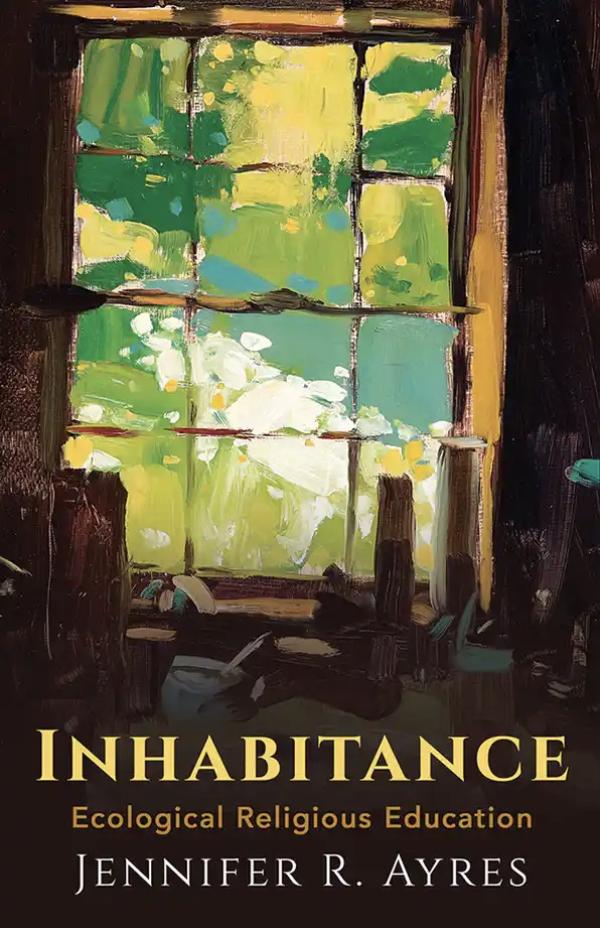
Like other creatures, human beings are inhabitants of their ecosystems. But are humans good inhabitants? According to Jennifer Ayres, the way of inhabitance is stubbornly elusive. The work of understanding, loving, and tending God’s world is constrained by patterns of alienation, exploitation, and systemic neglect and injustice. Faced daily by evidence of ecological death and decay, Ayres determines that this important work of inhabitance is constantly threatened by ecological despair. Ecological despair stems from alienation from the natural world, acute and generational grief resulting from loss of home places, and, for many, an overwhelming guilt at having been complicit in the planet’s suffering. In Inhabitance: Ecological Religious Education, Ayres proposes a solution to this increasing alienation: the way of inhabitance. Just as other animals live and thrive within their ecosystems, so do humans live in a habitat created, sustained, and loved by God. This God perpetually invites us to become better inhabitants. Many religious communities already cultivate inhabitance as a way of life, work that they consider to be central to their deepest theological commitments. Inhabitance examines a diverse array of such practices that foster more intentional engagement with the particular places in which people live. Ecological religious education, Ayres demonstrates, nurtures a disposition of loving commitment toward God’s creation. Inhabitance demands a willingness to love other beings and a willingness to courageously encounter the human and ecological suffering of the world and be fully present to that suffering. And even as humans live more lovingly, courageously, and attentively within their particular places, their lives are opened up to the deepest sources of human well-being—for when God’s world around us flourishes, so do we. (From the Publisher)