Resources
Based on results from interviews with theological educators at forty-five seminaries in North America, the author begins by listing twenty-six concerns expressed about technology in theological education, particularly the concerns about electronically mediated distance education. These concerns are categorized loosely under three headings: Practical and Personal Concerns, Pedagogical and Educational Concerns, and Philosophical and Theological Concerns. More important than the list is the sociology of decision-making surrounding technology among theological educators. In the final section of the article entitled, "how concerns about technology function within institutions," the author discusses how it is that these concerns are allowed to function in very different ways across the spectrum of theological education today.
Seminaries across North America are continuing to expand their use of technology for theological education. This article explores eight issues surrounding the strategic planning process when it comes to technology. These have to do with the obstacles to fresh thinking, the current best practices in strategic planning processes, detailed discussions of the impact of various models of technology for theological education on faculty, Information Technology personnel, and students as well as the issues surrounding delivery system models and the issue of sustainability.
This guide offers practical recommendations for individuals involved with the assessment of general education programs and outcomes on campus. It includes a step-by-step assessment checklist, tips for better assessment, and examples of assessment tools, methods, and rubrics for assessing a variety of key outcomes of a quality general education. (From the Publisher)

The authors discuss recent empirical evidence, gathered on behalf of the University of Michigan Supreme Court defense, demonstrating the educational benefits of diverse learning environments. These are environments that must be intentionally planned and nurtured, where diversity is conceived of as a process toward better learning and not merely an outcome that one can check off a list. Included are numerous suggestions for how to engage diversity in the service of learning, ranging from recruiting a compositionally diverse student body, faculty, and staff to transforming curriculum, co-curriculum, and pedagogy to reflect and support goals for inclusion and excellence. (From the Publisher)
Drawing on a large body of empirical evidence, former Harvard President Derek Bok examines how much progress college students actually make toward widely accepted goals of undergraduate education. His conclusions are sobering. Although most students make gains in many important respects, they improve much less than they should in such important areas as writing, critical thinking, quantitative skills, and moral reasoning. Large majorities of college seniors do not feel that they have made substantial progress in speaking a foreign language, acquiring cultural and aesthetic interests, or learning what they need to know to become active and informed citizens. Overall, despite their vastly increased resources, more powerful technology, and hundreds of new courses, colleges cannot be confident that students are learning more than they did fifty years ago. Looking further, Bok finds that many important college courses are left to the least experienced teachers and that most professors continue to teach in ways that have proven to be less effective than other available methods. In reviewing their educational programs, however, faculties typically ignore this evidence. Instead, they spend most of their time discussing what courses to require, although the lasting impact of college will almost certainly depend much more on how the courses are taught. In his final chapter, Bok describes the changes that faculties and academic leaders can make to help students accomplish more. Without ignoring the contributions that America's colleges have made, Bok delivers a powerful critique--one that educators will ignore at their peril. (From the Publisher)

Written by national expert on assessment, Peter Ewell, this paper reflects on the challenges of general education and assessment reform in the context of recent calls for accountability in higher education. The author argues that by focusing on abilities, alignment, assessment, and action, campuses can both improve general education programs and demonstrate student achievement of learning outcomes key to success in the 21st century. This book is ideal for general education or curricular reform committees and campus discussions about assessment, general education, and accountability. (From the Publisher)
Teaching Inclusively brings together a broad array of current "best practices" in the design, implementation, and assessment of multicultural change initiatives on college and university campuses. Readers will find that this volume advocates for more transparent connections between change initiatives at individual, departmental, and college-wide levels by highlighting the ways in which such practices and change goals can relate to and support each other, thus addressing a noticeable absence in the current available literature. The contributors to this volume present readers with a balance between theoretical models and demonstration projects that address change processes at three levels: individual courses, programs and departments, and across schools and institutions. In addition, there are descriptions of current, multi-year or multi-phase efforts at both departmental and organizational levels. Whenever possible, the contributors include their perspectives on important lessons learned from their efforts. Finally, we offer resource materials that promise concrete support for applications. Part I addresses models and perspectives that help to conceptualize, implement and assess diversity-related instructional and faculty development programs at the systemic level. Contributors offer models and descriptions of practices aimed at making transparent the values, beliefs, and goals that shape institutional and classroom climates. Note that in the context of this volume, "diversity" is deliberately defined broadly to encourage a more systemic approach to the analyses of and response to diversity-related issues. For many readers, this may offer new dimensions and greater texture to their current conceptualization of diversity. This section reflects the contributors’ interests in analytical tools and organizational frameworks useful in addressing individual, departmental, and institutional changes. Whenever appropriate, authors in this section identify a range of practical applications, such as course-based efforts in the major to courses that fulfill general education requirements. In Part II, contributors describe change initiatives that use departments (or programs) as the unit of analysis for diversity-related change efforts. In this section, readers will benefit from the descriptions and assessments of programs designed specifically to bring faculty and academic administrators together in cohorts to address diversity and teaching development goals within the disciplines in a sustained dialogue on diversity. Assessment of current efforts indicate that such initiatives illuminate the content, skills, and values necessary for sustained change and that such experiences can become important models for broader institutional change efforts. In Part III, the contributors discuss multicultural change efforts at the college or institutional level directed at creating and sustaining more inclusive teaching and learning communities. Additionally, contributors describe programs and practices useful in addressing diversity issues across the disciplines as well as within discipline-specific contexts. Particular emphasis is placed on understanding how can systematic multicultural organization change initiatives can support a departmental or campus-wide emphasis on teaching inclusively. These chapters offer rich descriptions of efforts at institutions learning how to address diversity-related initiatives in a sustainable, comprehensive manner. Such efforts can help others determine how best to assess their organization’s needs and strengths, and to determine what is needed in the larger environment to initiate and sustain successful pro-equity organizational change and innovations. Finally, Part IV pays particular attention to resources and program models particularly useful for faculty developers and centers. Contributors to this section provide a rich set of tools for self and course assessment, planning for new or revised programs, and suggesting well-proven strategies for approaches to diversity-related teaching development and organizational change initiatives. These include descriptions of specific, "hands on" consultation practices, workshop exercises, resource materials, and design elements (e.g., use of writing prompts) proven effective across the disciplines in engaging faculty in reflection, analysis, dialogue and innovation related to diversity-related teaching development goals. (From the Publisher)
In this important resource, leading figures in the field of student affairs examine the key issue of student expectations of college, then contrast them with the real experiences of students. The book identifies strategies for addressing the disjunctions between expectation and experience. Sponsored by the National Association of Student Personnel Administrators, the book is intended as the starting point for campus discussions and will undoubtedly spark similar conversations across higher education leadership, and perhaps even among parents and students as well. (From the Publisher)
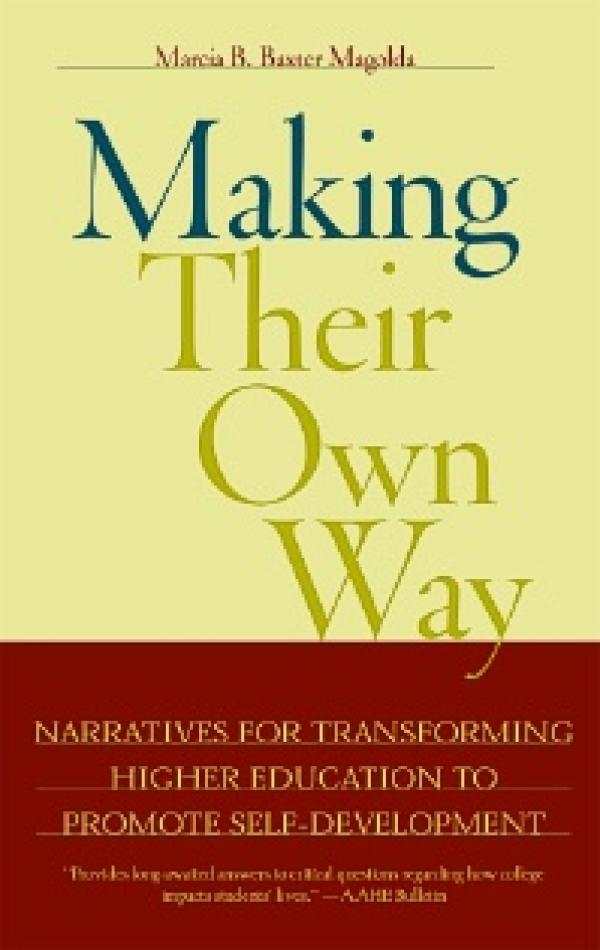
What impact does a college education have on students' careers and personal lives after they graduate? Do they consider themselves well prepared for the complexities, demands and ambiguities of contemporary society? What can we learn from their stories to improve the college learning experience? This ground-breaking book extends a unique longitudinal study of 101 male and female college students started by the author in 1986, and reported in her highly successful and influential book, Knowing and Reasoning in College (1992). This book follows the journeys of the young adults remaining in the study -- drawing on over 300 new interviews -- from graduation to their early thirties. Through the students' own stories, Marcia Baxter Magolda allows us to follow their journeys to an internally-authored sense of identity and belief systems, and in many cases to witness the development of the complex ways of making meaning that are needed for fulfilling participation in modern society. From her observation and analysis, she derives a new framework for higher education to achieve better stewarding and fostering of its students' crucial journeys of transformation. She develops the concept of providing "good company" -- through the shaping of curriculum and co-curriculum, advising, leadership opportunities, campus work settings, collaboration, diversity and community building -- that young adults need along the way to finding and to taking their place as citizens and leaders in the twenty-first century. This is an important book for all teachers and leaders in higher education who are concerned with the holistic development of students, and with higher education's responsibility to foster critical thinking, citizenship and leadership. It has particular relevance for student affairs educators and professionals; as well as for graduate, professional school and continuing education faculty who seek insight into young adult development. (From the Publisher)