Resources
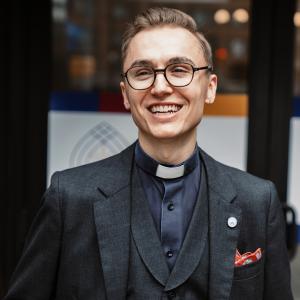
I started writing on a hot summer day in August, and at Colgate Rochester Crozer Divinity School that means classes are about to begin for the start of our 207th year. Our start date, which is earlier in the summer than at most institutions, isn’t the only queer (subversive; norm-transgressing) aspect of our community. You see, most students, and faculty, won’t set foot on our campus until Commencement in May. We are an intimate institution in size but diffuse in location. This isn’t a new reality. Since the COVID-19 pandemic, this institution, which proudly publicizes its commitments to “Peace. Service. Justice,” understands and has acted upon the conviction that online education is about more than convenience; it’s a matter of equity. And we are not alone. There are 174 ATS-accredited institutions currently approved to offer comprehensive distance education (50% or more of a degree), including four other divinity schools associated with the American Baptist Churches USA.[i]Thanks to President Angela D. Sims' leadership, the faculty’s flexibility, and the staff’s dedicated support and innovation, we have provided accredited theological education to students who would otherwise be unable to follow their callings due to various responsibilities and systemic injustices (such as being the primary caregiver for a family member and working multiple jobs), which preclude them from moving to a new city, commuting hours to and from campus, or attending class during work hours. Together, we have provided, and continue to provide, rigorous theological education to persons across the globe, primarily serving students from Black churches. Last spring, I had the opportunity to participate as second reader from Vienna, Austria, where I live with my German husband, in the MA thesis defense of a student located in Jamaica under the leadership of my colleague, Dr. Jin Young Choi, in Rochester, New York. The potential for transgressing the boundaries and confines of national borders in order to teach, learn from, and be deeply enriched by students and faculty around the globe is real and present. This is a queer context: close-knit and dispersed, historic and fully online, contextually-focused and internationally constituted. One identity doesn’t negate the other; their boundaries become porous and take on new meanings through our embodiment of them for such a time as now. But might something be missing in a community of learning such as this? Piloting a Virtual CampusThanks to a small project grant from the Wabash Center, we recently launched a virtual campus on the Gather platform in partnership with Young Prophets Collective, an LGBTQIA+-led nonprofit that designed a virtual church campus, which now houses the Colgate Rochester Crozer Wing (photo below). The virtual campus pilot seeks to continue this institution’s prophetic work, not only to provide access to classes and meetings, but to provide a shared sense of space and the unstructured communal formation that makes theological education different from merely reading texts at home or logging in for class while on the road.The open-ended, pedagogical question we’re asking is this: How might a virtual campus environment—one that enables spatial movement, ambient community (continuously present in the background of a shared environment, rather than requiring constant, direct interaction), and incarnational co-presence—transform the quality of theological formation and pedagogical engagement at Colgate Rochester Crozer? And, what intentional preparation for faculty, staff, and students alike is required to move from using such a platform as a novelty to integrating it as a quotidian habitat? We don’t have the answers, but we’re looking forward to pondering these questions together over the course of this fall semester. What You Can Expect From Us: CollegialityOur partnership with Wabash means a commitment to disseminate what we learn during this process – from the inevitable glitches and technical difficulties to the (hopefully) profound reflections on our own experiences as practitioners teaching, learning, and creating community as dispersed faculty colleagues. I have quickly become known in my institution for emphasizing “collegiality” as a guiding principle. Maybe this is due to our 6 to 9-hour time difference (depending on their location in the U.S.) and thousands of miles of distance can. At times, this can lead me to feel disconnected or out-of-the-loop on certain discussions and decisions. Or perhaps my emphasis on collegiality is a reaction to the heightened sense of alert that many of us feel in higher education at the moment—as democratic institutions once understood to educate and critically support the development of a responsible and learned citizenry are dismantled in real time. Or perhaps my push towards greater collegiality is due to the words of the queer theologian Marcella Althaus-Reid and how they ring uncomfortably true in this moment for so many: “a Queer theologian has many passports because she is a theologian in diaspora...”[ii] Collegiality can be a lifeline amidst the daily battle of simply persisting in our duties as best we can as professors of religion and theology—but it is not immediately or always available, especially in this moment.Over the next five months, you will hear from different members of our faculty, affiliates and full-time. We will spend time during two of our Fall 26 faculty meetings critically reflecting upon our experiences with the virtual campus. Not all of us will teach on the platform, in fact, most of us won’t. This is a pilot project, meaning no one is required to utilize the platform; it is an open, invitational phase. We’ll see if such an agency-oriented, organic approach works… My hope is that these conversations, the dedicated digital space in which all faculty, including affiliates, have personalized offices, and the invitation to write together as part of this blog series will all work together to enrich our experiences both as teachers and as colleagues both within and beyond our institution. Only time will tell. I hope you’ll stick around to find out, colleague. Notes & Bibliography[i] Association of Theological Schools, “Member School Distance Education,” accessed August 22, 2026, https://www.ats.edu/Member-School-Distance-Education.[ii] Marcella Althaus-Reid, The Queer God (Abingdon: Routledge, 2003), 7.