Resources
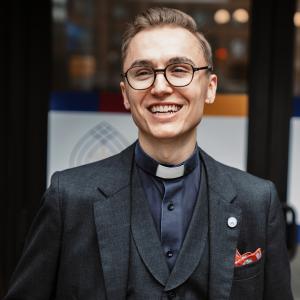
I started writing on a hot summer day in August, and at Colgate Rochester Crozer Divinity School that means classes are about to begin for the start of our 207th year. Our start date, which is earlier in the summer than at most institutions, isn’t the only queer (subversive; norm-transgressing) aspect of our community. You see, most students, and faculty, won’t set foot on our campus until Commencement in May. We are an intimate institution in size but diffuse in location. This isn’t a new reality. Since the COVID-19 pandemic, this institution, which proudly publicizes its commitments to “Peace. Service. Justice,” understands and has acted upon the conviction that online education is about more than convenience; it’s a matter of equity. And we are not alone. There are 174 ATS-accredited institutions currently approved to offer comprehensive distance education (50% or more of a degree), including four other divinity schools associated with the American Baptist Churches USA.[i]Thanks to President Angela D. Sims' leadership, the faculty’s flexibility, and the staff’s dedicated support and innovation, we have provided accredited theological education to students who would otherwise be unable to follow their callings due to various responsibilities and systemic injustices (such as being the primary caregiver for a family member and working multiple jobs), which preclude them from moving to a new city, commuting hours to and from campus, or attending class during work hours. Together, we have provided, and continue to provide, rigorous theological education to persons across the globe, primarily serving students from Black churches. Last spring, I had the opportunity to participate as second reader from Vienna, Austria, where I live with my German husband, in the MA thesis defense of a student located in Jamaica under the leadership of my colleague, Dr. Jin Young Choi, in Rochester, New York. The potential for transgressing the boundaries and confines of national borders in order to teach, learn from, and be deeply enriched by students and faculty around the globe is real and present. This is a queer context: close-knit and dispersed, historic and fully online, contextually-focused and internationally constituted. One identity doesn’t negate the other; their boundaries become porous and take on new meanings through our embodiment of them for such a time as now. But might something be missing in a community of learning such as this? Piloting a Virtual CampusThanks to a small project grant from the Wabash Center, we recently launched a virtual campus on the Gather platform in partnership with Young Prophets Collective, an LGBTQIA+-led nonprofit that designed a virtual church campus, which now houses the Colgate Rochester Crozer Wing (photo below). The virtual campus pilot seeks to continue this institution’s prophetic work, not only to provide access to classes and meetings, but to provide a shared sense of space and the unstructured communal formation that makes theological education different from merely reading texts at home or logging in for class while on the road.The open-ended, pedagogical question we’re asking is this: How might a virtual campus environment—one that enables spatial movement, ambient community (continuously present in the background of a shared environment, rather than requiring constant, direct interaction), and incarnational co-presence—transform the quality of theological formation and pedagogical engagement at Colgate Rochester Crozer? And, what intentional preparation for faculty, staff, and students alike is required to move from using such a platform as a novelty to integrating it as a quotidian habitat? We don’t have the answers, but we’re looking forward to pondering these questions together over the course of this fall semester. What You Can Expect From Us: CollegialityOur partnership with Wabash means a commitment to disseminate what we learn during this process – from the inevitable glitches and technical difficulties to the (hopefully) profound reflections on our own experiences as practitioners teaching, learning, and creating community as dispersed faculty colleagues. I have quickly become known in my institution for emphasizing “collegiality” as a guiding principle. Maybe this is due to our 6 to 9-hour time difference (depending on their location in the U.S.) and thousands of miles of distance can. At times, this can lead me to feel disconnected or out-of-the-loop on certain discussions and decisions. Or perhaps my emphasis on collegiality is a reaction to the heightened sense of alert that many of us feel in higher education at the moment—as democratic institutions once understood to educate and critically support the development of a responsible and learned citizenry are dismantled in real time. Or perhaps my push towards greater collegiality is due to the words of the queer theologian Marcella Althaus-Reid and how they ring uncomfortably true in this moment for so many: “a Queer theologian has many passports because she is a theologian in diaspora...”[ii] Collegiality can be a lifeline amidst the daily battle of simply persisting in our duties as best we can as professors of religion and theology—but it is not immediately or always available, especially in this moment.Over the next five months, you will hear from different members of our faculty, affiliates and full-time. We will spend time during two of our Fall 26 faculty meetings critically reflecting upon our experiences with the virtual campus. Not all of us will teach on the platform, in fact, most of us won’t. This is a pilot project, meaning no one is required to utilize the platform; it is an open, invitational phase. We’ll see if such an agency-oriented, organic approach works… My hope is that these conversations, the dedicated digital space in which all faculty, including affiliates, have personalized offices, and the invitation to write together as part of this blog series will all work together to enrich our experiences both as teachers and as colleagues both within and beyond our institution. Only time will tell. I hope you’ll stick around to find out, colleague. Notes & Bibliography[i] Association of Theological Schools, “Member School Distance Education,” accessed August 22, 2026, https://www.ats.edu/Member-School-Distance-Education.[ii] Marcella Althaus-Reid, The Queer God (Abingdon: Routledge, 2003), 7.

I have a feeling that this is going to be the crummiest semester of my teaching career. We’re tired here at my small undergraduate Catholic college outside of Boston. I’ve toggled back and forth between classes on Zoom and in person. As a result of all that, we’re now several weeks into the semester, and I saw some of my students’ faces for the first time yesterday. Well, the top half anyway. I’m sick of masks. The parts of the faces that I could see look tired. In fact, my students look about as exhausted as they usually do right before Thanksgiving. They tell me they are drained from the isolation, the uncertainty, and threat of going remote again. I am exhausted too. And we’re just halfway through a 15-week semester with no spring break (like many colleges, we canceled it to keep positivity rates down). All mental health numbers seem to go in the wrong direction. The college keeps sending out resources about support groups and numbers to call. I just got an email from my dean urging us to cut students’ workload this semester, to monitor their mental health, and to care for ourselves as well. At this point, my preference would be to cancel the rest of the semester so that we can all sleep until May but since that probably is not an option, I’m going to follow my dean’s advice. It’s triage time. Here’s my plan and survival guide: 1. Give the students more time to write their papers When the students in my gen ed classes have a paper due, they won’t have any reading assignments. Instead, they’ll submit three topic ideas on Monday, a shitty first draft on Wednesday, and the actual paper on Friday. We’ll use our class time on Monday and Wednesday as informal paper workshops. I won’t read the drafts at all; I’ll simply check that they submitted them. I’ll invite them to talk to me or visit the Writing Center if they want feedback. 2. Don’t teach any new materials In an optimistic moment in December, I included several new readings on the syllabus for my brand-new Catholic intellectual tradition course. They are good readings and they would improve the course. But I don’t know how to teach them. Honestly, I can’t even remember what they were about. So I’m going to skip them altogether and instead use materials I know well. I’ll accept that my Catholic intellectual tradition course will be light on Catholic readings this semester, and I’ll rely heavily on theology major Joe in the class to bring an informed Catholic perspective to our discussions. 3. Cancel classes In case you haven’t noticed, teaching and learning on Zoom is much harder and less effective than having class in person. Because of that, I’m going to avoid having class on Zoom whenever I can: If we get another snowstorm (did I mention I live in the Northeast?), I’ll just cancel class. I suspect we’ll get more learning done that way because it will give us a chance to rest and it will generate good will. Both will increase the chances of us having a good class when we’re back in the classroom the next day, so I’m trading two mediocre meetings for one good one. It’ll be worth it. If we must go remote again, I’ll cut back on class time for the students. We’ll all have class on Monday and then half will attend on Wednesdays and the rest on Fridays. I didn’t do this before because I couldn’t figure out how to have them use that extra hour without generating tons of extra work for myself (I’ve never had good luck with independent work for first year gen ed students). But now I have a plan. I’ll simply tell them to spend the extra time on the next homework assignment and choose not to feel guilty about it. 4. Stop obsessing about Zoom tuneout It’s harder to pay attention on Zoom, and we’ve all spent hours trying to figure out how to keep our students engaged. I’m done. I give up. I refuse to adopt my colleagues’ increasingly draconian suggestions. I don’t want to create a teaching environment filled with mistrust and even if I did, I don’t think it would work. The students are so tired that pushing them more won’t help. I’ll focus on those who are physically in the classroom and those on Zoom who are paying attention. I’ll remember that some of the students who keep their cameras off and refuse to talk really are listening. (I know that because I’ve seen their writing.) I’ll accept that some won’t pay attention. I’ll keep checking in on those who seem to disappear, referring them out as needed. Most of all, I’ll remember that it’s not personal. They are tuning out because they are exhausted and sick of Zoom, not because they want to disrespect me and my class. 5.Help the students cope Last week, a first-year student looked out at me from his Zoom box on my computer and asked, “Is it always going to be like this?” Suddenly, they were all paying attention, looking at me, intently. I put on my best confident professorial voice and said ‘no.’ I agreed that it feels like that now but I talked about vaccines and hope. But I also acknowledged that this semester will suck. And I promised that we’d muddle through it together. We will. Notes: I wish I had invented the phrase ‘shitty first draft’, but I got it from Anne Lamott. It’s from her essay “Shitty first drafts” in Bird by Bird – great essay! I did create the lazy staged assignment described above all by myself though.