Resources
We used to worry that an online presence would be perceived in academia as unprofessional. Increasingly, it's not "whether" to have an online profile, but how to manage one's online footprint professionally. The piece offers many annotated links with a variety of perspectives, advice, and how-to's. Comments also lend their own views.
Many instructors would like to make voice-recording (or audio-visual recordings) for their students, but either don't know how, or aren't sure how to make the recordings available to learners. This piece proposes one simple solution, while linking to others. Commenters also offer their own proposals.
This piece first describes the unprecedented possibilities offered by the Web to people with physical or cognitive disabilities. It then describes, with links, laws pertaining to accessibility. Finally, the work offers detailed guidance on creating Web (and also non-HTML electronic) content following the principles of assessible design.
This "help" document by Microsoft drills down into the details of making documents that are better accessible to users with physical and cognitive disabilities. Excellent organization and detail. Calls attention also to MS Word's "Accessibility Checker."
This free, online tutorial contains 10 modules, each explaining how to better design course materials for learners with physical and cognitive disabilities. Tutorials include: accessibility issues on online learning, and making more accessible PowerPoint presentations, videos, Word and Excel documents, PDFs, Web pages, and Web scripts.
Advocating that disability be valued as a form of diversity, Adams summarizes some of the less-obvious ways that campuses and classrooms stigmatize disability and in other ways fail to welcome the physically and cognitively disabled.
In this series, Williams provides annotated links to resources for building Web and other digital resources that are appropriately accessible to learners with physical or cognitive disabilities.
In this series, Williams provides annotated links to resources for building Web and other digital resources that are appropriately accessible to learners with physical or cognitive disabilities.
The author recounts his experience, as a young observant Jew, of James Kugel's academic biblical studies course at Harvard. The piece focuses specifically on how Kugel reconciles his religious faith  with his academic understanding, and how Jewish biblical scholars disagree with one another on what is involved in such a reconciliation. May be of special value for Christian learners undergoing a similar disruption, located as it is "safely" in a non-Christian context.
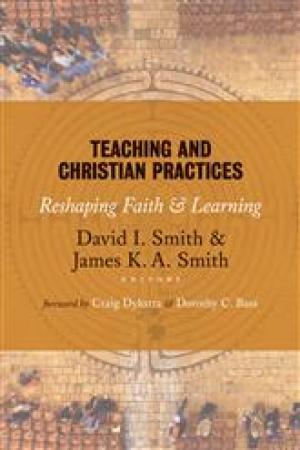
Over the past twenty years there has been a ferment of reflection on the integration of faith and learning -- yet relatively little notice has been paid to the integration of faith and teaching in the Christian university. In Teaching and Christian Practices twelve university professors describe and reflect on their efforts to allow historic Christian practices to reshape and redirect their pedagogical strategies. Whether using spiritually formative reading to enhance a literature course, table fellowship to reinforce concepts in a pre-nursing nutrition course, or Christian hermeneutics to interpret data in an economics course, the authors present a practice of teaching and learning rooted in the rich tradition of Christian practices -- one that reconceives classrooms and laboratories as vital arenas for faith and spiritual growth. (From the Publisher)