Resources

A study of the work which theological schools do in the preparation of persons for the parish ministry. (From the Publisher)
Exiles From Eden sounds a call to the American academic community to begin seeking a solution to the many problems facing higher education today by rediscovering a proper sense of its vocation. Schwehn argues that the modern university has forgotten its spiritual foundations and that it needs to reappropriate those foundations before it can creatively and responsibly reform itself. The first part of the book offers a critical examination of the ethos of the modern academy, especially its understanding of knowledge, teaching, and learning. Schwehn then formulates a description of the "new cultural context" within which the world of higher learning is presently situated. Finally, he develops a view of knowledge and inquiry that is linked essentially to character, friendship, and community. In the process, he demonstrates that the practice of certain spiritual virtues is and always has been essential to the process of genuine learning - even within the secular academy. Schwehn critiques philosophies of higher education he sees as misguided, from Weber and Henry Adams to Derek Bok, Allan Bloom, and William G. Perry, Jr., drawing out valid insights, while always showing the theological underpinnings of the so-called secular thinkers. He emphasizes the importance of community, drawing on both the secular communitarian theory of Richard Rorty and that of the Christian theorist Parker Palmer. Finally, he outlines his own prescription for a classroom-centered spiritual community of scholars. Exiles From Eden examines the relationship between religion and higher learning in a way that is at once historical and philosophical and that is both critical and constructive. It calls for nothing less than a reunion of the intellectual, the moral, and the spiritual virtues within the world of higher education in America. It will engage all those concerned with higher education in America today: faculty, students, parents, alumni, administrators, trustees, and foundation officers. (From the Publisher)
Since the 1970s, working-class individuals have made up an increasing proportion of students enrolled in institutions of higher education. At the same time, working-class studies has emerged as a new academic discipline, updating a long tradition of scholarship on labor history and proletarian literature to include discussions of working-class culture, intersections of class with race and ethnicity, and studies of the representation of the working class in popular culture. These developments have generated new ideas about teaching that incorporate both a sensitivity to the working-class roots of many students and the inclusion of course content informed by an awareness of class culture. (From the Publisher)
George Bernard Shaw thought that a Catholic university was a contradiction in terms--"university" represents intellectual freedom and "Catholic" represents dogmatic belief. Scholars, university administrators, and even the Vatican have staked out positions debating Shaw's observation. In this refreshing book, George Dennis O'Brien argues that contradiction arises both from the secular university's limited concept of academic freedom and the church's defective notion of dogma. Truth is a central concept for both university and church, and O'Brien's book is built on the idea that there are different areas of truth--scientific, artistic, and religious--each with its own proper warrant and "method." In this light, he argues that one can reverse Shaw's comparison and uncover academic dogma and Christian freedom, university "infallibility" and dogmatic "fallibility." Drawing on theology and the history of philosophy, O'Brien shows how religious truth relates to the work of a Catholic university. He then turns to the current controversies over Pope John Paul II's recent statement, Ex Corde Ecclesiae, which seeks to make Catholic universities conform to the church's official teaching office. O'Brien rejects the conventional "institutional-juridical" model used by the Vatican as improper both to faith and academic freedom. He argues for a "sacramental" model, one that respects the different kinds of "truth"--thus preserving the integrity of both church and university while making their combination in a Catholic university not only possible but desirable. O'Brien concludes with a practical consideration of how the ideal Catholic university might be expressed in the actual life of the contemporary curriculum and extracurriculum. For anyone concerned about the place of religion in higher education, The Idea of a Catholic University will be essential reading. (From the Publisher)
Reviews research and theories on college student learning. Examines attribution theory, self-efficacy in students, social constructivism, and Freire's theory of conscientization. Also explores theories that support or refute popular assumptions about college classrooms. (From the Publisher)
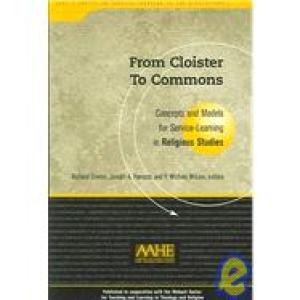
This volume, like its series companions, goes beyond simple "how-to" to discuss the implementation of service-learning within religious studies and what that discipline contributes to the pedagogy of service learning. The volume contains both theoretical and pedagogical essays by scholar-teachers in religious studies education, plus a resource guide. (From the Publisher)
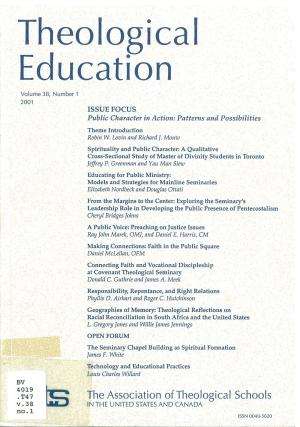
Journal Issue. Full text is available online.
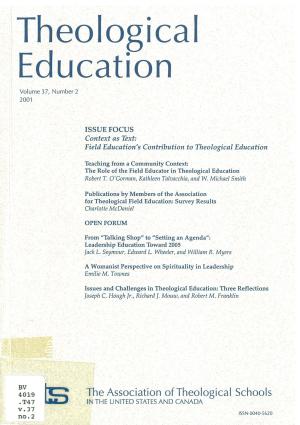
Journal Issue. Full text is available online.

The Bible tells of Naaman the Syrian, who entered the Jordan River to be cleansed. Comparing the affliction of racism to Naaman's illness, Enter the River by Jody Miller Shearer invites readers into their own healing. He explores definitions of prejudice and racism, the different effects of racism on white persons and people of color, affirmative action, and many other issues. The accessible presentation provides a strong foundation for study and action. (From the Publisher)
Wabash Center Staff Contact
Rachelle Green, Ph.D.
Associate Director
Wabash Center
greenr@wabash.edu