Resources
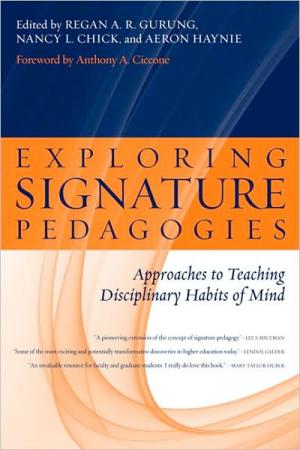
From the Foreword These authors have clearly shown the value in looking for the signature pedagogies of their disciplines. Nothing uncovers hidden assumptions about desired knowledge, skills, and dispositions better than a careful examination of our most cherished practices. The authors inspire specialists in other disciplines to do the same. Furthermore, they invite other colleagues to explore whether relatively new, interdisciplinary fields such as Women's Studies and Global Studies have, or should have, a signature pedagogy consistent with their understanding of what it means to 'apprentice' in these areas. How do individual disciplines foster deep learning, and get students to think like disciplinary experts? With contributions from the sciences, humanities, and the arts, this book critically explores how to best foster student learning within and across the disciplines. This book represents a major advance in the Scholarship of Teaching and Learning (SoTL) by moving beyond individual case studies, best practices, and the work of individual scholars, to focus on the unique content and characteristic pedagogies of major disciplines. Each chapter begins by summarizing the SoTL literature on the pedagogies of a specific discipline, and by examining and analyzing its traditional practices, paying particular attention to how faculty evaluate success. Each concludes by the articulating for its discipline the elements of a "signature pedagogy" that will improve teaching and learning, and by offering an agenda for futureresearch. Each chapter explores what the pedagogical literature of the discipline suggests are the optimal ways to teach material in that field, and to verify the resulting learning. Each author is concerned about how to engage students in the ways of knowing, the habits of mind, and the values used by experts in his or her field. Readers will not only benefit from the chapters most relevant to their disciplines. As faculty members consider how their courses fit into the broader curriculum and relate to the other disciplines, and design learning activities and goals not only within the discipline but also within the broader objectives of liberal education, they will appreciate the cross-disciplinary understandings this book affords. (From the Publisher)

Journal Issue.
With the general practice of online teaching still in relative infancy, nuanced approaches for teaching target populations such as black students are especially scarce. This article submits a theoretical framework for approaching the activity of teaching black students online using a transformative, postmodern pedagogy that is sensitive to black learning styles. It also offers practical suggestions for course design and deployment in online religion courses. In the interest of providing an optimal learning experience for every student, all instructors are encouraged to consider the race and culture variable in their online teaching, whether their roster contains one black student or many.
Order and organization are valued in the classroom, and there is a prevailing understanding that chaos should be avoided. Yet chaos can also be potent space or a source from which new things spring forth. This article investigates biblical, scientific, and cultural understandings of chaos to discover how these contribute to a revelatory metaphor for teaching. It examines Catherine Keller’s engagement with chaos theory in creation theology for pedagogical implications. Using a framework suggested in the work of Mary Elizabeth Moore, the author interprets powers and practices of chaos teaching and provides examples of how the metaphor plays out in the teaching of religion and theology.
One page Teaching Tactic to determine the level of knowledge and understanding students have of a particular subject (in this case, in a Hebrew Bible course).
One page Teaching Tactic: a method for convening discussion in large groups.
One page Teaching Tactic: using study sheet handouts to help students learn from lectures, in a compressed "Maymester" class.
For Life Abundant, the fruit of sustained reflection among systematic theologians, practical theologians, and pastors, is an important new work that deserves attention. The volume provokes creative and critical thinking about practical theology. Its contributors conceptualize the field as a disciplined practice of imagination and skill residing at the confluence of Christian tradition and living ecclesial communities, and ask what such a construal of practical theology might mean for theological education. Given the significance of For Life Abundant, Teaching Theology and Religion asked three theological educators who are located in different regions, types of institutions and fields, to review and respond to it. Rebecca Slough describes the volume’s central questions and organization, and considers how it might contribute to the deliberations of a seminary faculty regarding a school’s curriculum. Martha Stortz shows how the process and structure of For Life Abundant are in themselves illustrative of the conceptualization of practical theology for which it argues. Kwok Pui-Lan notes the volumes strengths and goes on to probe its lacunae, particularly with regard to global, gender and multi-cultural considerations relevant to a robust construal of pastoral theology in our time. While the authors of these three reviews and responses to the volume did not interact as they wrote them, together they comprise a conversation that should be on-going. TTR invites further responses to the volume.
Educational theorist Richard Kiely highlights the central importance of “high intensity dissonance” in successful international service-learning. This essay applies Kiely’s model of dissonance and transformative learning to Intercordia, an international service-learning program offered at the University of St. Michael’s College and the University of Toronto, in partnership with the Non-Governmental Organization (NGO) Intercordia Canada. By placing its students in situations of significant vulnerability and weakness, the Intercordia program attempts to problematize familiar assumptions about the otherness of oppressed persons and thereby encourage an authentic sense of belonging across boundaries of difference. The results, as reported by participants in the program, are quite profound. At the same time, the program design invites critical questions about how, and to what extent, such transformative experiences of dissonance should be scripted for students as an expected and desired result of their international service.
This article explores a set of practices in the teaching of Talmud called “the pedagogy of slowing down.” Through the author’s analysis of her own teaching in an intensive Talmud class, “the pedagogy of slowing down” emerges as a pedagogical and cultural model in which the students learn to read more closely and to investigate the multiplicity of meanings inherent in the Talmudic text, thus bridging the gap between an ancient text and its contemporary students. This article describes the specific techniques in the pedagogy of slowing down, and the ways in which this teaching practice contributes both to students’ becoming more attentive readers and to the ongoing development of their religious voices.
Wabash Center Staff Contact
Sarah Farmer, Ph.D.
Associate Director
Wabash Center
farmers@wabash.edu