Resources
This is the third and penultimate blog in a series of posts in which I have sought to meditate on the question of how one might present theoretical/conceptual arguments to students in an introductory course on Islam in a manner that does not burden them with theory talk. To recap, in the last two posts, I shared some thoughts on this front in relation to teaching about the category of religion and in regards to teaching Sufism. In this post, I want to continue this theme by reflecting on the topic of what could broadly be categorized as “Islam and colonial modernity.” Through this topic, I want to reflect on the experience of teaching two central and interconnected theoretical arguments: 1) that tradition/modernity is not an oppositional binary, and 2) that conditions and discourse are always intimately connected such that new conditions generate new kinds of argument and ways of arguing. These two points are by now staple to the humanities and to the study of religion. But what are some specific ways in which they might be impressed in an introductory Islam course? Here are some examples that speak to this question. In this context, I have found most helpful working with collections of primary texts, such as the anthology of Muslim Modernist writings (edited by Charles Kurzman) and the anthology of Islamist texts (edited by Muhammad Qasim Zaman and Roxanne Euben). Let me walk you through some moments from my teaching when I draw on these anthologies. I employ the relatively straightforward tactic of locating and then discussing places in a primary text where the author’s argument is indebted to modern conditions. So for instance, in the Modernist Islam sourcebook, we find the example of the 19th century Indian Muslim scholar Sayyid Ahmad Khan (d. 1898) arguing that Muslims should alter their explanation for why the Qur’an was miraculous. Rather than attach the Qur’an’s miracle to the inimitability of its language (a long running argument in the tradition), he argued that Muslims should instead locate the miracle of the Qur’an in the inimitability of its meaning and guidance. More crucial than the argument here (which was not altogether novel) was the logic behind the argument: namely that a linguistic explanation for the Qur’an’s miracle “cannot,” in his words, “be put forward in confrontation with nonbelievers” (Kurzman, Modernist Islam, 300). He continued tellingly, “it will not satisfy their mind” (Ibid). Clearly, the new condition of missionary activity and competition in colonial India had a lot to do with the content and framing of Khan’s argument. Similarly, elsewhere in the same anthology, we find the Lebanese/Egyptian scholar Rashid Rida (d. 1935) expressing his admiration for European “nationalism” (Ibid, 82). And even more illustrative is the case of the 20th century Central Asian intellectual Abdurrauf Fitrat (d. 1938) who championed a new system of education as a way to cultivate “perfectly civil, patriotic Muslims” (Ibid, 247). I have students reflect on the question of how desires such as nationalism and patriotism might be contingent to the emergence of the nation state as the center of modern politics. Would these desires have existed even a couple centuries ago? What would they have looked like? Again, what I am after in posing these questions is to have them ponder, even if indirectly, the interaction of conditions and discourse. Perhaps the most effective case study for this task is the extract from the 20th century Egyptian thinker/activist Sayyid Qutb’s (d.1966) landmark text Signposts Along the Road in Zaman’s and Euben’s anthology of Islamist thought. There are many moments in this text that can be mobilized. Let me offer one particularly cutting example. In pushing for an exclusively Qur’an centered understanding of tradition, Qutb exclaimed that Muslims should read the Qur’an “like a soldier studies ‘the daily command’ to act immediately upon what he learns in the battlefield” (Zaman and Euben, Princeton Readings in Islamist Thought, 141). “Knowledge is for action” (Ibid), he had memorably continued. Again, these quotes provide an opportunity to have students think about possible connections between approaching the Qur’an as a soldier’s manual and new technological conditions such as the efflorescence of print and the concomitant materiality of the Qur’an as a bound printed book. Having worked through some of these examples, I put on the board a list of different categories of conditions including political (rise of the nation state, colonialism etc.), technological (print, commerce, railways), institutional (new educational institutions etc.), and epistemic/intellectual (valorization of science, championing of secular reason and progress etc.). In another column, I list the discursive moves of the authors we have examined that depended on and were made possible by any of these conditions. The point of this exercise is to show students that in analyzing discursive arguments, it is important to carefully consider the conditions, the terrain so to say, that make those arguments thinkable in the first place, and that shape the modality of their articulation. This of course is the now familiar conceptual point advanced and executed most forcefully in the work of Talal Asad. A careful navigation of and commentary on illustrative primary texts holds the potential of at least attuning students to such a conceptual orientation that takes seriously the interaction of discourse, conditions, and ultimately, power. There are two limitations of this method that I should like to briefly mention by way of conclusion. First, while this exercise is effective in demonstrating the dynamicity of tradition by showing ways in which it adapts, responds, and negotiates modern conditions, it is less successful in interrupting a celebratory teleology of modernity. “Ok, Muslim scholars can also desire modern stuff” is an all too convenient conclusion that some students might draw. Constantly reminding them about the power differentials involved in how modern conditions shape indigenous discourses and about the violence of colonial modernity (physical and otherwise) is thus very crucial. It might also be useful to frame modernity as a “narrative category;” a narrative that dramatizes its own claims to have eclipsed the past and tradition. I have found that students respond favorably when asked to think carefully about the kind of story modernity tells about itself and to reflect on the problems attached to that story. And second, the teaching tactic described in this post makes acutely palpable the absence of a substantive anthology that engages the work of Muslim traditionalist scholars (the ‘ulama’). Certainly, many among the modernists and Islamists were also trained in traditionalist methods. But still, there will be much to benefit from a reader (like Kurzman’s and Zaman’s and Euben’s) that takes as its focus the writings of modern Muslim traditionalist scholars. Such a resource will be especially useful for discussing continuities and ruptures in Islamic legal and ethical reasoning in the modern period, a topic that adds a particularly rich layer to this discussion.
Develop effective models of practice and positively impact institutional teaching and learning quality. This volume provides examples and evidence of the ways in which post-secondary institutions in Canada have developed and sustained programs around the scholarship of teaching and learning (SoTL) that impact the institutional pedagogical climate. Topics include: - the historical development of SoTL in Canada, - institutional SoTL practices, including evidence of impact, - program design and case studies, and - continuing challenges with this work. This is the 146th volume of this Jossey-Bass higher education series. It offers a comprehensive range of ideas and techniques for improving college teaching based on the experience of seasoned instructors and the latest findings of educational and psychological researchers. (From the Publisher)
Click Here for Book Review No longer relegated to just the classroom, learning has become universal through the use of social media. Social media embodies constructivism itself as the users engage in the development of their own meaning. And, constructivism is relevant to education, and learning theory and technological advance can be better understood in the light of one another. This volume explores: - particular areas influenced by constructivist thinking and social media, such as student learning, faculty development, and pedagogical practices, - practical and useful ways to engage in social media, and - dialogue and discussions regarding the nature of learning in relation to the technology that has changed how both faculty and students experience their educational landscape. This is the 144th volume of this Jossey-Bass higher education series. It offers a comprehensive range of ideas and techniques for improving college teaching based on the experience of seasoned instructors and the latest findings of educational and psychological researchers. (From the Publisher)

Journal Issue.
Why is it important to learn about higher education in international contexts? Why learn about curriculum, teaching, and learning at Dubai Women’s College of the Higher Colleges of Technology? Global education systems have remarkable contributions to make to understandings of 21st century curriculum, teaching, and learning. Adult educators across the globe are exploring how to make learning meaningful in a world that is experiencing change, global migration, rapid development, cross-cultural communication demands, and systems with mandates for accountability and international standardized measures of quality. Dubai is an Emirate in the United Arab Emirates that has experienced these issues, which have had a profound impact on higher education for Emirati women. The international educators who contributed to this book reveal how they designed and implemented a curriculum that represented a complex balancing act replete with recognition of local, global, religious, cultural, and societal implications. There is no other book like The Balancing Act: International Higher Education in the 21st Century. It reveals the nature of a highly devoted team of international educators who designed a contextually and globally relevant transdisciplinary, 21st century curriculum. “Dr. Mary Gene Saudelli has tremendous knowledge and experience with delivering world class education in the Middle East. She has a deep commitment to progressive education and an understanding of global mindedness. It is wonderful that she shares her research on a wide range of topics in educational curriculum and global issues. In The Balancing Act: International Higher Education in the 21st Century, Dr. Saudelli opens the dialogue of reciprocity in learning from higher education in diverse contexts. This book honours Emirati women’s backgrounds and differences, yet cherishes the uniqueness of the international educators involved in this study.” – Kim Critchley, Dean and CEO, University of Calgary in Qatar (From the Publisher)
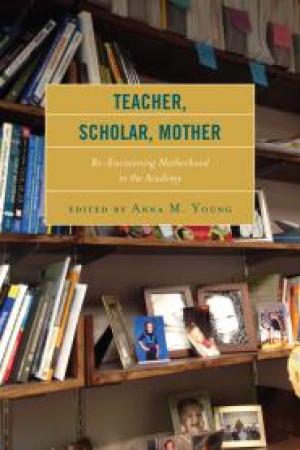
Teacher, Scholar, Mother advances a more productive conversation across disciplines on motherhood through its discussion on intersecting axes of power and privilege. This multi- and trans-disciplinary book features mother scholars who bring their theoretical and disciplinary lenses to bear on questions of identity, practice, policy, institutional memory, progress, and the gendered notion of parenting that still pervades the modern academy. (From the Publisher)
Click Here for Book Review Presenting current trends in transformative learning and adult higher education, this volume paints a vivid picture of the Transformative Learning theory in action. The concepts that knit these articles together despite the variety of educational settings and populations are: relationships, community, and the body experience - often missing in higher education. This volume includes: - the voices of marginalized populations often excluded from research studies such as community college students, emerging adults with learning differences, English language learners, native Alaskans, African-American health educators, doctoral students, and yoga practitioners; - new paradigms for thinking about adult undergraduate education; - new ways to deal with social conflict and advise doctoral students; and - personal stories from Black women leaders, college teachers, student writers as well as pregnant women, and social service providers. This is the 147th volume of this Jossey-Bass higher education series. It offers a comprehensive range of ideas and techniques for improving college teaching based on the experience of seasoned instructors and the latest findings of educational and psychological researchers. (From the Publisher)
A global leadership training and consulting program serving religious and civic leaders who are committed to solving society’s most intractable problems, such as racism, extremism, and economic justice. Includes resources suitable for classroom use.
Click Here for Book Review This book explores Marx's theory of the phenomenal forms in relation to critical pedagogy and educational action research, arguing that phenomenal forms pose a pedagogical obstacle to any endeavour that seeks to expand an individual's awareness of the larger social whole. (From the Publisher)
Click Here for Book Review This book provides a detailed look at the current state of Latino/a theological education in the United States. This includes consideration of the career development and opinions of Latinos/as in seminary education, as well attention to other important modes of Latino/a theological education, like non-degree programs and Hispanic-serving organizations like the HTI and HSP. Another goal of this project was to make recommendations for ways in which schools of theology can do a better job preparing the next generation of Latino/a religious leaders to serve as bridge builders for the future. Thus, we paid special attention to how hospitable theological educational institus are to Hispanics. This book also offers recommendations on improving Latino/a recruitment, revamping the curriculum and Hispanic ministry education, tending better to the sense of community on campuses, and so much more. (From the Publisher)
Wabash Center Staff Contact
Rachelle Green, Ph.D.
Associate Director
Wabash Center
greenr@wabash.edu