Resources

For those of us who teach on Islam and Muslims, the teaching of the narrative of Joseph, or Yusūf in Arabic, is old hat. It has proven to be a useful pedagogical device for placing the Qur’an in conversation with the Hebrew Bible. The narrative is easy to set for side-by-side comparative readings (Qur’an 12:1-111 and Genesis 37:1-50:26), and this particular Qur’anic narrative of a prophet is self-contained making it especially accessible to students. In contrast, the Qur’anic treatment of other figures like Moses, Abraham, Jesus, and Mary is spread across many different places. Having students read the biblical and Qur’anic narratives of Joseph alongside one another, when framed carefully, can be an incredibly productive and engaging learning experience for students. It raises questions concerning intertextuality and compels students to ask questions concerning language, authorial intent, and reception. Nevertheless, as many of you may well know, the assignment does not always go well. It is not a “set it and forget it” kind of assignment. Over the years, how I have taught the Yūsuf/Joseph narrative has changed as I continually adapt the unit to the reactions and responses of my students. Unsurprisingly, they are not all approaching the texts with the same set of presuppositions and sensitivities. I see in some of the papers that my students submit a dismissal of the Qur’anic narrative as purely derivative of the biblical one. Others walk away perplexed by what they believe to be the overly elliptical or densely opaque language of the Qur’an. With both narratives emerging from historical contexts greatly removed from those of today, I also find students conflating the Sitz im Leben or social contexts of the biblical and Qur’anic accounts. All ancient societies in arid climates start blurring together for them. What I would like to share are some of the changes that I have made to improve how I frame the assignment and guide my students. 1) I encourage my students to consider reading the passage from the Qur’an first. Students want to begin with the biblical account either out of familiarity or a desire to read the material in historical order, but this can prime them to privilege the biblical account as the “authentic” or “original” one. By flipping the reading order, how they go about processing the two texts is substantially shifted. This is evident in our class discussions. Typically the students end up split in which they read first, but this difference itself has generated fascinating discussions about how each student perceives certain narrative elements as either missing, added, extraneous, abbreviated, or prolonged depending on which scripture is granted “priority.” 2) If time permits in a semester, I try to provide a broader introduction to the work being done by the authors of these scriptural texts. While this naturally takes place with the Qur’an, since it is the subject of my course, it takes more effort to carve time out to properly situate the Hebrew Bible. What seems to be the Hebrew Bible’s larger objective? Who is its audience(s)? What overarching story is it trying to tell with its many books? How does it tell that story? Who is emphasized and why? Of course, we entertain the same questions when it comes to the Qur’an. In sum, I am trying to get students to think, what sort of work is each of these narratives doing in their respective historical and cultural settings? Attention is also paid to language. I have my students reflect and discuss on why the Qur’an and Bible seem to speak in different ways. How does naming, or the lack thereof, figure into the telling of the story and what effect does it have for the reader? This is also an opportunity for students to do some translation comparisons, a tactic I discussed in an early post. The point of the narrative assignment, of course, is not only the content of the accounts themselves, but drawing attention to the ways that the stories are told. 3) I have also found it helpful to extend the Yūsuf/Joseph unit on occasion by moving beyond scripture and looking at how the narrative is received and reinterpreted by later historical communities. What life has the Yūsuf/Joseph narrative had? Obvious choices are the musical and film Joseph and the Amazing Technicolor Dreamcoat and the array of religious art, both Christian and Islamic, that has been produced around the story. What I have found more compelling and useful, however, is the novel Paradise by Abdulrazak Gurnah which uses the Yūsuf/Joseph narrative to tell the history of East Africa during the period of European colonization. Both the setting and the characters of this book serve to further decenter our discussions from biblical normativities and the western cultural prism. We are dealing, after all, with Africans and Muslims under colonialism. Although the novel adheres relatively loosely to the scriptural accounts of Yūsuf/Joseph, it nonetheless allows us to revisit the narrative with a more contemporary lens as we explore questions of power, identity, and belonging. It is also a powerful reminder for my students of the ways that art and literature can intersect with religion and scripture. These narratives are not just old stories, but important ways of making meaning and shaping the present.
Derived from the authors’ year-long research study of a fifth-grade classroom’s experience with blogging, this work suggests that integrating student blogs into a curriculum is an effective way to promote student writing. According to the authors, requiring students to blog not only enhances their written communication skills by making writing a priority, but it also increases student investment in learning by providing a space for them to share their opinions, build content literacies across the curriculum, and learn in conversation with one another. Overall, this book provides educators with an accessible guide to incorporating student blogs into the classroom. It is divided into six chapters, plus a brief review of relevant works in digital literacy. In the first two chapters, the authors focus on how to integrate blogging. Chapter 1 highlights several important decisions that educators interested in teaching with blogs must consider – namely, how will student blogging contribute to one’s overall learning goals, what blogging platform to use, and whether the student blogs will be public or private. Once the answers to these questions are in place, Chapter 2 suggests effective methods for introducing students to the practice of blogging, as well as the importance of creating guidelines and procedures for safe and responsible online writing. Chapters 3 and 4 look at student blogging in action, suggesting that when students can practice and experiment with their writing in a low-risk environment they become more effective writers. Whereas Chapter 3 gives an inside view of the blogging instruction and learning that occurred in the authors’ fifth-grade classroom, Chapter 4 considers the importance of creating an interactive learning community that encourages dialogue and fosters student excitement for writing. Because digital spaces require students to engage with an audience beyond their teacher or peers, the authors contend that students are better able to engage their ideas in conversation with others and to see value in their writing. Finally, Chapters 5 and 6 outline several logistical concerns around student blogging. In Chapter 5, the authors cover basic tenants of copyright and fair use issues to help prepare teachers and students for the responsible use of the copyrighted works and images created by others. Following this discussion of digital citizenship, Chapter 6 discusses the importance of offering formative rather than evaluative feedback throughout the blogging process. The authors claim that regular, low-stakes assessment is foundational to supporting and developing successful student writers. Given the authors’ focus on elementary school writers, this book is perhaps most useful for K-12 educators who wish to begin incorporating student blogs into their classrooms. Nevertheless, those in higher education who are aspiring to improve student writing will also be able to glean sound pedagogical reasons for incorporating student blogs into our classrooms, as well as a helpful framework for how to do so. Unfortunately, several of the activities and examples provided by the authors throughout the book will be unhelpful given their primary and secondary school context.
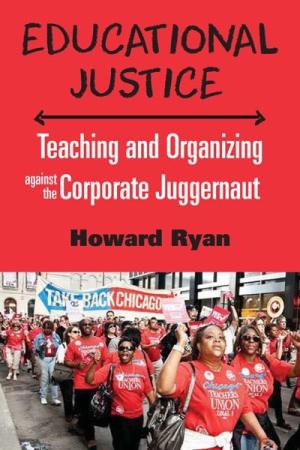
Educational Justice: Teaching and Organizing against the Corporate Juggernaut addresses what the authors call the corporate assault on public education. The book provides detailed stories concentrated in the Chicago and Los Angeles public systems that outline struggles and successes in regard to public schools. This collaborative book was written by Howard Ryan with Debra Goodman, Joel Jordan, and Joseph Zecola. Ryan describes school reform as corporate: “a package of public policies, private investments, and informal processes through which corporate and private actors are seizing control of education”(23). Ryan names teacher unions that partner with billionaires as part of the corporate juggernaut that places control of education in the hands of those who do not promote the best intentions of public education and leads to privatization of the school system. Ryan provides an elaborate and involved example of organization and resistance to privatization by Kelvyn Park High School in Chicago. He details the movements by parents, children, and teachers that lead to victory in keeping this one school from being privatized. Joel Jordan describes in detail how teacher unions fought back against the corporate movement and frames a strategic approach to the fight against school reform. In addition to providing an outline and methods for organizing to fight corporate school reform, the authors demonstrate school transformation through organization. Debora Goodman focuses on critical literacy, democratic schools, and the whole language movement. Goodman draws upon insights from progressive education, particularly whole language instruction, and progressive educators like John Dewey, Lev Vygotsky, and Paulo Freire to build a theoretical framework. She contrasts theories of literacy and teaching to further develop her thesis. Ryan provides a transformational organizational method as he describes the practices of Soto Street Elementary School in Los Angeles. He argues against scripted reading programs and supports solidarity among teachers – accomplished through family writing workshops, advocacy for literacy, and the addition of books available to students. Using the same rationale and promotion of transformation of reading, Ryan and Zecola present ideas on a curriculum model using Crenshaw High School in Los Angeles. It is promoted through an extended learning cultural model, extended learning time for teachers, collaborative units of study, and collaborative mapping and history. Additionally, they outline the need for extending learning into the community through internships and learning opportunities for parents. This book and the work of the authors might be difficult for those in public education outside of larger urban areas to relate to. The book addresses a critical issue facing public education but is limited by only looking at schools in urban settings. The book is valuable because it addresses public schools and social justice in a way that is challenging. The authors raise consciousness about how easy it is to take money from corporate sponsors and then be lured into an educational system dictated by those whose knowledge of how education actually takes place is limited.
As the title indicates, this book is intended for those in the fields of urban planning and architecture. That said, with some translation, this slim volume is a helpful resource for those who seek to include more creative pedagogy in their theological and religious studies classrooms. I can imagine theology and religious studies professors using this book to inspire their own use of play in the classroom and to persuade skeptical colleagues of the value of play within the academy. Author Ron Kasprisin defines and defends the role of play in teaching and learning with passion and precision. Rooting his concept of play in the pedagogical theories of Friedrich Froebel (founder of the German kindergarten movement), Kasprisin describes play as “ self-activity, enjoyable, sensory, wondrous, and thoughtful” (4). Play is “experimental, flexible” (60), and dedicated to “creative problem-solving” that “requires openness . . . divergent thinking, and an appreciation for ambiguity and complexity” (62). He extols its power to unlock creativity thanks to how it “disables fear, failure, and creates voluntary intentions” (7). Kaspirin’s consideration of how play overcomes fear and unleashes creativity (in Chapter Two, “Object Learning through Symbolic Play” [35-38 in particular]) could stimulate new directions in how faculty promote critical thinking within students and how to encourage and absorb diverse perspectives within class discussions. Similarly, his exploration of how the studio environment nurtures play and its attendant creativity (Chapter 5, “Setting the Stage-Play Environment”) offers fresh ways to create classrooms with a high tolerance for failure and consequent high innovation. Key throughout is Kasprisin’s conviction that play offers a legitimate method of student-directed learning at all levels of education. The final four chapters (“How Do Designers Play,” “Object-learning with Play-tools/Skills,” “Object-learning Applications in Design and Planning,” and “Integration of Digital Technologies and Crafting Processes”) are the ones most closely written for those who teach students of urban planning and architecture. A careful reading of the Introduction, first three chapters (“Creative Problem-solving (CPS) for Design and Planning,” “Object-learning through Play: Object-learning, Constructivism, and Self-learning through Symbolic Play,” and “The Gifts of Friedrich Froebel”) and Chapter 5 (“Setting the Stage – Play Environment”) is likely to suffice for professors in other fields. In those chapters, Kasprisin lays out the qualities and functions of play and the value of creative problem-solving in education. His insistence that technological methods short-circuit creativity is of special interest to me. As one who resists the encroachment of technology at every level of education, I found his discussions of the limits of technology illuminating and affirming. I was surprised that the theories of Maria Montessori were not mentioned as her theories of early childhood education have also taken strong hold in a segment of American education. Influenced by Froebel, Montessori embraced a similar ethic of sensory learning and offers a range of materials for children to engage that is wider than Froebel’s. If you are persuaded by the value of play, her thought will provide additional resources for consideration.

“Stop telling your children that they are smart,” is the new rage in parenting advice. Research has demonstrated that praising children for their smartness tends to undermine their performance. Kids who believe that success is due to innate ability also tend to think that failure is caused by innate inability. When they encounter hard tasks, they are prone to give up and to view themselves, or the task, as inept. Nearly every college professor has experienced the frustration of such students, who often feel that their smartness entitles them to automatic A’s on every assignment, regardless of the effort, accuracy, or sophistication of their work! In Are You Smart Enough? veteran educational researcher Alexander W. Astin calls upon college faculty to recognize that our institutions have helped to create this problem. Looking at the primary measures that colleges utilize to evaluate their success – standardized test scores, retention and graduation rates, course grades and GPAs – Astin’s central claim is that postsecondary institutions are more focused upon identifying smartness than developing it. College rankings, for example, are heavily weighted toward the standardized test scores for incoming classes. Course grades and GPAs mainly serve to mark students’ progression toward degree completion, to identify low-performing students who may need to be dismissed, and to aid in admissions for graduate and professional schools. Standard metrics do not assess the information core to colleges’ mission: what students learn and when they acquire the knowledge. Postsecondary education, consequently, has become more concerned with identifying and acquiring smart students than with developing students’ intellectual and academic capabilities. Astin places much of the responsibility for this preoccupation with smartness upon faculty. While faculty often complain about the culture of entitlement that exists among undergraduate and graduate students, we create this culture through our admissions and grading standards, which imply that our job is to reward – rather than enhance – smartness. Many faculty view their jobs primarily as imparters of specialized content knowledge; we expect students to already possess the analytical and communication skills necessary to acquire that knowledge when they enter our classrooms. Astin claims that faculty preoccupation with student smartness is a product of our preoccupation with our own, as evidenced by institutional processes for hiring, tenure, and promotion. Just as colleges expect incoming faculty to be fully formed experts capable of displaying our smartness, faculty expect students to be sufficiently formed when they enter our classrooms. Astin does not merely critique the institutional culture; he provides concrete guidelines for shifting our focus to growing and developing student learning. In particular, he recommends utilizing narrative evaluations in course grading. He also advocates expanding our assessment of student development to include the affective outcomes that are often central to college mission statements: leadership, citizenship, and service. He writes that colleges should pay particular attention to students’ spiritual development, given that a central component of the college experience is students’ exploration of their sense of purpose, their moral and ethical commitments, and their self-development. Astin’s text is a significant contribution to the emerging literature critiquing our culture’s obsession with innate ability. It explores themes similar to those in Carol Dweck’s bestselling book, Mindset (Random House, 2006), but unfortunately does so with less substance and more redundancy. It would have been helpful if Astin had integrated evidence from educational and neurological research to support his core assumption that intelligence can be, and should be, developed among young adults. He could also have provided more substantive suggestions for changing academic cultures, with attentiveness to not only admissions and grading, but also to student support services, academic advising, institutional effectiveness, faculty governance, development, and alumni relations. Overall, Are You Smart Enough? is an important and thought-provoking text for postsecondary faculty. While primarily focused upon undergraduate institutions, its central argument is just as relevant to graduate and professional programs.
For the faculty member transitioning a course from face-to-face (F2F) to an online or blended learning environment, Kathryn Linder’s workbook is a wonderful resource. After opening with a couple chapters reviewing the key components of backward course design, developing appropriate course learning objectives, and assessment, the remaining chapters provide a step-by-step guide for an instructor to convert a course from a physical to a virtual teaching space. The chapters cover a variety of topics including effective learning activities, assessment methods, creating a social presence, using and creating multimedia, and social media engagement. Each chapter contains a short introduction to the pedagogical theory behind the topic (What Do We Know About…) followed by a series of guiding questions, worksheets, and templates for incorporating the theory into course development (A Step-by-Step Guide to…). After a summary of the key ideas, there are questions for faculty and administrators, followed by a graphic that illustrates course design steps and additions. Online resources are often noted for additional planning. An instructor or administrator is provided with all the tools and resources necessary for working through the process in a hands-on, orderly fashion. The book’s main strength is its highly practical nature, highlighted by the ready-to-use worksheets, templates, and checklists for every step in the process. Not only does it explain the desired resources, it usually gives real-life examples of how the tool was used in a blended classroom effectively. Another strength of this book is Linder’s ability to translate and explain technological tasks reasonably for the technophobe. Without talking down, she methodically explains technical components in understandable and achievable action steps for readers. Equally important, she recognizes that schools use different types of technology (for example, Learning Management System), and identifies the major software, programs, and platforms available, accounting for this variety in her instructions. There is little to offer by way of criticism of the book. More than adequate appendices and glossaries complete an already copious amount of resources. The solid reference section supports the extensive research, clearly supporting the material. Given the practical nature of this workbook and its many ready-to-copy worksheets, it is strongly recommended for faculty members transitioning a classroom course to a blended or online delivery format. Likewise, academic deans leading a group of faculty through a similar transition process will find this a one-stop resource, especially if they are able to partner with an educational technologist.
Habits of the Heart (Bellah et al., U C Press, 1985) was required reading in my first-year seminar in the late 1980s. That book, and the liberal arts education into which I was being initiated, changed my life profoundly. It introduced me to new modes of thought (sociology, philosophy, religious studies), instilled a critical sensibility (concern about individualism in American culture), and planted a seed about the importance of religion within a culture (and why it is worthwhile to study it). When I saw the name of one of Habits’ authors attached to a new book on integrated learning, something my own institution takes very seriously, I was intrigued. Sullivan is a senior scholar at the New American Colleges and Universities consortium, and on one level this book merely reports on distinctive activities and programs at some of the member institutions. Those brief descriptions can be helpful and inspiring, especially if your school is embarking on similar programmatic development. A sizeable appendix offers short campus profiles of the twenty-five institutions. In the introduction, Sullivan addresses his readers as people (parents, prospective students, future faculty) who may be “looking for a college that seriously tries to integrate the liberal arts, professional studies, and civic responsibility” (1). There is a dizzying array of initiatives, but the book succeeds in its agenda of persuasion: that the ideals of integrated learning are significant and worthy. Yet, there is a second aspect to Sullivan’s agenda, and at that level the book is a lot more interesting to those already situated in higher education. Woven throughout the book, Sullivan offers insightful commentary on the significance as well as the effectiveness of integrated learning. For example, at the end of the first chapter Sullivan connects the importance of service learning with emerging research in developmental psychology. Drawing on the work of William Damon who writes about the importance of forming a sense of “life purpose,” Sullivan argues that “growing into a mature, educated person committed to significant purposes requires living in a community where values are taken seriously and structure behavior in everyday life” (27). That is precisely what our more innovative programs can do: cultivate that needed sense of purpose, which in turn fosters resilience. But in Sullivan’s hands, resilience is not just about retention and graduation rates – it is part of a larger mission to produce a healthier civic culture with an engaged, proactive citizenry. Later, Sullivan posits, “the key factor is that the members of such societies share a sense of membership in some larger whole. This gives them an ability and willingness to recognize that the well-being of each group depends on cooperation with the others. Such shared expectations and bonds are the prerequisite for a functioning, pluralistic democracy” (60). For those in theology and religious studies, this book offers a larger context in which to understand the work of instilling the virtues of tolerance and understanding. Those involved in service learning, study abroad, civic engagement, or vocation-related programming will appreciate that such initiatives are celebrated in these pages. At this level, the book can be a needed tonic for beleaguered faculty. If you share Sullivan’s ideals and his sense of the role liberal learning can play in that vision of a pluralistic, democratic society, then this book serves as a reminder of how your work contributes to that mission.
The standard perception of higher education in the United States is that it is only for the elite (or those middle-class folks who are willing to take out massive loans to pay for their education). However, the founding concept behind public higher education was to allow all who wish to earn an advanced degree the opportunity to do so. Obviously, the schema appears to have changed. Financial considerations, admissions standards, and other limitations can produce obstacles to admission. One way to overcome these obstacles is the Community and Technical College system. This system has flourished as a result of offering skills-based training in a number of readily employable fields. Another way to surmount obstacles to higher education, and the one that is the subject of this review, is through community engagement. Community engagement occurs when an institution of higher learning opens its doors to the general public and seeks to partner with them in providing academic and professional training. Community can occur in one of two ways: the institution can seek partnerships with the public through campus events or community service, or the public can seek partnerships with the institution through fieldwork arrangements or training programs. Obviously, this can also be a two-way street where the institution and the community collaborate in the engagement process. Welch’s volume is based on the Carnegie Foundation’s significant research study on existing community engagement offices at several major American universities and the conceptual writings on community engagement by John Saltmarsh. Welch outlines the purpose of, platforms for, and programs involved with community engagement. The strength of the volume is Welch’s thorough analysis and systematizing of the Carnegie report. However, the volume promises more than that; it promises to provide practical direction for how schools can connect with their community to implement these platforms and programs. This is where the volume falls short of expectations. As mentioned previously, this book is quite voluminous when it comes to the analysis and quantification of the Carnegie study. And if it had simply stayed there, this would have been an insightful and thought-provoking volume that naturally leads to two other volumes by the same publisher that appear to be connected (Publically Engaged Scholars edited by Post, Ward, Longo, and Saltmarsh, and Community Partner Guide to Campus Collaborations by Cress, Stokamer, and Kaufman). However, the book also attempts to craft an implementation plan for community engagement. It waffles between institutions partnering with community liaisons to provide internships for human services or business students on the one hand and developing institution-based think-tanks that, through strategic partnerships, craft economic and political policy through instructor-student-sponsor relationships on the other. Ultimately, Welch’s volume becomes a never-ending firehose that could lead to bloated institutions scrambling to keep their doors open or to anemic institutions beaten down by unnecessary feelings of academic and professional inferiority.
Luis S. Villacaňas de Castro, an assistant professor in the department of Language and Literature Education at the University of Valencia in Spain, wrote Critical Pedagogy and Marx, Vygotsky, and Freire as a companion volume to his earlier book The Copernican Turn and the Social Science, which was published in Spanish in 2013. Villacaňas de Castro writes extensively in epistemology, critical pedagogy, political philosophy, and language education and publishes in both Spanish and English. This volume has three sections and an introduction. In the introduction, the author explores the Copernican turn, which involves paradigm-shifting theories. He argues that four scientific theories qualify as Copernican turns: Freud’s psychoanalysis; Marx’s works in sociology; Neo-Darwinism; and the Theory of Relativity. Villacaňas de Castro explains that “a Copernican turn thus involves two kinds of knowledge: about the object and the subject; knowledge about specific realities; and also new knowledge about how human beings should understand themselves in relation to those four objects” (2). He argues that each Copernican turn creates epistemological obstacles, and he engages these obstacles through the lens of the German concept Erscheinungsformen, which he translates as phenomenal forms. The author explores “the threats and difficulties that the Erscheinungsformen pose to teaching and learning, and how educators should negotiate these obstacles” (5). Villacaňas de Castro uses the works of Marx, Vygotsky, and Freire to translate the epistemological obstacles into pedagogical problems and then engages pedagogical approaches to solve the problems (7). The author argues that these pedagogical approaches justify participatory action research as the most effective educational approach. The first section deals with Marx, Freud, and pedagogy. In Chapter I, Villacaňas de Castro introduces the major concepts of Marxist sociology and Freudian psychoanalysis in terms of pedagogical approaches to address the epistemological obstacles. Section II explores epistemology, critical pedagogy, and the liberal principle. The two chapters in this section engage concepts from Marx and Vygotsky to unpack and engage Erscheinungsformen. Villacaňas de Castro argues that this chapter reveals “a theoretical blind spot in Vygotsky’s pedagogy…which it is in the interests of critical pedagogues to resolve” (46). The work of Freire becomes key as Villacaňas de Castro develops this critical pedagogy in the form of social democracy. The last part of the book, Section III, explores the theory and practice of educational action research. Using Freire’s pedagogical approach and John Elliott’s liberal pedagogy, the author concludes “that John Elliott does not provide educators with a liberal pedagogy, but rather an appropriate method for them to fulfill their main critical goal: to help students understand the nature of the key subject matters that determine their life in society” (114). This supports Villacaňas de Castro’s argument and he concludes that participatory meta-action research is “an effective measure to break the vicious circle both students and I have fallen into” (144). This book is a very complex and abstract argument. Villacaňas de Castro’s academic writing style will throw off many readers. His sentence structures are very long (including a 141-word sentence on pages 86 and 87) with many embedded clauses. This makes attempting to unpack the already difficult concepts of Marx, Vygotsky, and Freire more challenging. However, the author develops a solid case for a stronger critical pedagogy rooted in participatory action research. Theological libraries that support programs with components of theological methodology should add this text to their collections. In addition, faculty and graduate students who are working with participatory action research should read this book to explore the epistemological foundations of their methodology.
Wabash Center Staff Contact
Rachelle Green, Ph.D.
Associate Director
Wabash Center
greenr@wabash.edu