Resources

Colleges and universities in the United States are experiencing a major shift: while their student bodies change, their faculties remain largely the same--at least in the short run. The student body grows increasingly diverse in terms of ethnicity, economic status, and academic preparedness, with more and more students coming from the groups that have been least-well-served by higher education in the past. Student retention and ultimate success depends, in part, on the ability of professors--most of whom have been teaching for many years--to provide appropriate classroom experiences and learning assistance. Faculty demographics present a start contrast: the professoriate, mostly white and male, will continue to age as the large faculty cohort hired in the 1960s and early 1970s reaches mid- and late career. More than half of all full-time faculty members in 1988 were over forty-five, nearly two-thirds had tenure, and relatively few between the ages of forty-five and sixty anticipated leaving their current position. The faculty members who face the challenges and opportunities of the college classroom in the 1990s are a seasoned, stable, and job-secure group. Happily for students and for institutions, faculty members frequently focus their energies on teaching in their later decades of their careers; to date, institutions seeking to support this crucial refocusing have not had resources or models to draw upon. If senior faculty in their last decades of professional service do, in fact, turn their collective energies to improving teaching and learning, the potential for long-term impact on collegiate education is tremendous. Engaging senior faculty, who control the reward structure, in reflection on how excellent teaching is best supported can fundamentally alter institutional priorities toward a more appropriate balance between teaching and research--and create a better teaching environment. (From the Publisher)

How do the careers and lives of academic couples differ from those of other academics? What advantages and disadvantages do they face, and what problems and opportunities do their increasing numbers present to academic institutions? Sixteen experts address these and many other questions in Academic Couples, offering new research and much vital information. (From the Publisher)

As academic service-learning continues to grow rapidly, practitioners are discovering a pressing need for solid empirical research about learning outcomes. Where's the Learning in Service-Learning? helps define learning expectations, presents data about learning, and links program characteristics with learning outcomes. It is the first book to explore the experience of service-learning as a valid learning activity. (From the Publisher)

These probing essays, factual case studies and critical commentaries by thirty-nine prominent scholars, educators, seminary administrators and church executives together address the emerging issues of the globalization of theological education. What does it mean to minister in a world of both interdependence and polarization? How can leaders be prepared to build up a church able and willing to respond to the challenge of global witness and service? What new ways of teaching and learning can seminaries and congregations develop toward the ultimate goal of faithfully and effectively embracing all of God's creation? (From the Publisher)

Drawing on media studies, literary theory, and the work of psychoanalytical feminist theorist Shoshana Felman, Ellsworth (curriculum and instruction, U. of Wisconsin-Madison) portrays the work of pedagogy as a performance practice. She argues that pedagogy's mode of address - its positioning of teachers and students in relation to one another - is crucial in the success or failure of education efforts. (From the Publisher)

Peter Elbow's widely acclaimed and original theories on the writing process, set forth in Writing Without Teachers and Writing With Power, have earned him a reputation as a leading educational innovator. Now Elbow has drawn together twelve of his essays on the nature of learning and teaching to suggest a comprehensive philosophy of education. At once theoretical and down-to-earth, this collection will appeal not only to teachers, adminitrators and students, but to anyone with a love of learning. Elbow explores the "contraries" in the educational process, in particular his theory that clear thinking can be enhanced by inviting indecision, incoherence, and paradoxical thinking. The essays, written over a period of twenty-five years, are engaged in a single enterprise: to arrive at insights or conclusions about learning and teaching while still doing justice to the "rich messiness" of intellectual inquiry. Drawing his conclusions from his own perplexities as a student and as a teacher, Elbow discusses the value of interdisciplinary teaching, his theory of "cooking" (an interaction of conflicting ideas), the authority relationship in teaching and the value of specifying learning objectives. A full section is devoted to evaluation and feedback, both of students and faculty. Finally, Elbow focuses on the need to move beyond the skepticism of critical thinking to what he calls "methodological belief" -- an ability to embrace more than one point of view. (From the Publisher)

This book identifies optimal practices or "benchmarks" for creating a quality learning environment within higher education and outlines steps faculty and administrators can take to improve student learning. Author Janet Donald integrates extensive research on teaching and learning with findings from her in-depth interviews with faculty and administrators at four of America's premier research institutions. She focuses on key factors influencing learning, identifies practices and policies central to effectiveness, and offers timely and feasible solutions for meeting student learning challenges. Using the voices of faculty, administrators, and members of higher education centers, Donald investigates institutional missions and priorities. She examines how learning goals vary across the disciplines and what this means in terms of student outcomes. She also describes practices that support the improvement of teaching and she discusses classroom assessment techniques that measure learning and teaching. Donald examines student selection and access - especially questions of quality and diversity - and discusses how to foster motivation for learning. In addition, she provides strategies for recognizing teaching in tenure and reward systems and points out the importance of academic leadership. (From the Publisher)

Designing and Assessing Courses and Curricula reflects the best current knowledge and practice in course and curriculum design and connects this knowledge with the critical task of assessing and learning outcomes at both course and curricular levels. Tested and refined through long-term use and study, the change model presented in this book shows how to move from concept to actualization, from theory to practice. (From the Publisher)

Learning Was Never Like This ! Take control of your life... free your natural genius to perform to its true potential. Quantum Learning features a revolutionary new format that introduces the reader to a world of learning unlike any other. Never before has a guide been designed to accomodate the unique learning style of the individual. Whether you're a professional, a student, or a person who simply wants to improve his or her learning capacity, this extraordinary guide will increase your personal power, help you learn more, earn more, and take you where you want to go. Inside you will learn: -How to spark your motivation. -How to master high-tech note-taking techniques. -How to discover your own personal learning style and cultivate a winning attitude. - How to work your own memory miracles, how to write with confidence, and much, much more! (From the Publisher)
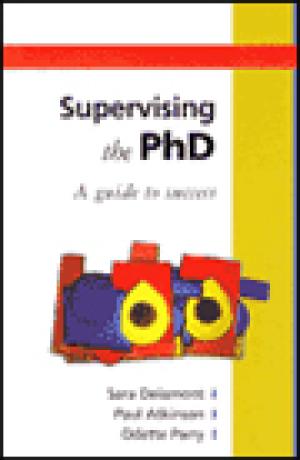
This guide to supervising doctoral research is a practical handbook for both the novice and the experienced higher degree supervisor. It looks at how to get students to produce good PhD theses on time, and how to prevent failed theses. (From the Publisher)
Wabash Center Staff Contact
Sarah Farmer, Ph.D.
Associate Director
Wabash Center
farmers@wabash.edu