Resources

These autobiographical and analytical essays by a diverse group of professors and graduate students from working-class families reveal an academic world in which "blue-collar work is invisible." Describing conflict and frustration, the contributors expose a divisive middle-class bias in the university setting. Many talk openly about how little they understood about the hierarchy and processes of higher education, while others explore how their experiences now affect their relationships with their own students. They all have in common the anguish of choosing to hide their working-class background, to keep the language of home out of the classroom and the ideas of school away from home. These startlingly personal stories highlight the fissure between a working-class upbringing and the more privileged values of the institution. (From the Publisher)
While there is much available research and theory about learning and motivation, until now there has been no resource that translates esoteric findings into everyday language and examples that can be readily applied in college classrooms. This book brings the findings and theories of educational psychology to classroom faculty, helping them to adopt a scholarly approach to understanding their students' learning problems. (From the Publisher)
Learning communities are small groups of students who come together with faculty and student affairs professionals to engage in common learning experiences. In Building and Sustaining Learning Communities, the authors, along with many of their colleagues, describe the rationale for learning communities, particularly in a large university; the process for setting them up; and reflections on these unique environments. After reading this book, administrators and faculty members will know precisely why they are worth considering and how to successfully create them. (From the Publisher)
JoAnn Moody shows majority campuses, faculty, and administrators how to dismantle the high barriers that block women and especially minorities from entry and advancement in the professoriate. Good practices for improving recruitment, evaluation, mentorship, and retention are offered. (From the Publisher)
At its most basic a rubric is a scoring tool that divides an assignment into its component parts and objectives, and provides a detailed description of what constitutes acceptable and unacceptable levels of performance for each part. Rubrics can be used to grade any assignment or task: research papers, book reviews, participation in discussions, laboratory work, portfolios, oral presentations, group work, and more. This book defines what rubrics are, and how to construct and use them. It provides a complete introduction for anyone starting out to integrate rubrics in their teaching. (From the Publisher)

Contemporary theological education is facing profound changes. Fundamental shifts in both church and society have established a volatile context for theological teaching and learning. Seminaries are struggling with the growing diversity of their students, faculties, and institutional commitments. This book addresses these issues both contextually and historically, engages the nature of theological teaching and learning, and offers educational practices that strengthen the vocation of teaching and enhance the school as a place of conversation. (From the Publisher)
Journal Issue.

Lee Shulman has been president of the Carnegie Foundation for the Advancement of Teaching since 1997. He is a former president of the American Educational Research Association as well as past president of the National Academy of Education. In this second volume of a landmark two volume collection of Shulman's best work, he addresses such compelling questions as What are the most effective approaches to teaching? How important is knowledge of subject matter to a teacher's success? And, how do we measure success in teaching and learning? (From the Publisher)
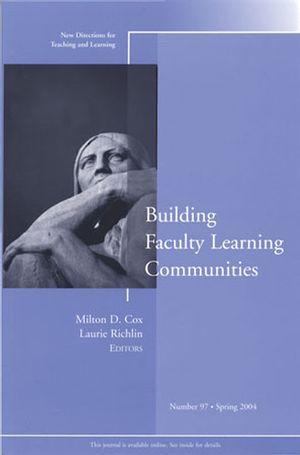
Changing our colleges and universities into learning institutions has become increasingly important at the same time it has become more difficult. Faculty learning communities have proven to be effective for addressing institutional challenges, from preparing the faculty of the future and reinvigorating senior faculty, to implementing new courses, curricula, and campus initiatives on diversity and technology. The results of faculty learning community programs parallel for faculty members the results of student learning communities for students, such as retention, deeper learning, respect for other cultures, and greater civic participation. The chapters in this issue of New Directions for Teaching and Learning describe from a practitioner's perspective the history, development, implementation, and results of faculty learning communities across a wide range of institutions and purposes. Institutions are invited to use this volume to initiate faculty learning communities on their campuses. This is the 97th issue of the quarterly journal New Directions for Teaching and Learning. (From the Publisher)
Wabash Center Staff Contact
Rachelle Green, Ph.D.
Associate Director
Wabash Center
greenr@wabash.edu