Resources

This book highlights the effects of power within the higher educational process, and argues that in order to understand the student experience we have to take seriously the institution as a context for learning. It considers key questions such as: • Why is the student experience of higher education sometimes negative or restricted? • How does power operate within the institution? • What are the forces that limit or enable student agency? • How can institutions of higher education create conditions which best support more enabling forces? Higher Education has its own particular culture, social relations and practices, governed by social and discursive norms. It is always implicated in relations of power through its function in society and its effects on individuals. This book considers how, for the student, these effects can be enabling and engaging, or limiting and diminishing. In exploring the effects of the institutionalization of learning and the workings of power implicated within this, it sets out to add to more cognitive and pedagogic ways of understanding student experience in higher education. Study, Power and the University provides key reading for educational researchers and developers, academics and higher education managers. Sarah J. Mann is Senior Lecturer in the Learning and Teaching Centre at the University of Glasgow. She is head of the Academic Development Unit and is responsible for the MEd in Academic Practice. (From the Publisher)
“Teaching the Facts, Inculcating Knowledge, or Instilling Wisdom? Rationale for a Textbook in BS101”
A 1000 word essay on using textbooks in introductory courses (or not).
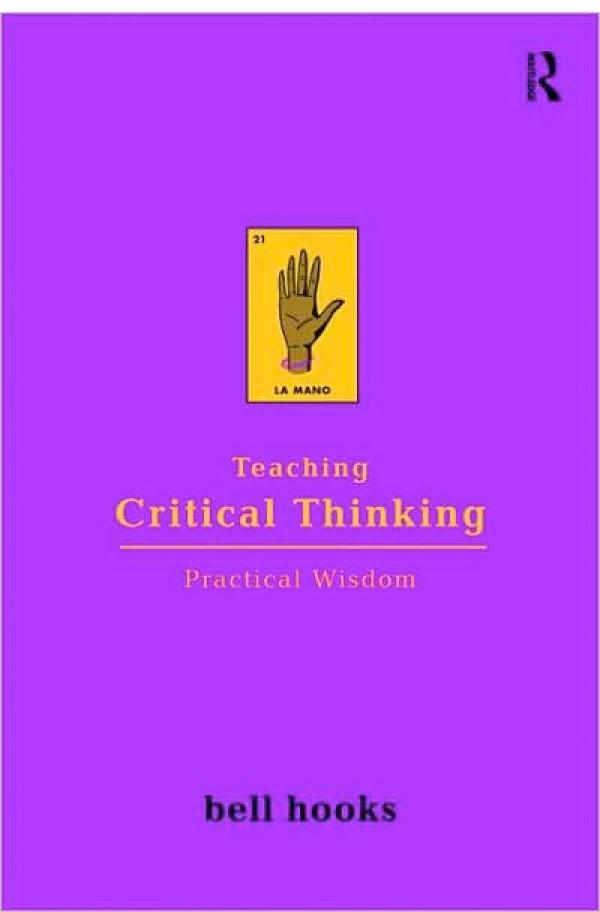
In Teaching Critical Thinking, renowned cultural critic and progressive educator bell hooks addresses some of the most compelling issues facing teaching issues facing teachers in and out of the classroom today. In a series of short, accessible, and enlightening essays, hooks explores of the confounding and sometimes controversial topics that teachers and students have urged her to address since the publication of the previous best-selling volums in her Teaching series, Teaching to Transgress and Teaching Community. The issues are varied and broad, from whether meaningful teaching can take place in a large classroom setting to confronting issues of self-esteem. One professor, for example, asked how black female professors can maintain positive authority in a classroom without being seen through the lens of negative racist, sexist stereotypes. One teacher asked how to handle tears in the classroom. while another wanted to know how to use humor as a tool for learning. Addressing questions of race, gender, and class in this work, hooks discusses the complex balance that allows us to teach, value, and learn from works written by racist and sexist authors. Highlighting the importance of reading, she insists on the primacy of free speech, a democratic education of literacy. Throughout these essays, she celebrates the transformative power of critical thinking. This is provocative, powerful, and joyful intellectual work. It is a must read for anyone who is at all interested in education today. (From the Publisher)
Much of the confusion and meaninglessness of the twenty-first century stems from the fragmentation of knowledge. Our postmodern times cry out for a return to wholeness. Enter Stratford Caldecott, who calls for renewal in education in Beauty for Truth's Sake. By reclaiming the classic liberal arts and viewing disciplines such as science and mathematics through a poetic lens, the author explains that unity is present within diversity. Ultimately, God is behind all truth. This book will benefit parents, homeschoolers, lifelong learners, and readers interested in the history of ideas. It is appropriate for Christian college and university students and will play an especially important role in curriculum development. EXCERPT I've heard many exasperated parents say to me, "If I can just get my kid through their teenage years then they'll be okay." There have been many tiring and frustrating days where I could agree with that sentiment. But I think you would agree with me that "just making it through" wouldn't exactly qualify as a lofty goal. As if somehow the goal of parenting is just to protect or tolerate and then hope for the best. That goal doesn't take into account the sponge effect. Last year, our daughter got a package of animal bathtub sponges as a gift. Each sponge was the size of a large multi-colored vitamin. She dropped one in the sink and we all watched as it started to grow. Within a few minutes it was the size of her hand. The sponge seemed to just keep soaking and soaking. Once it grew to its full size it never shrunk back again. After we drained the basin, we set the sponge animal on a towel and the water slowly seeped out of it. It took a longtime for it to dry out because it had taken in so much. Teens are like those sponges. They're not just trying to "make it through" these few years. They're soaking up everything in their environment. And they learn first and foremost through their experiences with you. If you have always responded to people in our culture out of fear, your teen will generally tend to do the same. If you respond with anger, so will your teen. If you model a disdain for the people that make up your culture, your teen may also. (From the Publisher)
Describes the emergence of powerful fields of consciousness that influence students’ learning and personal transformation. This pioneering work in teaching and transpersonal psychology explores the dynamics of collective consciousness in the classroom. Combining scientific research with personal accounts collected over thirty years, Christopher M. Bache examines the subtle influences that radiate invisibly around teachers as they work—unintended, cognitive resonances that spring up between teachers and students in the classroom. While these kinds of synchronistic connections are often overlooked by traditional academics, Bache demonstrates that they occur too frequently and are too pointed to be dismissed as mere coincidence. Drawing upon Rupert Sheldrake’s theory of morphic fields, Bache proposes that well-taught courses generate “learning fields” around them, forms of collective consciousness that can trigger new insights and startling personal transformations. Moving beyond theory, this book is rich with student stories and offers practical, hands-on strategies for teachers who want to begin working with these learning fields to take their teaching to a more conscious level. (From the Publisher)
On Teaching and Learning takes the ideas explored in renowned educator Jane Vella’s best-selling book Learning to Listen, Learning to Teach to the next level and explores how dialogue education has been applied in educational settings around the world. Throughout the book, she shows how to put the principles and practices of dialogue education into action and uses illustrative stories and examples from her extensive travels. Dialogue education values inquiry, integrity, and commitment to equity—values that are also central to democracy. Learners are treated as beings worthy of respect, recognized for the knowledge and experience they bring to the learning experience. Dialogue education emphasizes the importance of safety and belonging. It is an approach that welcomes one’s certainties and one’s questions. (From the Publisher)
This book speaks of a fresh approach to knowing and teaching. The editors have succeeded in combining a philosophical framework for the centrality of narrative and dialogue in education and human services with lively accounts from practitioners working in a variety of disciplines and levels. Rich with life histories and stories, this book is organized around three themes: that story and narrative are primary tools in teaching and the helping professions; that education means taking seriously both the quest for life's meaning and the call to care for persons; and that the use of narrative and dialogue can serve as a model for teaching and learning across boundaries of disciplines, professions, and cultures. (From the Publisher)
The history of the Christian spiritual life suggests that those who truly teach the spiritual life have been themselves "taught by God." The phrase "taught by God" occurs in Christian writings across several centuries. This book draws on the teachers and teaching models that animate Christian history, bringing it into conversation with the issues and concerns of contemporary teachers and learners who seek to follow Christ. The authors contend that the various strands of the Christian spiritual and mystical tradition provide continuing guidance for Christian teachers in the cultivation of their own spiritual lives and the lives of their students. They order this book around four aspects of Christian educational ministries: the identity of the teacher, contexts in which we teach, models for teaching, and evaluation of teaching. (From the Publisher)

This classic and rather poignant argument that education is the answer to the questions posed by Anglo-Saxon cultures was written by Meiklejohn (late president of Amherst College and founder of the U. of Wisconsin's Experimental College) as the horrors of World War II were a daily event. In such a time and with such a background, it is no surprise Meiklejohn freely ties theory to practice, policy, and pedagogy as he describes Protestant-capitalist education, the problem of reconstruction according to Rousseau, pragmatism according to Dewey, and the social contract as the primary basis of a form of education that will result in brotherhood and reasonableness. (From the Publisher)
Good teaching is both powerful and cautious. It is powerful insofar as it creates engaged students. Because an engaged mind is particularly receptive, however, good teaching is also cautious insofar as it provides students with focused guidance through the process of appropriating the learning material. This article reflects critically on expressionist pedagogy by evaluating a classroom situation in which students reacted in unexpected ways to the professor's disclosure of a personal story. It concludes that effective teaching exceeds the goal of merely facilitating student engagement. That is, the use of self-disclosure has the power to create engaged students, but it also requires cautious content consideration when facilitating post-disclosure learning. If, by using the powerful expressionist pedagogy of self-disclosure, we engage students but fail to cautiously guide them through the learning material, we have not taken seriously the ethical responsibility that teaching also implies.