Resources

Our seminary recently hosted a symposium on beauty. For the occasion, I performed a musical interpretation of a digital art piece entitled “By night and by day,” part of a larger composite of cloud themes depicting God’s presence with his people by artist Sarah Bernhardt. I explored a range of sonorities on the double bass to tell the Exodus story, to depict God’s leading of Israel out of Egypt by a pillar of cloud by day and of fire by night. To guide me in my portrayal of the theme of divine presence, I composed a musical setting based on a melody from a Latin American song entitled El Señor es mi luz (The Lord is My Light) based on Psalm 27. The psalm speaks of Israel’s trust in the Lord’s protection from adversaries who assail her during her earthly pilgrimage. The psalmist also sings of Israel’s eschatological hope to dwell in the house of the Lord forever and behold his beauty in his temple. In my composition I employed word painting, a technique used in sixteenth century music to match a concept in a written text with a corresponding musical effect. The following description of the flow of the piece explains how I used the range of the double bass to communicate various aspects of the biblical story. High pitch harmonics placing fingers over strings The piece begins with a variation of the psalm melody using high pitch harmonics, which are achieved by touching the strings without pressing them. This technique communicates a sense of God’s presence on high as Israel prepares to cross the sea. It is a calming presence; God is in control. Energetic tremolos with the bow The harmonics are followed by energetic tremolos made with rapid bow movements to the chorus of the hymn. This technique expresses the tumultuous movement of God’s people away from their enemies, with the pillars of fire and cloud ahead of them as they rapidly (and perhaps a bit anxiously) make their way through the great waters. Hitting strings with the bow’s wood (col legno) to introduce the theme (chorus) To express Israel’s proximity to the waters of salvation, I play the psalm melody with the back of the wooden bow (col legno technique), evoking images of drops of water falling on or sprinkling faces and bodies as people prepare to cross the sea. Flowing lyrical version of the theme with the bow (verse, stanza) Then I play a flowing lyrical version of the theme with the bow, depicting Israel’s safe arrival to the Promised land, which anticipates the final beatific vision of God’s people in his presence. Festive plucking to a Cuban guaracha Plucking the strings (pizzicato), I play a Cuban guaracha (salsa) rhythm based on the song’s chord progression to express the mood of eschatological fiesta after the people’s safe passage through turbulent waters into the Promised Land. Playing a Panamanian tamborito rhythm percussively on the wood of the bass… Finally, I sing the hymn’s chorus in Spanish while tapping the top wooden shoulders of the instrument to a tamborito Panamanian rhythmic pattern, using the bass in a percussive way. So, what makes the piece a Latin American interpretation? The most obvious element is the use of a psalm in the Spanish language. But the more interesting ones are the plucking of strings to a Cuban Guaracha (salsa) and the drumming of the wood on the shoulder of the bass to a Panamanian tamborito. But why infuse the text with a Latin American spin? Here the context of the performance matters. I have performed this piece in three settings with similar audiences—predominantly White, monolingual (English), mid-Western church audiences in the United States. By incorporating these elements in the performance, I am inviting the audience to imagine a world in which the biblical story is told, heard, and sung through Latino/a eyes. I am using music as a gentle challenge to see the biblical story in the context of the catholicity or universality of the church, which is a church of people from many ethnicities, languages, and nations. I am also raising awareness about the presence of forgotten Latino/a neighbors whose voices are often not heard, who crave for belonging, justice, and the psalmist’s hope in God’s deliverance. By foregrounding these elements into the piece, my double bass functions as an extension of the Latino teacher-performer’s own identity as a proclaimer of God’s story, a bearer of an inclusive catholicity, and a herald of hospitality, justice, and hope.

It’s no fun lecturing to blank stares. As a church historian in an undergraduate institution, I teach quite a few general education classes to students who come to me ready to “do their time.” Thankfully, I stumbled upon a unique learning aid that has helped me bring to life some previously disengaged students The Reacting to the Past (RTTP) historical role-playing games have been all the rage these last few years in higher-education and have helped radically increase student engagement in my own courses. There are a variety of games available, many of which are well-suited for religious studies and Christian higher education. While studies show increased overall student engagement, it’s the games’ effect on student leadership that caught my interest this semester.[1] With student permission granted to share this story, I’d like to talk about how playing the RTTP game helped “Sam” transition from passive to active learning through his leadership role in Rousseau, Burke, and Revolution in France, 1791.[2] Leadership Self-Assessment Let me start by saying that I was not expecting Sam to become our RTTP star player. While he made a few insightful comments during the class, he struggled with turning in work and general participation. I had quite a few blank stares from Sam from the back of the class. This semester I had my TA choose who would play what role in our RTTP game. Each student completed an online questionnaire that helped gauge their interest, experience, skills, and limitations. They had the opportunity to state if they would be open to a leadership role or had experience in a range of areas such as student debate, event planning, or gaming. This TA had no knowledge of the students in the class other than what she found on these sheets, which allowed her to make an unbiased choice of who would receive what role. The crowd leader in our game was the historical character “Danton,” a key role that needed a strong leader. Based solely on his self-assessment, my TA assigned Sam this part. It was a risk for me to let it stand—the game really needed this character to shine—but I trusted Sam’s self-assessment and I am so glad that I did! It turns out that the blank stare from the back of the class was masking a passionate leader. My previous lectures elicited a few comments from him, but nothing substantial. Now, all of a sudden, I had an excited student—when he received his role, he literally bounced out of the classroom. Moving forward, he came to class prepared, rallied his faction, made strategic plans, and worked outside of the classroom to meet his faction goals. His speeches were passionate, logical, and contained the necessary primary source material. He brought his “A-game” and helped lift the rest of the class with him. At the end of the game, his classmates voted for him as the strongest player. Removing Teacher Bias There’s a lot that could be said about how this highlighted Sam’s natural leadership abilities and buoyed his self-esteem, but teacher-to-teacher, I want to share this: Sam was able to lead and shine because my own potential bias was removed. He said he was a leader, my TA believed him, and that was that. There was no checking of attendance or grades, no memory of how often he had engaged in classroom conversation. The whole class benefited when I trusted the student’s self-assessment. The heart of RTTP pedagogy is pulling the professor into the background and letting students take the lead. However, we still steer things from behind the scenes, perhaps most importantly in role selection. Some professors just pull names out of a hat, while others hand pick roles. For myself, it was through the adaptation of another professor’s student pre-game questionnaire that I was able to land somewhere between these two options. Previously, I had used the questionnaire and selected roles based on student responses and my own knowledge of them. This made for some active games; however, with my TA assigning roles based only on student self-assessment, it created our best game yet. Sam’s success has taught me to release my own hand even more from this aspect of the game and is pushing me to reevaluate all of my courses beyond the game. What can I do to offer students an opportunity for self-assessment of their own leadership abilities and then honor it in the classroom? By finding ways to further reduce my own potential bias, I hope to cultivate a greater diversity of student leaders in the classroom. [1] Julie C. Tatlock and Paula Reiter, “Conflict and Engagement in ‘Reacting to the Past’ Pedagogy,” Peace Review 30, no. 1 (2018) and Matthew C. Weidenfeld and Kenneth E. Fernandez, “Does Reacting to the Past Increase Student Engagement? An Empirical Evaluation of the Use of Historical Simulations in Teaching Political Theory,” Journal of Political Science Education 13, no. 1 (2017): 46–61. [2] Mark C. Carnes and Gary Kates, Rousseau, Burke, and Revolution in France, 1791 (New York, NY: W.W. Norton, 2013). “Sam” is an anonymous name given to my student and with his permission.
I took a deep breath and stepped out of my office dressed as the Greek goddess Athena. My historically inaccurate Amazon purchase had me in a “Roman Spartan Costume Helmet,” a “Roman Empress” costume over my clothes, holding a large plastic spear and a “Wonder Woman” shield. It was the best I could piece together online, and it would have to do—and this was for fun! In our Reacting to the Past (RTTP) game, The Threshold of Democracy: Athens in 403 B.C., the students had to self-start their first Athenian Assembly debate by reenacting a pig sacrifice (pig picture torn in half) while priestesses of Athena offered prayers. The president sat at his table, ready to start the proceedings. They were nervous. I was nervous for them. So, in a flourish of polyester and plastic I stomped into the classroom. I banged my spear on my Wonder Woman shield and stood behind the shocked priestesses. I whispered, “Go for it!” Student faces were a mix of shock and amusement; I was certainly not cool enough for a couple of them. But who cared? My priestesses pulled it off, the pig was sacrificed, and the president called the meeting to order. They debated and voted. The next week I gave extra credit for showing up in a toga, and about 20 percent of the class came wrapped in random bed sheets. In preparation for our five-session role playing game I told them repeatedly to “just have fun with it!” and fun was had! At the end of the game I had students fill out a “Win Sheet” where they discussed what they accomplished and reflected on their own game play. Paraphrases of some responses ranged from “I didn’t think that this would be fun, but it was,” and “I have never liked history before,” to “I normally don’t speak up in class, but this helped me overcome that” and “I met new people and made friends.” I took that for a win. For this church history professor assigned to teach Western Civilization, the RTTP role playing game provided a way to make a notoriously boring class engaging (for all of us). As it turns out, I had stumbled upon a “ludic pedagogy” or the “pedagogy of fun”: Sharon Lauricella and T. Keith Edmunds’ post, “A Serious Look at Fun in College Classrooms” discusses how the rigor of education is not lost in a fun environment, rather it lowers the cognitive load and increases intrinsic motivation and learning. It is probably no surprise to you that studies show that by making learning fun, student stress decreases and learning increases. The bigger question most professors ask isn’t, “Should I try this?” but rather, “What would this look like in my classroom?” Here are some ideas that I have tried: We reenact a house church with dollar store decor and food. During review week, students write either three church history characters or the attributes from them that they want to have in their own life on a dollar store Christmas ornament. At the end of the class around a common question, “Why do we have so many denominations?” I have students create their own church with their denomination of choice, or none. They design a building, pick a symbol for the logo, choose the music, governance style, etc. They are creative, and they enjoy the in-class activity “for fun.” When studying the Desert Fathers and Mothers, we learn to make prayer ropes from a YouTube video. The joy in this is that the knot is almost impossible to make, so we have a good laugh trying. Pre-pandemic, we went for pizza and then visited a Russian Orthodox Church together. A class did the Reacting to the Past’s “Trial of Anne Hutchinson.” (There was burning at the stake!) The Reacting to the Past “Council of Nicaea” role playing game is on my radar for the future. NOTE: These RTTP games are not intuitive to lead, you’ll need all summer to prepare. I highly recommend joining the association and the Facebook group for help. Plan on the game taking four to eight weeks of your semester. Clearly this is not an exhaustive list and many of you have your own successes to add. If you could take a moment to write down some of those in the comments, this could make it a very helpful space for all of us searching for new ideas.

Years ago I devised a classroom demonstration, to use early in a semester when trying to help students become more aware, first, of the multiple dimensions of religion and, more importantly, of the ways in which diverse analytical lens for comparing and contrasting religion in a “toolbox for critical thought” will bring different dimensions forward while leaving others in the shadows. Conceptually this is not a groundbreaking theoretical intervention for a first week of class exercise, although it does imply some theoretical “chess moves” that I feel strongly about. Its main value here is to hone an entertaining and effective way to dramatize my points with a set of children’s blocks—both old-school wooden blocks and a few legos—plus a few crowd-pleasing additions to spice up the demonstration. I wrote this up for Teaching Theology and Religion in 2009 and have used it “live” with reliable success many times since then. Since I recently have been experimenting with moving one of my classes online, I decided to make a video version for my voice-over-powerpoint lectures. It seems potentially useful to share the video here.
As a teacher trained in textual analysis and the religious practices of living human communities, the language of images, videos, and recorded sound are not my mother tongue. Yet, I know that for my students, communicating in an era where these visual forms of communication are the lingua franca of the people they lead means that they must develop the capacity to deploy images and cinematic narrative styles to engage their leadership teams, parishioners, board members, students, or volunteers in not-for-profit organizations. So must I. Given the powerful digital image-making and sharing tools that over 77% of the US population carries in their pockets, working in video and image while teaching is not a problem of a lack of technology. A lack of fluency keeps us from speaking these languages. However, like learning to communicate in a foreign language, the only way forward is to begin to speak. Many of us have had the experience of trying to hold a conversation in a language where we have novice level competency. We search for words, we stumble over the technicalities, we feel our intelligence level has been dropped by decades because we have only the most rudimentary vocabulary to express complex ideas. Learning to work in the visual languages of digital media is no different. We may have fabulous pedagogical visions for what is possible, but our capacity to capture those ideas and craft them to our satisfaction feels elementary and gawky. We have all been trained by our daily exposure to visual culture to recognize good visual communication when we see it. As veteran radio producer Ira Glass once noted, when we start a new form of creative work, our taste often outdistances our ability and causes us to become discouraged in what we produce. And as professors, we often do not want to appear a beginner, especially in something we are trying to teach our students. Rather than continuing to practice that new creative form, many of us, cowed by the challenge, stick with what we do best. We work primarily in text and demand that our students do so as well, whether or not this is to their detriment in the performance of their leadership when they leave our programs. After my first miserable quarter of teaching youth ministries online a decade ago, I realized that I was going to have to learn to play online if I was going to be able to teach online. The easy student interactions, the joy of conversation and dialogue, the embodied relationality of the physical classroom was gone, and I was either going to have to quit teaching or figure out how to do some of those things in a virtual environment. That is what drove me to join Facebook, and I began to reconnect with family members and friends far distant in time and space, practicing the skills I needed to teach online. I re-discovered how to be playful, to delight in connection with other human beings, to share things that were important to me in online settings. Practicing those skills in an environment where I was not the expert allowed me to develop them and deploy them in my teaching work. Likewise, I think faculty benefit from opportunities to play with new forms of visual communication outside of the classrooms in order to learn how to work with those languages. This could take many forms. My own faculty at Iliff brought in a photographer for a playful session during faculty retreat where we learned how to compose images and edit them with Snapseed. We wandered the retreat center, snapping photos and editing them digitally on our phones, then enjoyed a slide show at the end where we explored the resulting images. During the “Teaching with Digital Media” Workshop at the Wabash Center last summer, we sent faculty with disparate teaching contexts and fields of expertise off for an afternoon to create a “Teach Something in a Minute” video (a classroom exercise that Elizabeth Drescher had previously developed with her students at Santa Clara University). Participants decided on their topic, storyboarded videos, shot them around campus, edited them in free available software, and screened them that evening. We set minimal criteria (videos had to be one minute long; had to include titles, moving and still images; needed a soundtrack; all members of the three person team had to be involved in creating it), but otherwise allowed them to do what they could in the time allotted. We also invited the participants in the Wabash Programming Leadership Event into a similar activity to create short videos communicating the significance of various Wabash Center programs last October. The trajectory of these experiences for participants has been the same. Disbelief at the enormity of the task without adequate instruction in the technologies and techniques. Frustration at their lack of prior experience in filmmaking. Emerging eagerness to give it a try as they work together. Laughter and camaraderie as they shoot the material. Frustration with learning editing techniques as they try to pull together the piece in limited time. Moderate satisfaction with a finished project. Pride in their team’s efforts and emerging confidence to try again another time. No faculty inservice on the importance of digital media or demonstration of someone else’s use of digital media in teaching would serve as well as playfully engaging in the task of speaking the new language together and using it to teach one another.
Gaming technologies have become effective learning tools within education. Gamification has the potential to increase engagement using real-time feedback on learning activities, which allows students to reflect on their completion and retention of a learned activity. Gaming Innovations in Higher Education: Emerging Research and Opportunities is an essential reference work featuring the latest scholarly knowledge on the application of different gaming techniques within education to make learning activities more enjoyable and successful. Including research on a number of topics such as virtual laboratories, interaction media, and intrinsic and extrinsic motivation, this publication is ideally designed for academicians, researchers, and students interested in the benefits of providing an entertaining and intellectually-stimulating learning environment. (From the Publisher)
As the title indicates, this book is intended for those in the fields of urban planning and architecture. That said, with some translation, this slim volume is a helpful resource for those who seek to include more creative pedagogy in their theological and religious studies classrooms. I can imagine theology and religious studies professors using this book to inspire their own use of play in the classroom and to persuade skeptical colleagues of the value of play within the academy. Author Ron Kasprisin defines and defends the role of play in teaching and learning with passion and precision. Rooting his concept of play in the pedagogical theories of Friedrich Froebel (founder of the German kindergarten movement), Kasprisin describes play as “ self-activity, enjoyable, sensory, wondrous, and thoughtful” (4). Play is “experimental, flexible” (60), and dedicated to “creative problem-solving” that “requires openness . . . divergent thinking, and an appreciation for ambiguity and complexity” (62). He extols its power to unlock creativity thanks to how it “disables fear, failure, and creates voluntary intentions” (7). Kaspirin’s consideration of how play overcomes fear and unleashes creativity (in Chapter Two, “Object Learning through Symbolic Play” [35-38 in particular]) could stimulate new directions in how faculty promote critical thinking within students and how to encourage and absorb diverse perspectives within class discussions. Similarly, his exploration of how the studio environment nurtures play and its attendant creativity (Chapter 5, “Setting the Stage-Play Environment”) offers fresh ways to create classrooms with a high tolerance for failure and consequent high innovation. Key throughout is Kasprisin’s conviction that play offers a legitimate method of student-directed learning at all levels of education. The final four chapters (“How Do Designers Play,” “Object-learning with Play-tools/Skills,” “Object-learning Applications in Design and Planning,” and “Integration of Digital Technologies and Crafting Processes”) are the ones most closely written for those who teach students of urban planning and architecture. A careful reading of the Introduction, first three chapters (“Creative Problem-solving (CPS) for Design and Planning,” “Object-learning through Play: Object-learning, Constructivism, and Self-learning through Symbolic Play,” and “The Gifts of Friedrich Froebel”) and Chapter 5 (“Setting the Stage – Play Environment”) is likely to suffice for professors in other fields. In those chapters, Kasprisin lays out the qualities and functions of play and the value of creative problem-solving in education. His insistence that technological methods short-circuit creativity is of special interest to me. As one who resists the encroachment of technology at every level of education, I found his discussions of the limits of technology illuminating and affirming. I was surprised that the theories of Maria Montessori were not mentioned as her theories of early childhood education have also taken strong hold in a segment of American education. Influenced by Froebel, Montessori embraced a similar ethic of sensory learning and offers a range of materials for children to engage that is wider than Froebel’s. If you are persuaded by the value of play, her thought will provide additional resources for consideration.
Thomas Henricks’ Play and the Human Condition provides a valuable guide to the academic study of human play. Henricks has been teaching at Elon University since 1977 as a sociologist. He has been studying human play since his PhD dissertation, which explored the relationship between sports and social stratification, and he has over thirty years of academic publications in play studies. In this volume, Henricks attempts to advance his thesis that “play is fundamentally a sense-making activity and that the broader goal of this process is to construct the subjectively inhabited sphere of operations and understandings called the self” (209). Henricks organizes this book into an introduction and nine chapters. He begins the introduction with three questions that guide his work: “How do we discover who we are? How do we determine the character of the world in which we live? And how do we decide what we can do in a world so configured?” (1). The introduction provides a rationale for studying play as well as an overview of the book. The first three chapters explore general models of play. In Chapter I, Henricks explores the difficulties around establishing a definition for play as he reviews several modern definitions. He presents six ways of understanding play: as action, as disposition, as experience, as context, as interaction, and as activity while he connects each model to their major theorists. The next chapter presents how play is different from other patterns of human behaviors including ritual, work, and communitas. The final chapter in this section develops a theory of play that centers upon self-realization. Henricks notes that “play best teaches people how to conceive self-directed lines of action and to mobilize varieties of resources to realize these ambitions” (89). In the middle of the book, Henricks devotes five chapters to various aspects of play including psychology, the human body, physical environment, social life, and culture. After focusing on the mind in his chapter on the psychology of play, Henricks turns to the human body and play in Chapter Five. While examining animal play, he concludes “play integrates symbolic and physically based meaning systems. . . play is a form of consultation between matters manifest and latent, known and unknown. In consequences, players extend and secure their understanding of themselves” (137). Next, he engages the physical environment and social aspects of play, because as he explains, “play is complicated by the presence of more than one player” (161). Chapter Eight builds upon the foundation of the earlier chapters to explore culture and play. This is an important chapter that engages the work of Geertz, Deerida, and Gadamer to list a few. Henricks’ final chapter weaves the various themes of the earlier chapters together to support his thesis. He examines the relationship between play and freedom. He concludes that “if play has a legacy, it is its continuing challenge to people of every age to express themselves openly and considerately in the widest human contexts” (227). Play and the Human Condition is a well-developed and scholarly text. Henricks engages a wide range of disciplines and carefully builds his arguments. The book offers a detailed road map to professional play literature that will be very useful to any scholar researching in this field. Except for a few terms, like communitas, this volume is accessible for the non-specialist. Theologians and graduate students should have no problem understanding and engaging this text in fruitful dialogue. This volume would be a good addition to major theological libraries. It is especially important for scholars and programs that explore ritual studies and hermeneutics. Chapter Four, on play as therapy, gives a foundation for this important approach to clergy who want to explore this avenue of pastoral care and counseling.
The first section of this book is devoted to working through the complex definition of what constitutes a “knowledge game,” and more specifically, what does not. Schrier’s book is a substantial literature review of the vast – and rapidly growing – field of games that contribute to knowledge production. “Knowledge games,” by her definition, are “the set of practices, contexts, designs, and relationships that emerge from and around those games with a goal or sub-goal of generating new knowledge about humanity, society, the universe, and any previously unknown phenomena” (26). In contrast to games such as “citizen science games,“ “crowd games,” “collective games,” “participatory games,” and “human games,” Schrier takes great care to delineate that she is exploring only those games which seek to produce knowledge, solve authentic, applicable problems, and/or “generate new ideas and possibilities for real world change” (25). A few of the games she examines include those she designates as “cooperative contribution games” (Happy Moths, Citizen Sort, Reverse the Odds), “analysis distribution games” (VerbCorner, Who Is the Most Famous?, IgnoreThat!, Apetopia), “algorithm construction games,” (The Restaurant Game, Foldit, EteRNA, The SUDAN Game, Which English?), and “adaptive-predictive games” (SchoolLife), although she notes this final category is not yet robust, being instead “the next frontier of knowledge games” (30-31). The second section of Schrier’s book tackles the challenging question of “why” knowledge games. That is, in what ways might knowledge games contribute to problem-solving? What kinds of motivation to play exist within these games, which are often produced very cheaply and without access to the million dollar production budgets of games in the entertainment world? Further, to what degree is social interaction nurtured or constricted by such games? Schrier acknowledges that these are complicated questions that require deeply contextual responses. She does not really offer answers, instead choosing to sketch out a brief summary of relevant research findings that point to principles related to motivation and games. The final section of this book turns towards “perspectives, potentials, and pitfalls” to be found in the midst of knowledge games. While Schrier draws on significant theorists and wider literatures here (for example, Lave and Wenger, Jenkins, Benkler, Gee) she only lightly engages issues of ethics, and leaves entirely untouched pragmatic questions of pedagogy. This book is not likely to be of much interest to people teaching in the fields of religion or theology, with the limited exceptions of those for whom shared knowledge creation in the midst of significant amounts of data are of pressing concern, or those for whom games are a specific focus. In that case Schrier’s appendices, where she lists categories of knowledge games along with examples, and where she enumerates a significant set of design principles, will prove useful. Aside from those small exceptions, this book is not likely to be pertinent to the readers of Teaching Theology and Religion.
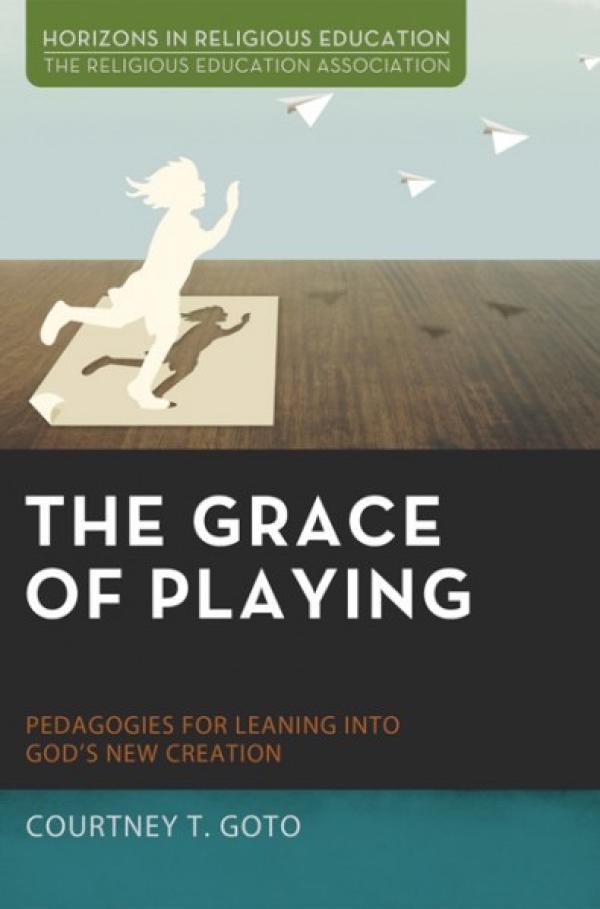
In The Grace of Playing, Courtney Goto offers a project in practical theology for Christian religious education that uses the notion of playing to better understand teaching and learning. Goto distinguishes her project from a formal practical theology of play, where play could be explored as a universal category of human existence. Instead, she works in the line of Paulo Freire’s search to move beyond a traditional schooling model of education towards learning that is more integrated, experiential, and creative. Specifically, Goto reflects critically on the notion of revelatory experiencing through the language and pedagogies of playing. Her focus is on playing as it relates to adult learning, and her investigation demonstrates – both conceptually and through case studies – how playing cultivates faith formation. Goto is an Assistant Professor of Religious Education at the Boston University School of Theology and a co-Director of the Center for Practical Theology. She writes as a third generation Japanese American United Methodist primarily for an audience of theorists, students, and practitioners who are liberal mainline Protestants. She invites Roman Catholic, Orthodox, and Charismatic Christians into the conversation as well, but notes that her advocacy of revelatory experiencing is to be understood in terms of the contextualized perspectives encountered in mainline Protestant churches. This is an important caveat. Theologically conservative readers will take issue with her concept of revelatory experiencing, whereby revelation happens in between persons as they relate to one another (as opposed to approaching Christian revelation as a totalizing meta-narrative). That Goto makes her theological liberalism so clear and defined, particularly in terms of her understanding of revelation, is a great service to readers. The Grace of Playing investigates playing from social scientific, theological, and historical perspectives and offers two case studies for application. After a preface and introduction, Chapter 2 explores psychoanalytical and psychological concepts of playing, relying particularly on D. W. Winnicott to articulate sociologically what occurs in revelatory experiencing. In Chapter 3, Goto turns to theology to build a theory and constructive proposal of play by appropriating insights from Jürgen Moltmann’s Theology of Play. Chapter 4 is a historical accounting of medieval practices of play, including the use of devotional dolls by fourteenth century nuns in the Rheinland, Germany and the practice of holy foolery by those in both Western and Eastern Church traditions. The final two chapters contain case studies of grace-filled play. The first describes the creation of a pretend garden at a Japanese American church for the purpose of congregational reconciliation, and the second briefly recounts a practice of playing with inmates in a juvenile detention center.To conclude, Goto demonstrates that the grace of playing leads a world in need towards God’s new creation. The Grace of Playing skillfully navigates insights from sociology, theology, and history to make a compelling case for the theological practice of play as a mediating, revelatory experience within Christian religious education. The book is readily accessible for students and practitioners, without neglecting the more technical needs of theorists. For the case studies, Goto deliberately refrains from providing much, if any, direct data; this effectively condenses the reading, but also leaves a sense of wanting to know more about how the grace of playing works itself into and through these unique settings. Overall, the book is a warm invitation for all to play in the fullness of God’s grace.