Resources
It has been estimated that in the next ten years, about half of the current higher education faculty will retire. How can we best prepare the next generation of faculty members to fill this tremendous gap in our educational system? Paths to the Professoriate offers all those involved in higher education—everyone from administrators to scholars to graduate students—a much-needed resource that brings together major research, the most important developments in practice, and informed analysis on improving graduate education and preparing the future faculty. This important book includes chapters from some of the best-known researchers, practitioners, and scholars working to prepare the faculty of the future. In one volume, the authors offer a synthesis of what has been learned about the challenges and concerns in graduate education as preparation for faculty careers, highlight the various projects and approaches for improving graduate education, and identify strategies for institutional leaders, department chairs, faculty advisors, and graduate students. Paths to the Professoriate: * Presents important reasons for considering ways to improve the preparation of the next generation of faculty * Describes research studies concerning the graduate school experience * Highlights illustrative examples of innovative programs and projects * Provides a synthesis of key lessons from the research and projects addressing the preparation of future faculty This solidly research-based book covers such vital topics as: the lack of systematic developmentally organized preparation for those aspiring to teaching careers in higher education; graduate students’ perceptions of their graduate experiences and their preparation for faculty work; particular challenges confronting Black doctoral students; reasons students leave doctoral study; programs to prepare graduate students for roles as teaching scholars and engaged citizens; strategies to help graduate students and faculty members identify mutual goals and resolve conflicts; and much more. Paths to the Professoriate offers all those concerned with the fate of higher education a valuable resource for the future. (From the Publisher)
Four primary factors are relevant to social and cultural diversity in the college classroom: students, teachers, course content, and teaching methods. Faculty can use understanding of these factors and their interrelationships to facilitate learning in an increasingly multicultural environment.
The majority of undergraduate instructors hold contingent appointments, a term used here to include not only the non-tenure-track part-time faculty but also many instructional staff who lack faculty status, an increasing proportion of full-time non-tenure track faculty, and a substantial number of graduate student teaching assistants. This volume seeks to foster a dialogue, long overdue, between those who believe that the academy has failed to give adequate respect and support to undergraduate instruction and those who believe that the academy has failed to give adequate support and respect to the selection and terms and conditions of employment of undergraduate instructors. It may be that the increasing dependence on contingent appointments imperils undergraduate learning no less than it imperils the future of the academic profession. (From the Publisher)

Success Strategies for Adjunct Faculty provides adjunct instructors with a multi-faceted toolkit for increasing both effectiveness and efficiency in today's college courses and enhances their opportunities for success. Building upon the research and strategies recommended in The Adjunct Professor's Guide to Success, Dr. Lyons leverages his subsequent workshop experiences throughout North America as well as focused research. The book adds new self-analysis tools that enable the instructor to integrate personal strengths into course planning and delivery, provides additional course management tools, such as a model mentoring agreement and an exam development exercise. Brand new features include testimonials from 28 successful adjunct professors throughout North America, which open and close each of the book's 14 chapters, as well as a new chapter focused on infusing technology into the adjunct professor's instruction. The book includes a rich array of online support resources. (From the Publisher)
* Do students gain when they are taught by active researchers? * Should all faculty be involved in research? * What are the benefits students (and their parents) should get from studying at an elite research university – and paying higher fees for the privilege? In Scholarship Re-Considered, Ernest Boyer challenged US universities to "break out of the tired old teaching versus research debate." This book provides an international perspective on how universities, departments and individual faculty have successfully sought to connect their research to the benefit of student learning and institutional mission. It directly addresses the ways teaching-research links can be developed. Building on research, the literature and wide practical experience, the authors show how academic research activity can be connected to academic teaching activity in such a way as to ensure that neither operates in a vacuum and, most importantly, that each can be enhanced by the other. The book addresses the issues at the individual, course and institutional levels, as well as at the level of public policy. An important work for faculty, faculty developers and administrators. (From the Publisher)
This report relates to the concept of teaching portfolios. It discusses the importance of accounting for institutional culture when introducing the concept of teaching portfolios. Includes information on how the department chair can help to improve teaching. (From the Publisher)

Global developments directly or indirectly affect teaching and learning in higher education. In this new era of telecommunication revolution and growing international cooperation, it is time for university and college teachers to talk across national boundaries about teaching. In this volume of New Directions for Teaching and Learning, contributors from around the world describe issues they are currently facing in their teaching practice. National differences are put into the context of universal themes. Faculty are responding to demands for social development and to pressures from the world of work. They are influenced by government policies and financial constraints. Regardless of the context within which they practice, faculty still struggle with the familiar issues of how to learn about teaching, how to juggle teaching and research, and how to evaluate both teaching and learning. The international perspectives presented in this volume give readers a fresh outlook on everyday concerns and introduce new thoughts on teaching and learning. This is the 72nd issue of the quarterly journal New Directions for Teaching and Learning. (From the Publisher)

This monograph explores practical and theoretical issues in use of case studies for college faculty to reflect on and improve instruction. Six chapters: (1) describe teaching case studies, with an overview of how and why they are used; (2) explore the rationale for their use within the frameworks of scholarship and professional development; (3) present three brief case studies and suggestions for their use in discussion; (4) present reports from faculty groups who have written case studies, with their suggestions on how to proceed; (5) discuss nine issues that have emerged through the use of cases (how they can place the focus on learning as well as teaching, possible alternative formats, getting at the more subtle issues of practice, going beyond problems to the problematic, whether and how cases can represent best practice, including content issues, using cases to build on one another, creating occasions for more productive use of cases, and the impact of case use on teaching improvement); and (6) describe three possible scenarios illustrating how cases might contribute to a campus culture that takes teaching and learning seriously. Four additional cases and teaching suggestions are appended as is a list of 13 resource organizations. (From the Publisher)
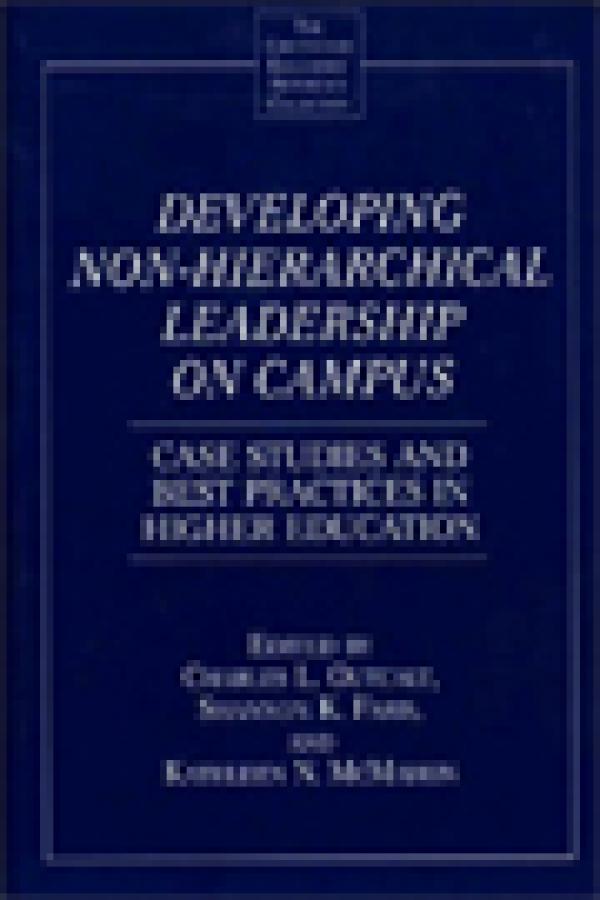
Abstract: Key figures in the field of non-hierarchical leadership development share their insights on conceptualizing, promoting, and assessing models of leadership based on teamwork, diversity, and service. This volume will be essential for theorists and practitioners in higher education. (From the Publisher)