Resources
This is the new side bar for Web Site On Religion, this page is named (custom-sidebar-website_on_religion)
This is the new side bar for Syllabi, this page is named (custom-sidebar-syllabi)
This is the new side bar for scholarship, this page is named (custom-sidebar-scholarship)
This is the new side bar for Blog, this page is named (custom-sidebar-post)
This is the new side bar for programs, this page is named (custom-sidebar-page)
This is the new side bar for grants, this page is named (custom-sidebar-grants)
This is the new side bar for Books Reviews, this page is named (custom-sidebar-book_reviews)
My grandmother used to speak in adages, parables, metaphors, similes and symbols. Now I call her proclivity for language, literature, and meaning-making “wisdom-speak.” Then, I thought she was being corny. She knew her wisdom-speak was meant to teach me enough until I am ready to know more. Her adages came from bible verses, poetry lines, and quotes from novels, cultural remembrances and living life as an African American woman in the USA, born in 1887. Folks like Langston Hughes, Booker T. Washington, Sojourner Truth, Pearl Bailey, Jesus, and Sarah Vaughn were regularly invoked. Wisdom-speak is colorful, witty language - easy to recall and recite, with a depth of multiple meanings. Wisdom-speak is part of everyday conversation. It is a pithy quote or well-placed refrain woven into a conversation like salt on fried fish. It is accompanied by a hmmm or tongue click, a foot pat, a shoulder shrug or an eye roll. Wisdom-speak is a body, mind and spirit lesson. Grandmother Vyola would say, “All that is is not visible.” As a child, I thought she meant that there is more to creation than what can be witnessed with the naked eye. If knowing is only about what is directly in front of us – then we miss so very much of all that is. Learning to see the invisible is the task of knowing. Learning the ways of the wind and the saints, angels, ancestors, cherubim and seraphim; the dream world and the day dreaming world; the ways of prayer and meditation are the learning of the invisible. Then as a young adult, I decided she was talking about identity politics and the politics of domination. The genderless politics of patriarchy, with its racist undertones and dictates, considers much of “all that is” to be too much for women, many children, and most men. The truncation of imagination engineered by systems of domination and control renders the capacity of many people as inferior thus negating all that is. Poverty drastically limits opportunities for in-depth exploration – so when we meet persons who have carved out an education in the wake of social depravity we should be in awe. As a young adult, I came to understand good teaching meant finding ways of seeing the manifestations of oppression in my own classrooms, church, society, and world. And I encountered Alice Walker and figured Grandmother Vyloa was talking about what Dr. Walker was talking about. Grandmother Vyola is resonant with novelist, poet Alice Walker’s four-part definition of a “Womanist” from In Search of Our Mothers’ Gardens: Womanist Prose, 1983. The first part of the definition reads in part: “….Wanting to know more and in greater depth than is considered ‘good’ for one.” It seems as though Vyola and Alice were cut from the same cloth. In the last few days, I have turned my attention exclusively toward preparation for school. I have my head down as I put finishing touches on my syllabi, design learning activities, schedule guest colleagues, locate films, and order art supplies. My mode is one of efficiency and my mood is closed off. I am, in my planning, working from an attitude of indubitability. I have a clarity about what I will teach, how I will teach and what my students will learn. While immersed in my preparations, grandmother whispered in my ear. Grandmother Vyola says that patent planning is not good for me or my students. She advises that the better way is to be more opened ended – like Jesus’ parables. Allow the students’ voice to affect most aspects of the course design, not just the convenient parts. Consider that you cannot see all there is to see so leave room for your own learning while you teach. Most of all, the plan that that which is revealed will be marvelous and know it is unplannable, but can be readied for – Get Ready! I have learned to pause when grandmother speaks. I take a second look at my plans and see that I have relied, a bit, on stale redundancy and a few too many current conventions. I recognize that when I start telling myself I know what will happen, what can happen in my own classroom – I am in danger of not allowing for surprise, the unexpected, or the un-expectable activity of Spirit. My grandmothers Vyola and Alice remind me that my certainty is likely a trap. If I plan for only what I know, only what I can see, only for what I can do – then I am not being womanish, not acknowledging all that is in the world. With this wisdom, I have begun to incorporate more ways of acknowledging the hegemonic forces which hide in our midst. I have adjusted and added ways which invoke the freedoms of learning for my students – freedoms like their own questioning, curiosity, and concerns being integrated into the full length of the course. School starts the week before Labor Day --- I am less certain of my plans and better for it.
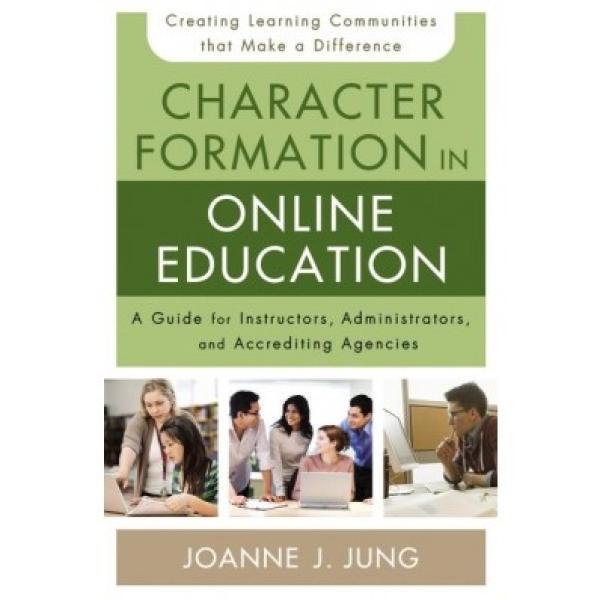
Joanne Jung’s overview of character formation in online education serves as an introductory resource for the topic. It is primarily intended to be a practical and accessible guide for faculty and administrators at religious institutions that offer online courses. Throughout the book Jung tackles the “skepticism among educators about character formation in online education” (15). The book examines various aspects of online learning and how it contributes to character formation. In the beginning section, Jung addresses the purpose of online education alongside best practices for online pedagogy. She provides an overview of Learning Management Systems, which house online classes, as well as an overview of the course design process, which involves working as a team with a curriculum and instruction expert. The second section discusses best practices of pedagogy within online courses, focusing on a holistic view of human personhood that drives one’s approach to character formation. Jung discusses practical means for using discussion forums, hybrid classroom formats, and social media toward the end of character formation, including an important chapter on integrating faith and learning. The final section addresses assessment and improvements that administrators and faculty can make to online courses in order to achieve learning outcomes for character formation more consistently. Jung also includes an accessible and informative glossary of terms relevant to online education. Faculty who are unfamiliar with teaching online courses will find this book a valuable help in beginning to teach and form character in online modalities. Administrators and accrediting agencies will find many sections useful for their purposes as well, especially chapter three on course design teams, chapter seven on the integration of faith and learning, and chapter nine on assessment. As Jung writes, her purpose in the book is to give “practical ideas for customizing your online courses and improving your pedagogical methodology, irrespective of your discipline” (9). One concern with the text is its basic, introductory approach. For faculty and administration who are experienced with online education, the book will be primarily review, albeit with a clear focus on character formation. Chapter seven on the integration of faith and learning and chapter nine on assessment are important exceptions, and they present insights for any institution concerned with character formation in education. Additional studies could help supplement and add insight to some of the essential points that Jung makes, particularly studies that focus on the creation, delivery, and assessment of learning outcomes specifically designed for the purpose of character formation. Such studies could engage resources on moral or character education and focus on the application of character formation research to online modalities. If one is looking for an introductory guide to forming character in the world of online education, this book provides resourceful and insightful suggestions toward best practices. In order to delve deeper into character formation for online education, there remains a need for further pedagogical study regarding the application of character formation research in general to online education in particular and regarding the means of facilitating character growth in the learning environments of online education.
As we go back to the classroom (and shake off the dust of summer), we all have mixed feelings and expectations. While some of us will just go back to the normal, others will be anxious and perhaps fearful about a new semester. The beginning of a semester can carry a feeling of being displaced, a sense that we don’t know what is coming our way and what is next. In one word: the lack of control. That is why we occupied so much of our syllabi in order to gain immediate control of that space we actually cannot control, and in fact never have controlled. What will my class be made of? How many students and who are they? Will we be able to control everything? Be fair with everybody? Be attentive to our own tasks, juggling the school’s demands and all that the teacher hopes for? The specific details of the practical aspects of our syllabus, the division of tasks, the proper tools to be used, the connections to be made, the boundaries to be established. In truth these are questions that only end when classes are over after a whole semester. Besides, after being away from the classroom for a while we may feel a little out of joint, as if the classroom is again a foreign/home space, until the map we draw (our syllabus) will help us travel through this newly foreign terrain. In our classrooms we are both professors and educators. Rubem Alves makes a distinction of these two roles. He says: “A professor is an employee of institutions that manage lagoons and puddles, specialist in reproduction, an instrument of the social apparel of the state. As the educator, on the contrary, [the professor] is a founder of worlds, mediator of hopes, pastor of projects.” [1] As we go back I wonder how our duties as professors will cast a shadow over the role of the educator. Will our pedagogies be more faithful to the management of forms of reproductions or attentive to the ways our students can become more expanded, more fully human beings? Will we dare to be a “mediator of hopes,” or a “pastor of projects?” If we only trust the readings of our classes we are more professors than educators. If we believe that the evaluation can only take a form of a formal final paper we will not tap into the rich resources of our students. If we make classrooms be a “one fit for all” place, we will make our educator side slip into the perfectly devilish/delightful combination of institutional bureaucracy and personal fears. A combination where students pay the price of teachers whose hope is confounded by fear. In classrooms we are educators! That is why we gather together: to share knowledge as we share tastes, to share complexities and differences as we share life together. But in order to get there, we must be awakened! That is what Alves says of how to prepare the educator: “is necessary to wake her/him up… its enough that we call them from their sleep, by an act of love and courage. And when awakened, they will repeat the miracle of the instauration of new worlds.”[2] I think we are very good at managing lagoons and puddles. However, our task as we begin our semester is to be awakened into the educators that live inside of us and be(come) a co-founder of worlds in our students, a stretcher of horizons, jokers of our common worlds and satirists of our own stupidity, doing what we do with a sense of praxis that will be able to transform actions, gestures, movements, feelings and create possibilities. In a word: dreamers of new realities! Paulo Freire talks about this dreamer in a more academic language. Forgive the sexist language: “Because he admires the world and therefore objectifies it, because he grasps and comprehends reality and transforms it in his action-reflection, man is a being of praxis. Even more so, man in praxis… His ontological vocation, which he ought to existentiate, is that of a subject who operates on and transforms the world. Subjugated to concrete conditions that transform him into an object, man will be sacrificing his fundamental vocation… Nobody is if he prevents others from being.”[3] Every dreamer must start in reality, it the midst of contrasts, racial divides, economic disparities, political dualisms, violent neighborhoods, dialectical complexities and all kinds of conflicts. We must make unhidden the social processes of reality that prevent change and transformation especially for minorities and oppressed people. Educators can (be)come the very material they use in the classroom, the texts they read, the dialogues they have, the educational tools they use, the theories they choose and the very awareness of what kind of pedagogy that they foster. We are caught into this action-reflection that stirs up, criticizes and amplifies theories and praxis. We are not detached from the world, but rather we are the result and consequence of the world we create. Our pedagogies are not meant to keep the status quo but to transform things and people, even if we know that what we do will not transform anything or anybody. More than anything we must keep our fundamental vocation as teachers, whatever that might be, so we will not prevent students from being the fullest they can be, in the owning of their bodies, their feelings, their thoughts and their capacity to reach out, to expand, and to listen to their own selves. As we go back to the classroom, let us awaken ourselves into the praxis of being educators! Dreaming dreams of new worlds and human beings fully stretched, while hoping for a good semester with all the rights and wrongs we will certainly make if we dare to be “a founder of worlds, mediator of hopes, pastor of projects.” [1] Rubem Alves, Conversas com quem gosta de ensinar. (São Paulo: Cortez Editora, 1980), 27. [2] Ibid. [3] Paulo Freire, La Concepción problematizadora de la educación y la homanización.” Cristianismo y Sociedad. Montevideo, 1968, 18. Freire... quoted by Carlos Alberto Torres, "Dialetics, Conflict, and Dialogue," in Moacir Gadotti, Pedagogy of Praxis: A Dialectical Philosophy of Education (New York: Suny Press, 1996).