Resources
A 2015 course taught by Michael L. Satlow at Brown University traces "the development of both the Hebrew Bible (Old Testament) and the New Testament from their origins to their development as foundational texts for Jews and Christians."
A 2006 course taught by Russell Morton at Ashland Theological Seminary offers a "systematic introduction to the Gospels in the context of present day biblical research. The study will concentrate on such areas as historico-religious backgrounds and methods of New Testament criticism, and the individuality and interrelationships of the Gospels."
A 2011 course by Joseph Adler at Kenyon College examines "the various expressions of Daoism (Taoism) in the Chinese religious tradition."
A 2010 course by Joseph Adler at Kenyon College "is a historical and contemporary survey of religious life in Japan, focusing on the Shinto and Buddhist traditions.."
A 2011 course by Mark Unno at the University of Oregon "traces select themes and developments in the history of Japanese religion . . . various aspects of intellectual and social history are examined including: the relation between state and religion; issues of gender, class, and cultural identity; religious experience; and ritual and institutional practices . . .(in) various forms of Japanese Buddhism including Zen and Pure Land as well as Shinto."
A 2010 course by Mark Unno at the University of Oregon "examines the sacred scriptural traditions of East Asian Buddhism with a focus on Chinese and Japanese Zen, Pure Land Buddhism, and associated developments. . . . This examination will cover a wide range of themes against the backdrop of social and historical developments, including the development of sectarian traditions, cultural and national identity, gender and race."
A 2013 course by Doug Kennard at Houston Graduate School of Theology delves into epistemology, theological method, hermeneutics, and apologetics.
A 2013 course by Daniel Alvarez at Florida International University focuses on Lewis's "interpretation of Christianity . . . (and) whether his interpretation merits the acclaim that it has received . . . (and) whether Lewis can be said to be a defender of Christianity in its most rigorously orthodox form."
A 1997 course by Katie Cannon at Temple University examines "the Black Women's Literary tradition to understand how it functions as a continuing symbolic expression and transformer of value patterns fashioned by the female members of the African American community" with a focus on ethical perspectives.
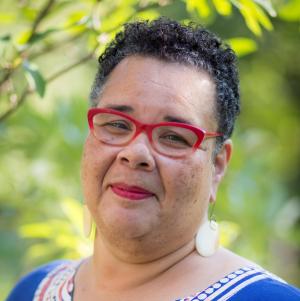
Training students to identify and traverse the identity politics in the United States begins on the first day of my courses. On day one, I introduce myself, then launch into the syllabus review. In describing the required readings, I hold the book or article in my hand, tell students the kind of text it is (fiction, non-fiction, etc.), then I discuss the author. I identify the race and gender of the author, and give a description of the author’s work in and beyond scholarship. And then I tell the students my rationale for selecting this author and particular text for our conservation. Last year, during this part of the syllabus rehearsal, a white woman student, who I will call Sara, raised her hand while I was waxing on about the authors. Sara (age 50ish, married, middle to upper class, suburban mom of three teen-aged children, devoted church member and avid Jets fan, self-identified as politically liberal) asked that I stop identifying the race of the authors. I have paraphrased this interaction in the following vignette: Sara said, in a chastising tone, “The race of the authors does not matter. We should read the books regardless of the person’s race.” I responded, “In our classroom conversation, my race matters, your race matters, and the races of the authors matter. Our voices and our perspectives, our values, our behaviors, and our beliefs are directly connected to our racial identity. No author writes for all people or from a universal perspective. We have to be aware of their perspective to better understand their work.” Sara looked puzzled. I continued, “Sara, when you look at my face do you see the face of an African American woman?” Immediately, Sara looked suspicious. She strained for what to say. She did not know if she should say she saw my race or if she should say she did not see my race. Sara said, “I don’t think of you as a black person. I think we should just be people.” Sara gestured as if she had said something obvious. In my mind, I heard her say, “I think we all should just be white people…. normal people . . . just plain people.” I said, “My race informs me and to ignore my race is to ignore my voice, as well as the voices of my people. Please know that I like being an African American woman. I embrace our ways, wit, and wisdom.” Sara’s face became quizzical, like she was considering something new and for the first time. I continued, “I think of you as a white woman.” This soft statement hit her with a jolt. Sara’s shock gave way to dismay – she frowned. Seeing her alarm, I suggested that she hold her concern for later in the semester. I went back to my syllabus rehearsal. When I entered the classroom for the second session, Sara was seated. As I unpacked my briefcase she came up to talk with me. She reported that while she enjoyed reading the African American woman author, bell hooks (our first assigned reading), she did not think hooks was talking to her. Sara said, “I just think bell hooks has such a different perspective . . . I am not sure why this book is assigned for this class.” I told Sara to “hang-in” with the conversation – it was just the beginning. On the last day of class, as Sara walked out of the door she thanked me for the “nice” course. Her hollow pleasantry reminded me of the way a tourist, while leaving the tram-ride, thanks the guide at the end of the amusement park safari. I thought of James Baldwin. James Baldwin, acclaimed novelist, legendary essayist, and important human rights champion said, “Not everything that is faced can be changed, but nothing can be changed until it is faced.” I made a mental note to include writings by Baldwin the next time I taught this course. I love Baldwin’s use of the word face(d). It means to confront, challenge, provoke, even threaten or defy. He is also not so subtly suggesting that people need, if societal change is to be given a chance, to turn and face one another. Baldwin suggests that relationships of respect, decency, decorum, and dignity will change the world for the better, if we have the fortitude, tenacity, and care to make the attempt.The politics of the face is serious territory. The police do not take a mug shot of your feet or elbows. We are known by our faces. We face the world with our faces. Most racial profiling happens in the nanosecond it takes to gaze upon the face. The Sweat on their Face: Portraying American Workers, an exhibit of the Nation Portrait Gallery at the Smithsonian, says, “the face is the primary canvas of the story of our lives.” I agree. Once Sara signaled on the first day that conversations on social hatred were new to her and that she lacked the experience of challenging the social lies she had internalized, I watched for moments of particular distress and discomfort through the arch of our semester-long conversation. From my recollection, here are the three teachings that also shook Sara: #1) Just as victims of rape are not experts in the crime of rape or experts on rapists, so African American people, with our experience of violation, dehumanization, and oppression are not experts in the sin of racism or the contributing systems of oppression. We are typically, and rightfully so, reactionary. Reactionary is not the same as critically reflective. Please do not expect African American people to inform you about the intricacies of racism. Surviving racism does not equip one to teach about racism. Consult well-informed and mindful white persons who are aware, repentant, and doing the work of equity. There are many people. #2) Even with the sophistication and technological advancements of the 21st century, many white people still do not think they have a race. They still think race is for “other-ed” people – people of brown-hued skin or simply black people. Even so, white people typically do not hesitate, on a census form, to tick the box for Caucasian or white. Given the choices of Asian, Hispanic, African American or mixed they can declare they are white. Other than selecting that box, the everyday behavior is usually one of tension, anxiety, nervousness or just plain confusion about issues of race and racial identity. They still believe that their racelessness is just being “normal.” The politics of this identity-delusion is debilitating to non-white people. #3) The USA has exported its systemic prejudices and social hatreds around the world. As an American traveling overseas, being African American has mattered sometimes in dangerous and unpleasant ways. Being an African American has made me a novelty in Japan, an oddity in Korea, a target in Jamaica, an object of suspicion in Ireland and Israel, beloved in Ghana and ogled-at in France. The emotional outpouring, from rage to reverence, was at times overwhelming. The world is quite aware of the racist and stereotypical narratives of blackness in the USA and, for the sake of power and prestige, has chosen to embrace them. As an African American traveling abroad, I was a spectacle, an embodiment of the racist narrative. I was a spectacle as in celebrity or spectacle as in despised – all expressions of objectification, commodification, and all quite scary. Racism in the USA makes it difficult for African Americans to travel the world. It was challenging for Sara to understand that our goal is never to overcome all differences (being post-Obama is not the same as being post-racial), since God clearly created our spectrum of differences. God loves our faces in all their many colors, textures, shapes and sizes. It is when differences are deemed to be deficiencies that the problem of other-ing occurs. When whiteness and maleness are considered “normal” then any person not white and not male are, by base logic, abnormal and inferior. This white supremacist mentality undergirds and maintains social systems which control, sort, are suspicious of, exploit, criminalize or eradicate (quickly or slowly) those who are deemed as other. Facing this reality is our liberation – mine as well as Sara’s. The Saras of our time are uncomfortable when the lies of the melting pot and assimilation are exposed, countered and rejected. There is great resistance in allowing the voice of someone who has been othered (bell hooks and me) to speak our perspective. There is surprise, dismay and disorientation to learn that those who have been othered have a perspective of merit, even a perspective that is potentially revelatory. Allowing an Other’s perspective to decentralize previously un-contested norms, values and beliefs takes time, prayer, and patience. As we wait, we must acknowledge that until it is faced we will not be able to find our way forward. I have an urgency about this.