Resources

Roger S. Nam It’s that time of year. Yes, it’s the season where professors often find themselves dealing with breaches of academic integrity. The explosion of online learning, alongside everyone’s massively expanded access to information, has further complicated this issue. Exhausted professors, I’ve got a special holiday gift for you:...
Elisabeth T. Vasko Ph.D. Assistant Professor of Theology Duquesne University In recent years, I have taught an upper-level Christology course in which we examine race, gender, and power. Sometimes my students register their dissatisfaction with reading Christology from the margins (James Cone, Kelly Brown Douglas, and Marcella Althaus-Reid) instead of the center (Anselm, Barth, von Balthasar, and Rahner). I can understand their frustration and discomfort. In the classroom, I make an effort to accept it and to take it seriously. I should also note that I teach at a university where the student population is mostly white. By and large,
Kate Blanchard Is anyone else out there taken by surprise, year after year, at how absurdly crazy the weeks feel between AAR and winter break? I’m not complaining – I just had a wonderful time with 10,000 religion nerds in sunny San Diego (which included a video shoot with my...

Robert C. Fennell, Th.D. Associate Professor of Historical and Systematic Theology Atlantic School of Theology The most uncomfortable thing I ever say among professional colleagues is that when I was a child I was taught that we are all racist. In 1970s Western Canada, where I grew up, racism was real but often obscured by polite indifference and feigned ignorance. Yet our public school system urged us to see that within most of us there is an element that fears and reacts to difference. The terms for this dynamic were probably different then, but that was the heart of the...

When a school discovers a declining trend in enrollment it's time to huddle for some frantic strategic planning. If anxiety about the enrollment numbers is high enough some will want to talk about how the times they are a changin'...
Eric D. Barreto Ferguson is revelatory. “I wanted to comment on the tragic rift that we’re witnessing,” Bob Staake says about his cover for the December 8th issue of The New Yorker, arriving next week. “I lived in St. Louis for seventeen years before moving to Massachusetts, so watching the...

Although targeted mainly to K-12 teachers, this short and easy to read book is helpful and could serve as a companion to professors of religious studies and theology who want to better their understanding of action research for improving classroom instruction. The ideas and principles presented in the book are not difficult to translate into higher education classroom contexts. The book consists of six chapters and begins with defining teacher research and framing the research question. Dana provides five “wondering” questions for teachers to consider: (1) Is your wondering something you are passionate about? (2) Is your wondering focused on student learning? (3) Is your wondering a real question? (4) Is your wondering focused on your practice? and (5) Is your wondering phrased as a dichotomous (yes/no) question? The author then illustrates how to reframe these initial wonderings into pointed inquiry. She believes that good ideas and thought-provoking questions can only flourish through methodical inquiry. The book ends with two chapters that are concerned with ways to present inquiry-based research to colleagues and help them to improve their own teaching and research practices. In the chapters that fall between them, Dana discusses ways to fine-tune the research plan in chapter 3 and how to analyze data in chapter 4. Chapter 3 focuses on fine-tuning the research plan, and asks a number of pointed and useful questions that would be relevant for university, college, and seminary professors: (1) Does your data collection strategies align with your wondering and all other aspects of your inquiry plan? (2) Are you using multiple forms of data to gain insight into your wondering? (3) Does one of the forms of data you will collect include literature and/or have you already used literature to frame your wondering? (4) Is the design of your study experimental? In chapter 4, Dana distinguishes between formative and summative data analysis by giving real life vignettes from the field and also provides practical ways to avoid data analysis paralysis by way of self-guided worksheets. This might be helpful for those seeking to link teaching goals with outcomes and assessment strategies. Throughout the book, Dana inspires, reminds, and finally guides the reader through an action research process. As a result of going through this research process, readers are escorted through the process of improving their own pedagogical practices, “studying your practice empowers you to: engage learners, enable other professionals to learn from you, expand the knowledge base for teaching, express your individual identity as a teacher, and embrace all the rich complexity inherent in the act of teaching and learning” (80). This book might initially overwhelm professors of religious studies and theology if they have not read in practitioner action research or have not used action research to improve their own pedagogical practices. However, for those with some experience using action research as a strategy for teaching, this book is a welcome resource to help improve teaching and learning practices in the classroom.
Leah Gunning Francis, Ph.D. Associate Dean for Contextual Education and Assistant Professor of Christian Education Eden Theological Seminary Now I get it. For the past three months, I couldn’t figure out why a jury would believe that an 18 year old unarmed man would charge – head first – toward a police officer who is shooting at him. Soon after Michael Brown was killed on August 9, several local officials intimated that Brown was charging at Officer Darren Wilson and left no other recourse but to kill him. Why would a person with no history of mental illness or of
Eric Barreto, Kate Blanchard and Roger Nam I’ve started wondering recently if scholarship boils down to the courage to say something aloud, the courage to say something in the midst of a chorus full of others saying similar or different things. This same description could well be applied to...
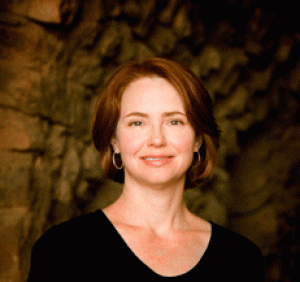
Miriam Y. Perkins, Ph.D. Associate Professor of Theology and Society Emmanuel Christian Seminary When Michael Brown was shot and killed in Ferguson, Missouri, I was reading the sermons of Martin Luther King, Jr.[1] “The tension in this city is not between white people and Negro people. The tension is at bottom between justice and injustice, between the forces of light and the forces of darkness.” “… noncooperation and boycotts are not ends themselves; they are merely means to awaken a sense of moral shame in the opponent. The end is redemption and reconciliation.” “Noncooperation with evil is as much a
Wabash Center Staff Contact
Rachelle Green, Ph.D.
Associate Director
Wabash Center
greenr@wabash.edu