Resources
Analyzes the spiritual journey of a student affairs practitioner and scholar. Experience gained by the practitioner in educating graduate students; Description of spiritual principles that guided the life of the practitioner; Contribution of the practitioner to student development.
Journal Issue.
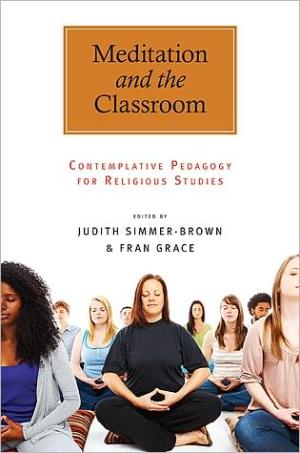
A groundbreaking book on using meditation in education and how it can enhance teaching and learning. Meditation and the Classroom inventively articulates how educators can use meditation to educate the whole student. Notably, a number of universities have initiated contemplative studies options and others have opened contemplative spaces. This represents an attempt to address the inner life. It is also a sign of a new era, one in which the United States is more spiritually diverse than ever before. Examples from university classrooms and statements by students indicate benefits include increased self-awareness, creativity, and compassion. The religious studies scholars who have contributed to this book often teach about meditation, but here they include reflections on how meditation has affected them and their teaching. Until recently, though, even many religious studies professors would find sharing meditation experiences, let alone teaching meditation techniques, a breach of disciplinary and academic protocols. The value of teaching meditation and teaching about meditation is discussed. Ethical issues such as pluralism, respect, qualifications, power and coercion, and avoiding actual or perceived proselytization are also examined. While methods for religious studies are emphasized, the book provides valuable guidance for all those interested in this endeavor. (From the Publisher)
The Survival Guide for New Faculty Members: Outlining the Keys to Success for Promotion and Tenure provides new faculty members with practical, down-to-earth wisdom and suggestions for successfully working through to tenure and promotion. The authors—both successful and experienced administrators and experts in higher education—have provided an extremely well-organized and useful guide for new faculty members. It focuses on all aspects of becoming a new faculty member including the various expectations in completing a successful journey toward promotion and tenure. The book underscores the importance of recognizing the three facets of faculty life of teaching, research, and service. This volume clearly sets out, compares, and separates those three components with clarity and provides very useful advice for putting the three together. Taken together with the chapters on “Documenting Your Progress” and “Promotion and Tenure,” new faculty are provided with a solid, practical introduction to building a foundation for success in higher education. Feedback and tips are also provided within each chapter. It is written in a style that readers will be able to easily comprehend and understand and is supported with many examples. In addition, the information can be easily applied to new faculty at various types of institutions of higher education. (From the Publisher)
While there is consensus that institutions need to represent their educational effectiveness through documentation of student learning, the higher education community is divided between those who support national standardized tests to compare institutions’ educational effectiveness, and those who believe that valid assessment of student achievement is based on assessing the work that students produce along and at the end of their educational journeys. This book espouses the latter philosophy—what Peggy Maki sees as an integrated and authentic approach to providing evidence of student learning based on the work that students produce along the chronology of their learning. She believes that assessment needs to be humanized, as opposed to standardized, to take into account the demographics of institutions, as students do not all start at the same place in their learning. Students also need the tools to assess their own progress. In addition to updating and expanding the contents of her first edition to reflect changes in assessment practices and developments over the last seven years, such as the development of technology-enabled assessment methods and the national need for institutions to demonstrate that they are using results to improve student learning, Maki focuses on ways to deepen program and institution-level assessment within the context of collective inquiry about student learning. Recognizing that assessment is not initially a linear start-up process or even necessarily sequential, and recognizing that institutions develop processes appropriate for their mission and culture, this book does not take a prescriptive or formulaic approach to building this commitment. What it does present is a framework, with examples of processes and strategies, to assist faculty, staff, administrators, and campus leaders to develop a sustainable and shared core institutional process that deepens inquiry into what and how students learn to identify and improve patterns of weakness that inhibit learning. This book is designed to assist colleges and universities build a sustainable commitment to assessing student learning at both the institution and program levels. It provides the tools for collective inquiry among faculty, staff, administrators and students to develop evidence of students’ abilities to integrate, apply and transfer learning, as well as to construct their own meaning. Each chapter also concludes with (1) an Additional Resources section that includes references to meta-sites with further resources, so users can pursue particular issues in greater depth and detail and (2) worksheets, guides, and exercises designed to build collaborative ownership of assessment. (From the Publisher)
Journal Issue.
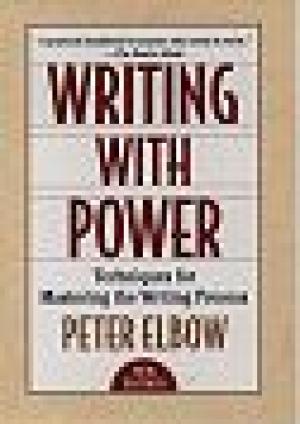
A classic handbook for anyone who needs to write, Writing With Power speaks to everyone who has wrestled with words while seeking to gain power with them. Here, Peter Elbow emphasizes that the essential activities underlying good writing and the essential exercises promoting it are really not difficult at all. Employing a cookbook approach, Elbow provides the reader (and writer) with various recipes: for getting words down on paper, for revising, for dealing with an audience, for getting feedback on a piece of writing, and still other recipes for approaching the mystery of power in writing. In a new introduction, he offers his reflections on the original edition, discusses the responses from people who have followed his techniques, how his methods may differ from other processes, and how his original topics are still pertinent to today's writer. By taking risks and embracing mistakes, Elbow hopes the writer may somehow find a hold on the creative process and be able to heighten two mentalities--the production of writing and the revision of it. From students and teachers to novelists and poets, Writing with Power reminds us that we can celebrate the uses of mystery, chaos, nonplanning, and magic, while achieving analysis, conscious control, explicitness, and care in whatever it is we set down on paper. (From the Publisher)
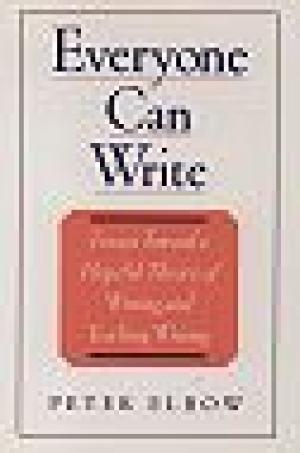
With Writing without Teachers (OUP 1975) and Writing with Power (OUP 1995) Peter Elbow revolutionized the teaching of writing. His process method--and its now commonplace "free writing" techniques--liberated generations of students and teachers from the emphasis on formal principles of grammar that had dominated composition pedagogy. This new collection of essays brings together the best of Elbow's writing since the publication of Embracing Contraries in 1987. The volume includes sections on voice, the experience of writing, teaching, and evaluation. Implicit throughout is Elbow's commitment to humanizing the profession, and his continued emphasis on the importance of binary thinking and nonadversarial argument. The result is a compendium of a master teacher's thought on the relation between good pedagogy and good writing; it is sure to be of interest to all professional teachers of writing, and will be a valuable book for use in composition courses at all levels. (From the Publisher)
Journal Issue.
Wabash Center Staff Contact
Sarah Farmer, Ph.D.
Associate Director
Wabash Center
farmers@wabash.edu