Resources

This second edition of the informative and influential The Essential Department Chair offers academic chairs and department heads the information they need to excel in their roles. This book is about the "how" of academic administration: for instance, how do you cultivate a potential donor for much-needed departmental resources? How do you persuade your department members to work together more harmoniously? How do you keep the people who report to you motivated and capable of seeing the big picture? Thoroughly revised, updated, and expanded, this classic resource covers a broad spectrum of timely topics and is now truly more than a guide—it's a much-needed desk reference that tells you "everything you need to know to be a department chair." The Essential Department Chair contains information on topics such as essentials of creating a strategic plan, developing and overseeing a budget, key elements of fundraising, preparing for the role of chair, meeting the challenges of mentoring to increase productivity, and creating a more collegial atmosphere. The book also explores the chair's role in the search process, shows how to conduct a successful interview and what to do when it's time to let someone go. And the author includes suggestions for the best practices to adopt when doing an evaluation or assessment. The Essential Department Chair, Second Edition, contains a wealth of new, realistic case studies to equip leaders in this pivotal position to excel in departmental and institutional life. (From the Publisher)
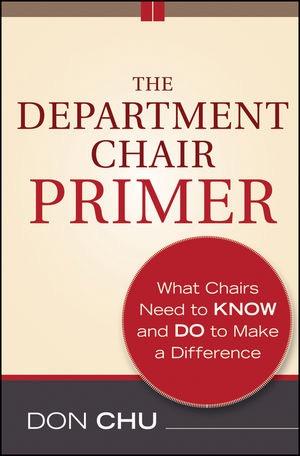
If higher education is to fulfill its vital social mission, new department leaders must be prepared for their positions and get up to speed on the basics quickly, educating themselves about the role and continuing to learn on the job. In this second edition of his classic resource, Don Chu outlines the proven ideas and strategies new department chairs need in order to do their jobs well. Thoroughly revised and updated, The Department Chair Primer contains information that addresses the current pressures and challenges in higher education and offers practical suggestions for responding to them. Filled with illustrative examples, the book gets straight to the heart of challenges and issues. Each chapter details a particular problem, includes a brief introduction to the topic, and provides tips on how to deal with the situation. Covering a wealth of topics, The Department Chair Primer -Explores the chair's role as department leader -Offers suggestions for handling stress and conflict -Includes information on budgeting, resource management, and development -Contains strategies for professional development, people management, and working with challenging personnel -Presents ideas for handling department communications, student development, and strategic positioning Written in a concise and accessible manner, The Department Chair Primer is an ideal resource for the busy new department chair. (From the Publisher)

Feedback is one of the most powerful influences on student achievement, yet it is difficult to implement productively within the constraints of a mass higher education system. Designing Effective Feedback Processes in Higher Education: A Learning-Focused Approach addresses the challenges of developing effective feedback processes in higher education, combining theory and practice to equip and empower educators. It places less emphasis on what teachers do in terms of providing commentary, and more emphasis on how students generate, make sense of, and use feedback for ongoing improvement. Including discussions on promoting student engagement with feedback, technology-enabled feedback, and effective peer feedback, this book: -Contributes to the theory and practice of feedback in higher education by showcasing new paradigm feedback thinking focused on dialogue and student uptake -Synthesises the evidence for effective feedback practice - Provides contextualised examples of successful innovative feedback designs analysed in relation to relevant literature -Highlights the importance of staff and student feedback literacy in developing productive feedback partnerships -Supports higher education teachers in further developing their feedback practice. Designing Effective Feedback Processes in Higher Education: A Learning-Focused Approach contributes to the theory and practice of higher education pedagogy by re-evaluating how feedback processes are designed and managed. It is a must-read for educators, researchers, and academic developers in higher education who will benefit from a guide to feedback research and practice that addresses well recognised challenges in relation to assessment and feedback. (From the Publisher)

In Dilemmas and Decisions the author argues that dilemmas, medical, political and personal are clearly universal, requiring decisions with a painful choice. Nevertheless, we are witnessing an increasing tendency amongst opinion leaders, from management consultants to religious fundamentalists, to inform us that dilemmas either do not really exist or are merely problems awaiting the “right” solution (which they happen to possess). Such moral certainty is dangerously mistaken, breeding extremism and undermining democratic values. Education can become a kind of preparation for Multiple Choice Question-type exams or TV quizzes, with facts recalled under pressure of time and problems needing fast solutions. Problems, however, are different from dilemmas; they have solutions and disappear as soon as these are found. Dilemmas leave you with an aftertaste and a sense of regret about the rejected alternative. (From the Publisher)

Mid-career faculty comprise the largest segment of the academy yet there is scant empirical evidence for the policies and practices related to mid-career faculty. The aim of this chapter is to provide an introduction to the lives of mid-career faculty working at institutions of higher education in the United States. The National Study of Postsecondary Faculty, conducted in 2004, served as the source of the demographic information and included a sample of 1,080 public and private not-for-profit degree granting postsecondary institutions, as well as a sample of 35,000 faculty and instructional staff (National Center for Educational Statistics, 2004). An analysis of recent articles related to mid-career faculty provided a theoretical foundation from which to begin our exploration into the topic. (From the Publisher)
Free, high resolution photos.
Low cost webhosting site for educators.
Totally free sound files for presentation slides and videos.
Source for gif downloads
Password protected video uploads with a range of payment structures.
Wabash Center Staff Contact
Sarah Farmer, Ph.D.
Associate Director
Wabash Center
farmers@wabash.edu