Resources

How do you help students get the point you’re trying to teach? More often than not most of us try the direct approach: “Just tell them!” But a paradox in learning is that often students do not learn what they are told as well as when they discover it for themselves (there are two contrasting schools of pedagogy here: direct instruction vs. discovery learning). The issue at heart is that to by-pass the process of how one acquires learning is to inhibit learning. As I am fond of saying, “Teaching-by-telling doesn’t work because it does other people’s thinking for them.” One way to help students acquire a concept is to use Entry Points to help them approach the concept indirectly and through multi-faceted dimensions of learning. Here are the characteristics of Entry Points: ● Entry points are used to develop learning experiences aimed directly at developing understanding of key concepts (theses are usually identified in the learning objectives). ● Entry points “validate” instantiations of the target entry point. (E.g., an aesthetic entry point activity must tap into and apply the aesthetic dimension and align with an aesthetic learning outcome; an analytical entry point must help "advance rehearse" an analytical learning outcome, etc.) ● Entry point-based learning experiences require students to engage actively, and think with, and about, concepts in novel ways. Rich learning experiences employ a range of entry points to the content (i.e., introductory or “messing about” experiences that invite students with varying backgrounds, experiences, and expertise to work thoughtfully with the content). Joseph Piro provides a great example of the use of entry points in his article, "Teaching Rembrandt," Humanities (November/December 2007) Volume 28 Number 6). First, he provides a rationale for the function of the teaching in using this particular entry point: "Being an “agent of civilization” is one of the many roles ascribed to teachers. If we are to have any expectations of producing a well-educated, well-prepared generation of deep-thinking, resourceful leaders, then it is essential to give students an opportunity to review, respond to, and ultimately revere the power of the human imagination—past and present. There may be no better way to promote this than to study, understand, and exult in masterpieces." In the examples given in the article we can see a variety of concepts addressed through this entry point: A springboard into the Protestant Reformation, Counter-Reformation, the Thirty Years’ War, and other events in seventeenth-century Europe. The importance and significance of Biblical themes. The philosophical concept of aesthetic: beauty. Entry points can be used at any point in the lesson, not just the beginning. Remember that the function of the entry point is to lead into concepts-attainment. I have used the following with students as entry points for segments for concepts attainment in the learning process: ● A video clip of ballet dancers to understand the concept of triangles and homeostasis ● Playing with clay to understand Aristotle’s form-matter hypothesis ● Playing the game Cranium to understand the concept of multiple intelligences ● A slide show of paintings and sculptures to understand different philosophies of aesthetic interpretation ● A short movie to understand “postmodern” concepts followed by a film critic's critique ● Creating a board game to understand group dynamics and the “rules about rules.” As you prepare for your next teaching experience, take time to consider how you want your students to “enter the learning experience” by creating an entry point that leads to the learning outcome.
Using examples of community and civic engagement (CCE) at Auburn University, this collection of essays provides readers with a lens through which to view a number of debates in higher education. In the broadest sense, the essays address the question of the role of higher education. More narrowly, they ask questions such as, how do universities respond to increasing public pressure to demonstrate clear connections between education and job placement? Since the volume focuses on civic engagement, authors ask what the ideal relationship between a university and its surrounding community might be. How, for example, does a public university foster such relationships, of what sort, and to what end? With increasing pressure on students to graduate in four years, along with widespread perceptions of higher education as a form of job-specific training, it may seem rather bold for educators to promote a liberal arts education. However, Brunner argues that one can address these questions by looking to the ancient Greek and Roman liberal arts models, which “foster personal growth and civic participation” (1). Through diverse case studies, the authors illustrate the high impact learning experiences that occur in CCE situations. For example, students in political science who do internships have a higher degree of satisfaction with the course, learn nuances about relationships between theory and problem-solving in a community, and often reconsider their career choices. This reconsideration results, in part, from the reflective component of CCE, which helps students make connections between classroom learning and their internships via writing assignments. These connections further illustrate the critical thinking (among other skills) that liberal arts education fosters – skills which align with employers’ desires in hiring. While much of Creating Citizens focuses on teaching and student-learning outcomes, Brunner also addresses the contentious issue of how promotion and tenure committees are to evaluate the work of engaged scholarship. How, for instance, does engaged scholarship measure up to traditional peer-reviewed scholarship? Again, this is not a new question, but one that nevertheless impacts pre-tenured faculty decisions for research plans. Brunner notes that engaged scholarship combines teaching and service, is as rigorous as other peer-reviewed scholarship, and upholds university missions and values by engaging faculty in mutually-beneficial, community-based problem-solving. In short, students, faculty, the university, and the community all benefit from CCE. Readers may wonder how the final essay fits within this volume; though interesting as a reflection on the role of non-native activist anthropologists working in India, the connection to the thematic foci of the other essays is tenuous. Overall, however, this volume would be of interest to educators looking for practical models of CCE that can be adapted to fit one’s own institutional location, mission, values, and vision for community relations. Land-grant institutions such as Auburn explicitly aim to promote application of research, in this case through CCE, a model that any institution of higher education would do well to consider adopting.
If you are a librarian or educator engaged in student learning, and are satisfied with the sameness and predictability of current methodologies, read no further. However, if you have need of developing strategies that are up-to-date, relevant, and promote shared perspectives, read on. Emerging Strategies for Supporting Student Learning equips the reader with an arsenal of educational approaches, geared for higher education. They are field-tested, validated by case studies, and include both North American and European perspectives. Like many other researchers focusing on emerging trends in education, Allen echoes the common refrain that today’s rapidly changing society necessitates “new approaches to support student learning” (1). Where this volume finds its niche and wields special power, is its ability to connect across disciplines – amongst librarians, information workers, and classroom instructors. It can also be utilized with students from undergraduate to doctoral level, and in varied settings. Among the trends included in this text are: student digital literacies, learning and teaching activities, designing face-to-face, blended and online courses, assessment, and issues of lifelong professional development. The chapters are divided into sections that include a concise introduction, subject content, summary, and references. Allen brings to her research an acute awareness of the challenges faced in higher education, having worked for several years in varied educational settings in the United Kingdom. She might even be faulted for showing too much concern when covering certain settings in minute detail. For example, she reminds us that because educators have so little choice about room allocation, “it is worth visiting it beforehand to check the facilities….This double checking could help you avoid being in an embarrassing situation” (126). This relentless attention to detail can also be viewed as her way of ensuring that such strategies are successfully executed. Throughout the text, we are encouraged to ask critical questions that will help inform the decisions we make about education strategies. When examining formative and summative assessment, the author offers a multitude of questions that might be asked beforehand, including: Why am I assessing? What type of assessment is better served? And where is the best place to do the assessment? (91-92). The strategies Allen offers are never dogmatically presented. They are, rather, offered in a smorgasbord manner. They are easily constructed and user-friendly. She encourages the use of ice-breakers, informational graphs, and e-posters at academic gatherings and as a way of allowing material “to be presented in a colorful and imaginative way” (87). Pedagogic models like flipped classrooms are viewed as a way of maximizing student engagement and which runs counter to conventional approaches to teaching and learning. Traditionally face-to-face classroom time is spent by a tutor explaining or presenting new ideas, and this may be followed by some activities. In a flipped classroom, students explore the material outside the classroom and then spend time with the tutor clarifying and developing deeper knowledge through discussion and activities. (116) Keeping up-to-date with professional skills is a high priority for this author. She suggests several digital resources across the spectrum to help make that happen, including the American Library Association (ALA), Flickr Creative Commons, MERLOT, and the National Digital Learning Resource (NDLR) – a “collaborative educational community in Ireland…. interested in developing and sharing digital teaching resources and promoting new teaching and learning culture” (110). The emerging strategies included in this book bear testimony that education is both evolving by the day and in need of constant need of revision. This book helps us move a little toward embracing good educational practice and relevancy.
Outcomes-based learning invites the question of how to best produce them, and this book introduces the reader to seven high-impact practices (HIPs), namely high expectations, close and frequent student-faculty interaction, effective teaching strategies, undergraduate research, collaborative learning, service learning, and diversity. Chapters are organized around these seven features. The authors use their own school, Oxford College of Emory University, as a test case for their hypothesis that these features provide the best means for student success as measured in desire to continue learning, graduation rate, STEM interest, and community engagement. Institutions promoting HIPs provide intentional support to their students for these practices, cultivate diversity, and blur the boundaries between classroom and extracurricular life. The book is seasoned with excerpts from faculty and student interviews and almost constant reference to the last thirty years of research on academic practice. High expectations are created in classroom synergy between students and instructors, where instructors lead students in exploring beyond the basic subject information students are expected to learn on their own. Students report appreciation for being pushed beyond introductory knowledge and for gaining the self-knowledge that they underestimate their own learning capacities, something they would not have learned without high expectations. High expectations are successful when students have more opportunities to interact with faculty. This works best at smaller institutions and requires the institution’s support to work. While faculty report that interaction helps them tailor their instruction to students’ needs and abilities, they also caution against an over-customization that reduces a subject’s breadth and prevents students from being challenged by new and unfamiliar material. As expected, high-impact teaching calls for active learning techniques, with fourteen such practices – called “Inquiry Guided Learning” – described in the third chapter. Among them are student discovery (as in problem-solving), systematic construction of knowledge, cross-disciplinary integration, addressing misconceptions, creating surprise in the classroom, and using mistakes strategically. These practices are not formulas set forth by the authors but were derived from student-faculty conversations about good teaching at Oxford College. The reader looks in vain, however, for the redemption of the lecture as a component in active learning. In any case, faculty are advised to use practices that fit their personality and their discipline; some fit better than others. Collaborative learning is enhanced through student research projects, which should be found across the disciplines (STEM fields have done the best job here). Such learning is best coupled with collaborative leadership in student life activities. The greater benefit accrues the less division there is between a campus’s academics and student life. Students learn leadership skills and gain confidence if collaboration with their peers is encouraged in both areas. Service learning includes collaboration and moves students beyond mere cognition to an experience the authors describe as spiritual and aimed at the “whole student.” And, the more diverse a campus, the better the outcome of any sort of collaborative activity. The conclusion offers readers ways and means of implementing these HIPs on their own campuses. Flexibility and adaptation are key, and in the process, more HIPs may be devised from conversations among all parties in different campus contexts.
This global study of teaching, learning, and assessment goes beyond the typical single country context to extend to good pedagogical practice on six continents.The argument of each chapter is supported by examples of good practice accounts from around the world, a collection that forms a refreshing change from a generic case study model. Although the examples lean most heavily toward English-speaking institutions and classrooms, there is significant attention paid to various elements of pedagogy from many cultural perspectives. The author takes great care throughout the book to consider all elements of the changing higher education landscape, including the changing student body, changes in technology, and changes in expectations about the goals of higher education and graduate employability. The twelve chapters of this book take a comprehensive view of diversity in higher education teaching, learning, and assessment. The book opens with a consideration of cultural mores and assumptions that directly affect interactions in higher education. Brown looks both to the past and the future in subsequent chapters, noting pedagogical traditions and innovations in the context of today’s higher education landscape. She argues that we must adjust to a technology-rich world that necessitates more focus on “learning how and learning why than on learning what” (21). Her view of technology in the balance as both a distraction and a valuable addition to certain aspects of both teaching and learning is refreshing, as so many books either glorify or decry technology in classrooms and society. This ability to see things in the balance is one of the greatest strengths of this book: rather than arguing for a “best” way to teaching or learning or assessment, this book offers multiple possibilities from multiple contexts and thus leaves much to the reader to judge based on his or her context and constraints. Brown identifies a few global trends. The most widespread seems to be a move from transmissive to transformative education. She notes that there is a “movement from perceiving the university teacher as an all-knowing, unchallengeable authority figure” (27) and parallel a movement by institutions and disciplines toward encouraging learning outside of the lecture hall. Another trend is teaching toward the multiple literacies expected of a twenty-first century graduate, looking well beyond academic literacy to digital, assessment, and interpersonal literacies (88). Finally, Brown notes that all education needs to think of itself as taking place in a global environment. This book is itself a fine way to encourage broader thinking about pedagogical contexts in higher education: our students are shortchanged when we privilege our own pedagogical traditions and ignore the broader, global context of higher education. The strengths of this book are many. For instance, the author provides substantive and exhaustive bulleted lists in each chapter, a diverse set of highlighted good practice accounts, and a full chapter devoted to higher education teacher development. The book is easy to navigate, written in clear prose, and at once expansive but grounded in particulars. I would recommend this book highly to teachers and administrators in higher education across the disciplines.
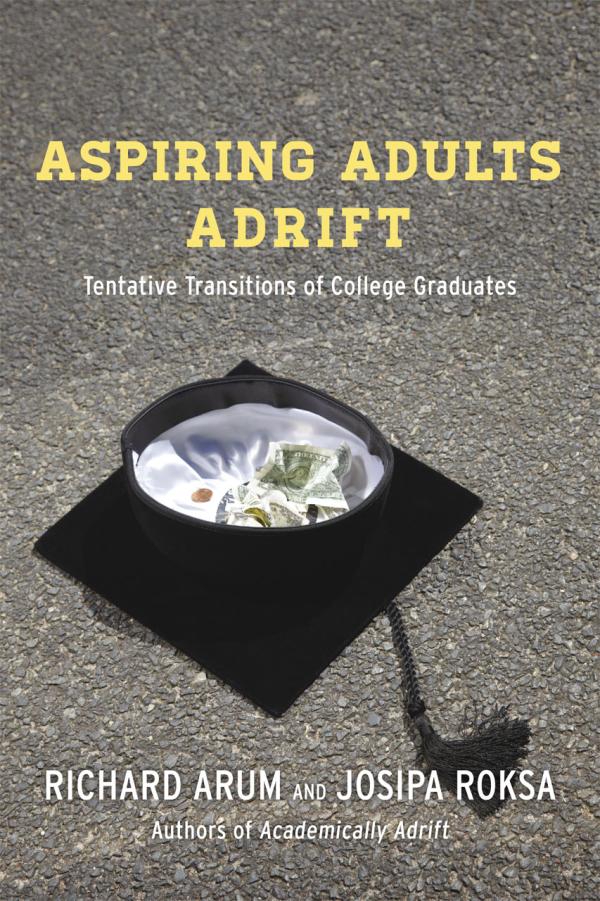
Aspiring Adults Adrift: Tentative Transitions of College Graduates, by Richard Arum, professor in the Department of Sociology at NYU and senior fellow at the Bill and Melinda Gates Foundation, and Josipa Roska, associate professor of sociology and education and associate director of the Center for Advanced Study of Teaching and Learning in Higher Education at the University of Virginia, is the much-anticipated sequel to the authors’ celebrated, often cited, and hotly debated Academically Adrift: Limited Learning on College Campuses (2011), which documented in great detail the academic gains – and stagnation – of some 2,300 students of traditional college age enrolled at a range of 4-year college and universities. In the 2011 report, students were measured on gains in critical thinking, analytical reasoning, and other “higher level” skills taught at college, and the results were not encouraging. The most often-cited findings included: 45 percent of students “did not demonstrate any significant improvement in learning” during the first two years of college; and 36 percent of students “did not demonstrate any significant improvement in learning” over four years of college. The main culprit for students’ lack of academic progress, the authors claimed, is lack of rigor, particularly with respect to critical reading and analytical writing. Aspiring Adults Adrift tracks the same cohort of undergraduates out into the working world into (what should be) adulthood, and documents their struggles to make the transition to traditional adult roles. The results of this follow-up study are no more inspiring: 24 percent of graduates living at home with their parents; 74 percent of graduates receiving financial support (in some cases quite substantial) from their families; and 23 percent of graduates in the labor market who are unemployed or underemployed. Despite these discouraging findings, however, the authors report that these graduates are quite optimistic about their futures, 95 percent of them reporting that they expect their lives to be better than their parents. The authors set out to determine what accounts for this optimism. One compelling argument put forward by Arum and Roksa is a theory given recent prominence by social psychologist Jeffrey Arnett in his notion of “emerging adulthood,” a new demographic identified as the period between eighteen and twenty-five years of age, a period of “self discovery” and “self exploration” during which adolescence is extended; a period in which these aspiring college-educated young adults struggle with identity exploration, instability, and self-focus, often do not live independently, are un- or underemployed, and do not have the income to be financially self-sufficient. Arum and Roksa put the blame, fairly or unfairly, largely on institutions of higher education, and their commitment to “promoting a personnel perspective that celebrate(s) self-exploration and social well-being” (11) – put more bluntly, that caters to the ethos of consumer society, and a broader “cultural adoption of a therapeutic ethic” (9): “both the students and institutions have put such a high focus on social engagement as a key component of higher education that the students have come to believe that it’s those skills and networks that are going to be critically important for their lifelong success.” The evidence, however, suggests otherwise; that the emphasis on social “engagement” at the expense of academic rigor is not achieving these results. “Widespread cultural commitment to consumer choice and individual rights, self-fulfillment and sociability, and well-being and a broader therapeutic ethic leave little room for students or schools to embrace programs that promote academic rigor” (136). It is, the authors contend, ultimately a mutually-reinforcing race to the bottom: “This may reflect the self-centered nature of emerging adulthood,” they write, “or the education system’s decreasing emphasis on preparing individuals for participating in a democratic society. Whatever the underlying causes of this tendency, colleges could adopt a more productive role in the development of values and dispositions for greater engagement with the world at large” (113). In essence, the responsibility is ours, as educators, to reject consumer satisfaction as “a worthy aim for colleges and universities” and “do more to help students develop the attitudes and dispositions they need to reach their aspirations” (134). Wherever the solutions lie to the oft-cited “crisis in higher education,” the authors of Aspiring Adults Adrift have once again contributed significantly to the centrality of educator-led reform.
Concerns about mastery of learning outcomes or competencies, grade inflation, student motivation, and faculty time compel reflection on how we assess students in higher education. In Specifications Grading, Nilson critiques the traditional, point-based grading system and argues that students should be assessed on whether they have mastered course learning outcomes. She proposes specifications (specs) grading as a positive alternative to the current grading system. Nilson makes the case for specs grading in ten chapters. Chapter 1 examines critiques of the traditional grading system and offers fifteen criteria for judging a grading system. Chapter 2 briefly introduces learning outcomes and course design. In chapter 3, Nilson shows that grades should correspond to whether a student has mastered learning outcomes. Nilson ties grades to specific learning outcomes: a student can earn higher grades for demonstrating the amount of their learning, mastering more learning outcomes, or both (25). In chapter 4, Nilson argues that assessments should be graded pass/fail because this raises the expectation for a passing grade to the B-level. This also potentially reduces faculty time spent grading as it eliminates the need to justify partial credit. In chapter 5, Nilson outlines some aspects of specs grading: a single level rubric, faculty clarity on assignments and assessment, student choice, and opportunities to resubmit work. Chapter 6 describes how to convert specs grading to final course grades by either employing a point system for assessment or requiring students to complete certain assessments (bundles or modules) to achieve a particular course grade. Chapter 7 offers examples of courses that employ specs grading in diverse disciplines. After addressing theories of motivation, chapter 8 demonstrates how specs grading can motivate students to master learning through student choice. Chapter 9 explains how to design a specs grading course and introduce students to this grading system. Chapter 10 evaluates specifications grading according to the fifteen criteria set out in chapter 1. Among its strengths, Specifications Grading offers experiential evidence from faculty as well as examples of specs grading from diverse disciplines. These examples encourage faculty to creatively re-envision their courses. Moreover, Nilson challenges faculty to draw on adult learning theories and motivational theory to promote mastery of course outcomes and encourage students to achieve their potential. Nonetheless, Nilson recognizes faculty’s hesitation in committing to a new grading system. As a result, Nilson describes (pure) specs grading courses as well as blended courses: courses that employ a mixture of point-based assessment and specs grading. These options enable faculty to slowly adjust to the new grading system or to attend to departmental or institutional grading expectations. Nilson argues provocatively for the ways specifications grading motivates students and raises the standard of student work. To do this, faculty must know their expectations for student work and be clear in the directions for assignments. Moreover, faculty must expect students to fulfill those expectations – to take responsibility for their own grades and master course outcomes.
Designing Teacher Evaluation Systems is a collection of sixteen articles analyzing data produced by the Measures of Effective Teaching project, an initiative of the Bill and Melinda Gates Foundation. The research was conducted with three thousand pre-collegiate teachers working in urban districts. The results and the articles forming the book itself are divided among three themes: using data for feedback and evaluation, connecting evaluation measures with student learning, and the properties of evaluation systems. In short, the book takes on the challenge of what classroom observations and standardized test scores can tell us about good teaching. The core audience for the book seems to be those responsible for educational policy and leadership in primary and secondary schools. University faculty, especially those responsible for the evaluation of classroom teaching, may find this book to be of some use. The third chapter underscores the difficulty of consistency in classroom observation scores and insists on training procedures “that discipline observer judgments in order to produce valid and reliable scores” (53). The chapter goes on to analyze the distinctive approaches of “master scorers” versus those who are newly initiated. Similar arguments are made in the twelfth chapter on minimizing rater bias in classroom observations. The tenth chapter, “Understanding Instructional Quality in English Language Arts,” may be interesting to instructors in the humanities at any level. The authors of the study note that evaluation systems “make transparent what an organization values” and “no observation instrument is neutral” (325). They report that instructional quality varies in relation to the content of lessons and single out the teaching of writing as particularly challenging; an insight that college educators can appreciate. In chapter eleven, researchers investigate how “working conditions predict teaching quality and student outcomes” (332). Their evidence reveals that “active believer” teachers who maintain high expectations for their students and participate actively with colleagues produce better results in their classrooms. Amusingly, teachers in the contrasting and ineffective category are deemed “isolated agnostics.” It is also shown that students benefit from a mixture of “academic support” and “academic press” – they are fostered in different ways by being both cared for and challenged. This chapter ends with a list of thought-provoking implications for how educational leaders can create a better environment for effective teaching. Chapter fourteen offers another look at the “cognitive complexity” of scoring classroom observation rubrics (436). It is suggested that an observation cycle might be an effective remedy, where an initial thirty-minute observation focused on scoring a rubric precedes a longer diagnostic observation. In this way the observer is able to provide more focused feedback. The data-driven authors of this book would be the first to admit the conclusions within are not necessarily translatable to the college environment. I cannot, therefore, recommend a cover-to-cover reading to faculty working on the evaluation of university teaching. I do, however, believe that individual chapters contain interesting points of reflection on the teacher evaluation process at any level and have endeavored to highlight some of the best examples above.
If you are looking for a book on teaching in higher education that does not scare you off with its heft, or frustrate you with its discipline-specific content, or confuse you with so many tips your head spins, then this little book might be just the thing for you! The authors combine their 110 years of faculty development and educational experience to offer their “Ten Top Traits for Terrific Teachers,” targeting the basic dispositions, skills, and strategies that have the greatest impact on deep student learning. Furthermore, they encourage teachers to reflect on their practice with a series of rubrics and action plans: “To improve by increments you must do something” (108). Throughout, they give snapshot summaries of the best research, all in a conversational tone. In an unusual turn, the first half of the book deals, not with mastery of content or course design, but with the internal drivers of the teacher. According to the research, teachers in the classroom have the most impact on students’ success, especially those teachers who exhibit a set of dispositions, or “positive ideologies of self, others, and the very act of teaching” (17-18). More specifically, these teachers demonstrate passion for their subject, professing, and student success; they care deeply, build excellent rapport with students and colleagues, and demand excellence from students and themselves. These dispositions can be learned. The second half of the book addresses the more external markers of excellent teaching. The authors promote solid organization that clearly identifies student learning outcomes and directly links related assessment and learning activities (47). They promote the use of CRISP to create a unity of purpose in individual classes: Contextualize; Review; Iterate; Summarize; and Preview (49-54). They encourage teachers to be “mentors from the middle,” to assume as necessary such roles as facilitator, coach, artist, critical reflector, model, and scholar (61). The authors encourage the use of technology in service of higher-level learning goals, and they recommend the most useful and cost-effective strategies (71-77). They encourage teachers to integrate their teaching, scholarship, and service in order to stimulate student interest and to model scholarly behavior (95). They promote experimentation and welcome creativity into the classroom both by accident and by design. Finally, they invite teachers to consider their teaching environments – everything from the space in which they teach to the psychological space they create for student risk-tolerance (105-109). While not specifically addressing educational strategies in religion and theology, this little volume compacts significant research on teaching and learning into accessible portions – enough to get started but not too much to overwhelm – with support from a concise and pertinent bibliography. And it invites readers to set plans in place for improvement and on-going assessment with its set of rubrics. The book is a useful entry point for both new and seasoned teachers to revitalize and to enhance their teaching practice. It is my choice for use in faculty development initiatives.