Resources
for Rebecca Badertscher What’s your superpower? The question is playful. It invites imagination. It flirts with the extraordinary. It asks us to consider who we might be if we were not so bound by the ordinary limits of time, fear, gravity, or flesh. It is a contemplation of freedom. Common answers come easily. Flight. Speed. Mind reading. Super strength. Time travel. Invincibility. The question suggests that we long for capacities beyond ourselves. It suggests that we are weary of constraint. It suggests, too, that power is something we add on, something we acquire, something that dazzles. We yearn to be more. But some superpowers are not imagined. They are practiced. They are learned early. They are honed in ordinary spaces where fear lives quietly and persistently. Invisibility is one of those kinds of real superpowers. The ability to make oneself invisible is often imagined as magical. A sudden disappearing. A body present then vanished—moved to the unseeable realm. In classrooms, invisibility is neither magical nor sudden. It is deliberate. It is disciplined. It is a survival strategy.I learned invisibility in elementary school. I do not remember a single lesson on how to do it, yet I mastered it quickly. I learned to still my body. I learned to avoid eye contact. I learned to quiet my breath and fold myself into the smallest possible version of who I was. If I did all of this well enough, the teacher’s gaze would pass over me. I would not be called. I would not be exposed. I would not be required to speak. This invisibility protected me. I was shy. I was anxious. Speaking felt risky. Answering incorrectly felt dangerous. I learned that when another student answered a question wrong, the room changed. The air tightened. Time became prickly and slowed. Mistakes lingered longer and thicker than they should have. I learned that invisibility could carry me safely through those moments. I could disappear until the tension passed.This is how classrooms teach. Not only through curriculum and standards and objectives, but through atmosphere. Through tone. Through what happens when someone gets it wrong. Through what happens when fear enters the room and no one names it or ushers it out. We often mislabel invisibility as disengagement. As lack of interest. As laziness. As absence. As passivity or disinterest. But invisibility is effortful. It requires attention, control, and constant monitoring of the environment. It is hard work. Frequently it is exhausting work. For many adult students in our classrooms the practice of invisibility is their work. They sit in seminar rooms, lecture halls, and Zoom squares, perfecting disappearance. They keep cameras off. They speak only when required. They offer safe answers. They avoid drawing attention. Like me, they learned invisibility early, and like me, they learned it because learning spaces did not feel safe. Too often learning spaces were harmful, painful, even violent. A superpower is needed for survival. Educators often misread student silences. Silence is wrongly judged as deficiency. Quiet becomes lack of preparation. Invisibility becomes a problem to be corrected rather than a strategy to be understood. We ask students to participate without asking whether participation feels dangerous or is an invitation into violence. We celebrate visibility without interrogating the conditions that make invisibility necessary. Participation is not politically neutral. Visibility is not innocent. Who can risk being seen, heard, corrected, or misunderstood is shaped by race, gender, class, language, past schooling, and accumulated harm. Some students speak because they trust the room. Others disappear because they do not. Many classrooms are not trustworthy. Invisibility, then, is not a student’s failure. It is intelligence. It is the body remembering what it needed to do to survive learning spaces. When we label it as resistance or apathy, we miss the story it is telling. We miss the work of teaching all the students in the room rather than simply teaching the complying students. Good teaching requires listening for what is not said. It requires noticing who disappears and when. It requires asking not Why won’t they speak? but What makes silence feel safer than voice?If we are serious about education, we must teach against invisibility—not by forcing students into the light, but by changing the conditions of the room. We must slow down. We must treat mistakes gently. We must create multiple ways of being present. We must make fear discussable rather than disciplinary. I suspect it is a superpower of the highest caliber to invite students to reappear. Making learners visible again is worth the effort. Perhaps the better question for the teaching life is not What superpower do you have? but What powers did you develop to survive classrooms? And then, more importantly, What would help you no longer need that ability?Teaching is not about exposing students. It is about making it possible for them to reappear. At their own pace. On their own terms. In rooms where invisibility is no longer necessary.
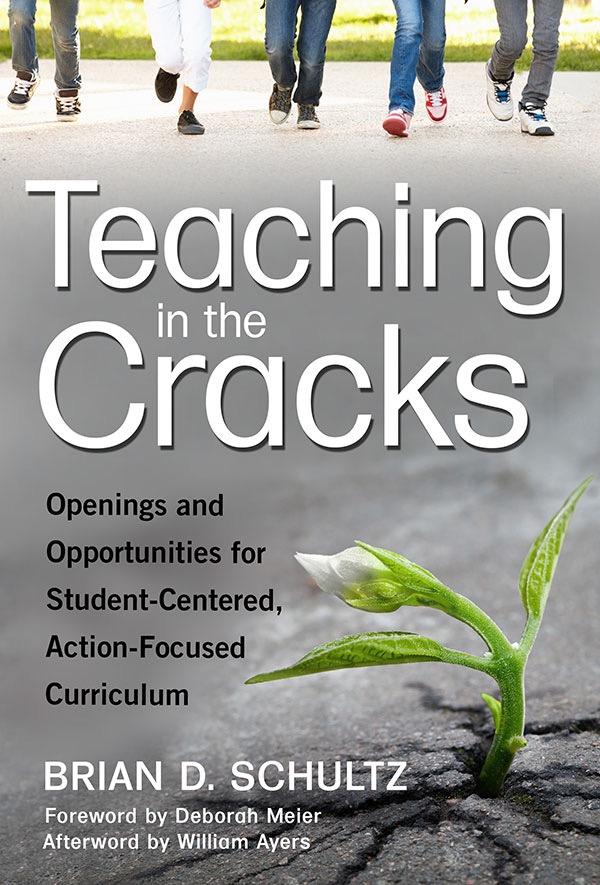
Teaching in the Cracks: Openings and Opportunities for Student-Centered, Action-Focused Curriculum Brian D. Schultz New York, NY: Teachers College Press, 2017 (xiv + 128 pages, ISBN 9780807758311, $29.95) Teaching in the Cracks by Brian D. Schultz, a professor of education at Northeastern Illinois University in Chicago, explores ways to make current K-12 classrooms more student-empowering, justice-oriented, and action-based. It is not that already available curricula are not student-empowering, have no concern for justice, or seldom inspire creative student actions; What most concerns the author are school systems that dictate almost everything that students experience, think, and do. In such a system, says Schultz, learning is largely top-down, authoritarian, controlled by agendas that perpetuate the status quo, and “bombarded by standards, assessments, [and] evaluations” (86). Shultz’s critiques and enthusiasm focus on reforming this “troubling” system and more specifically on transforming current everyday curricula in classrooms (86). His proposal, however, stays at the level of reforming or transforming, rather than completely negating or overhauling our current educational practices. That is why he calls his suggestive methodology and transformative tactics “teaching in the cracks.” He encourages educators to find creative loopholes in the present system where they can make education more democratic, collaborative, and thus bottom-up. Schultz acknowledges that his proposal sounds great on paper but is hard to implement in the classroom, and so throughout he offers numerous practical examples of proposed curricula and how they are working around the nation. Examples vary, covering everything from a single classroom, the entire school’s curriculum, forming close partnerships with surrounding communities, and specific topics, to teacher preparation (all covered in chapters two to six). Together they make this book an invaluable reference for field educators. In particular, chapter six, “Becoming the Teacher I Want to Be: Finding Support to Teach in the Cracks,” and chapter seven: “Turning the Corner: Techniques, Resources, and Tools for Taking-Action,” should be helpful for those who would like to implement the proposed learner-centered class education in a seemingly impotent school context. In chapter six, Schultz gives two fine examples of veteran teachers who introduced several effective strategies that are applicable to other contexts as well. To be sure, contexts differ. Yet, as long as a similar school structure is involved (for example, executive administrators, a sizable student body and its own governing entity, supportive community groups, and an aspiring teacher), these strategies would be beneficial anywhere. Websites introduced in chapter seven are extremely useful resources too. This book is not per se a theoretical book on student-centered, action-focused curriculum. Rather, it is full of vivid examples of actual current practices. Some readers may find this book insufficiently radical to make a dramatic change in the existing school system, but that is not the author’s purpose. Its particular strength lies in its unabashed focus on the classroom itself. The author believes that the real change can and must happen in each individual classroom where the teacher and students meet for daily education, before any large-scale systematic change is possible. In this respect, this book provides a small, yet reliable, hope for most field educators who, like me, aspire to create a more learner-led class environment.

This book is about preparing for a future already dawning on North American college campuses, a future belonging to “New Majority” (NM) students. Ross describes NM students as Latino/a, African-American, Southeast Asian, Pacific Islander, first generation, and low income. Evidence of NM students is statistically demonstrable, as with the 50% rise of Pell Grant applicants between 2002-13. Demographic surges suggest a “majority-minority” U.S. by 2050. These students often have an educational disadvantage, met in some places with "bridge programs" or other efforts to bolster their success. But is more needed? Are faculty aware and equipped enough to serve NM students, or will faculty continue to be befuddled when students do not speak up in class or react to assignments and grades in unexpected ways? This book addresses these issues by introducing professors to NM students so that they can better understand the cultural cues and expectations these students bring. Part I, "Strategies for Engagement," assesses ways of keeping students engaged, but with special attention to issues NM students face. Chapters begin with classroom vignettes that set up the problem the chapter addresses. Students may disengage because of “stereotype threat,” a socio-psychological phenomenon described in chapter four. Professors best confront this stereotype by bolstering self-confidence while pushing students to engage subject matter more deeply. Students are reluctant to ask questions in class not because they are uninterested, but because they fear sounding ignorant or come with cultural traditions of deference that discourage public questioning. This mismatch of expectations between teacher and students can be confronted through strategies presented in chapter five. Taken for granted as a privileged space with its own practices, the college classroom is strange new territory for NM students. Six chapters in parts II and III introduce strategies that build inclusion and confidence. For instance, NM students benefit from classroom cultures built around interdependence and teamwork rather than individual achievement, which can be perceived as selfish and disloyal in some minority communities. Journaling is another strategy that invites NM students to deeper reflection on a subject and builds connection with the instructor. It helps to overcome the assumption that learning is simply mastery of information delivered through lectures, as opposed to personal discovery and evaluation. Journaling is an important ingredient in the wider purpose of creating leaders for minority communities who produce personal observations, share insights, and opinions with confidence, contributions which are valuable not only for minority communities but also for the wider society in which they will participate. NM students will graduate and enter a workforce where they will continue to face debilitating stereotypes (the final chapter’s opening vignette is about Gabriela, a Latina architecture student who faced negative stereotyping on her first day). College classrooms should be spaces of empowerment for these students so they can begin building a professional identity during their educational experience. Professors can facilitate this with frank discussions of stereotypes NM students will face, by sharing stories of role models, and by cultivating good practices in communication and self-presentation. This book will sensitize faculty to the needs of this growing part of the student body. However, much of the information is applicable to students from all backgrounds, and will improve college teaching for all involved.

In my last blog, I reflected on my regret about the way that my classroom had become politicized in an election season in ways that I came to regret. Unexpectedly, I find myself once again politicizing my classroom; towards different ends this time. This time my act of radicalization is not so much about policy differences as about precluding a future which I would wish for none of my fellow citizens, much less my students. As I awake each morning, nowadays, I do so with the lurking fear that if we, as a nation, are not careful the morning sun may arise on an America which my grandparents knew. Theirs was a world of authoritarian regimes and dictatorships here in the United States, not in far off lands. Jim Crow was quite simply a dictatorship; one based, albeit on race, but an authoritarian regime nonetheless. This personal history of my folks, along with the programs of genocide carried out against Native Americans, and the relocation of Japanese Americans to places just shades shy of concentration camps leaves me little illusion that it could not happen here. The it being the rise of an authoritarian regime which uses genocide and ethnic cleansing as a means to gain and maintain power. I am not at all convinced that we are not in such a moment. Nor, am I naïve enough to believe that large numbers of our fellow citizens would not welcome such a development believing foolishly that only they would be its beneficiaries. So, for me, the question each day is how do I, as a teacher, work to preclude this future in favor of one in which we all have a place? I forget. Having learned that to simply make a political argument runs the risk of creating a fissure in my classroom which precludes the imagining of a common future, I now do simple things to resist what I know to be the ways of authoritarianism. Writ large in this resistance is my willful forgetting of my student’s names. A forgetfulness which requires that each class session I must ask them to reintroduce themselves, where they are from, and in some form give voice to their hope and aspiration for our future. This is done in differing ways but the shape and intent remain stable. While I realize that I run the risk of seeming doddering and not attentive enough I am willing to accept these assessments. My willingness comes from my understanding of how authoritarian regimes co-opt people into ways of being which they would normally find unrecognizable. The most common way is to constrict the public square in such a way that people can only enter and leave it at the cost of the personal identity of themselves and others. Public identity is then mediated wholly on the terms of the regime. A thumbnail way to think of this is that individual selves are subsumed into a super-self that then robs them of their identity as individual persons, and most importantly as moral agents. It is this collapse of the public square that I seek to counter through the continual invitation for students to re-inscribe themselves in and on the public square which is our classroom. By the time we have “re-introduced” ourselves the room is so full of stories and our hopes there is little room for a super-self to emerge. In this, I attempt to cultivate the habits of being and mind for my students which intuitively resist invitations to lose themselves for the sake of a grand future for some of us at the expense of others of us. A future which has no place for my neighbor is a future not worth having and one which demands acts of faithful resistance, no matter how small.
Nancy Lynne Westfield Associate Professor of Religious Education Drew Theological School God is unknowable. So, the things of God cannot be learned – they must be revealed. What does it mean to teach our students to wait for the revelation, to be aware of the revelation, to find joy in
Nancy Lynne Westfield Associate Professor of Religious Education Drew Theological School Phil Salter, a current student and muse of this Blog, in describing himself as a seminarian, said, “I am learning on the fly.” Intrigued by this notion, I have been thinkalating … Habakkuk has come to mind…. Recorded in..
Nancy Lynne Westfield Associate Professor of Religious Education Drew Theological School When you are a teenager, at least in the 70’s, the house with abundant food and a loving mother was the place to gather. Our house had both. Unlike all the other mothers in the neighborhood, Nancy Bullock Westfield
Nancy Lynne Westfield Associate Professor of Religious Education Drew Theological School The gaze. eager sparkle – happy batting of lashes – signaling “…go!”; cautious, diverted looks – at the floor or just “away”— ….no!-- down caste/mostly shut eyes, maybe even the downright defiant stare – fixed & cocked….Occasionally the gawk.