Resources

Growing up, one of my all-time favorite TV cartoons was Quickdraw McGraw and his faithful companion, Babalooi (does that date me?). Do you remember it? Quickdraw was the noble but naive, quick-on-the-trigger sheriff who fought off wicked desperados who inevitably found their way into his small, quiet prairie town. Sheriff Quickdraw’s first attempt at stopping a criminal type was to cry out, “Cease and desist!” Of course, it never worked. What hardened criminal would desist bad behavior just because you tell them to? Which brings up the question, when learners misbehave, how do you get them to desist without disrupting the learning process? While those of us who teach graduate level courses rarely have classroom management problems as those in undergraduate and lower grades, when they do happen, they can derail the learning experience. I once had to dismiss an adjunct in a graduate course mid-semester due to her poor handling of classroom management issues, mostly due to her inexperience. Because she was not able to get her classroom under control early by providing effective interventions (desists), things just got worse, to the point that the situation became unsalvageable. Fortunately, there are effective ways for a teacher to say “Cease and desist” to stop off-task behavior and get learning back on track. A teacher who knows how to stop class disruption before it spreads not only stops the deviancy, but at the same time has a positive effect on other learners in the class. A desist is an action the teacher makes to stop off-task learner behavior. The trick of course, is to use desists which not only stop unwanted behavior but will not also distract the other learners in the class. For example, if a teacher uses angry, punitive desists, then the acting out learner may stop his or her misconduct, but the ripple effect on the other learners will cause an increase in emotional anxiety which disrupts learning, and possibly causes additional unwanted disruptive behavior. An effective teacher gives attention to the quality of desist, those characteristics of teacher behavior used to stop disruptive learner conduct. Quality of desist has three indicators: Clarity, Roughness, Task-Force, and Approval-Focus. Clarity of Desist. Clarity refers to behavior on your part that specifies who the acting-out learner is, what he or she is doing wrong, and why this is improper behavior or what the proper behavior is. Roughness of Desist. Roughness refers to the way an attempt to stop misbehavior expresses impatience and anger, or ways the teacher's facial or bodily behavior expresses anger. Task-Force Desist. The task-force desist refers to ways you direct learners to the task at hand as the desist is given. Major Deviance Desist. In this teacher behavior, the teacher selects the major disruption when two or more deviancies occur simultaneously. The rule is to focus on the major disruption and ignore the lesser. Correct Target Desist. In this behavior, the teacher desists the learner who caused the disruption, not a bystander. Approval-Focus Desist. In this student-affirming teacher action, you make a statement that implies your warmth toward and feeling for the learners. This type of desist loses its effectiveness after about the third grade. Research in classroom management indicates that: Soft reprimands are more effective in controlling disruptive behavior than loud reprimands, and that when soft reprimands are used, fewer are needed Learners who witnessed a punitive or angry desist responded with more behavior disruption than when they observed a desist without roughness Task-focused desists resulted in more favorable ripple effect on the conduct of learners than the approval-focus desists When a simple reprimand was observed, learners felt the teacher was fairest and able to maintain control. Learning effective desist techniques is one of the most valuable skills a teacher can master. A teacher who can minimize time spend on classroom and behavior management will increase the time he or she has for actual teaching and instruction. One study found that teachers trained in specific management behaviors, including the use of positive questioning techniques and soft reprimands/desists, decreased the amount of non-instructional time by 20 minutes per day! SOURCES: Becker, W.C. et al. Production and elimination of disruptive classroom behavior by systematically varying teachers’ behavior. Journal of Applied Behavior Analysis (1968) 1:35-45. Borg, W.R. et al. Teacher classroom management skills and pupil behavior. Journal of Experimental Education (1975) 44:52-58. Emmer, E.T., et al. Effective Classroom Management at the Beginning of the School Year. Elementary School Journal (1980) 80: 219-231. Kounin, J.S. Discipline and Group Management in Classrooms. New York: Holt, Rinehart and Winston (1970).
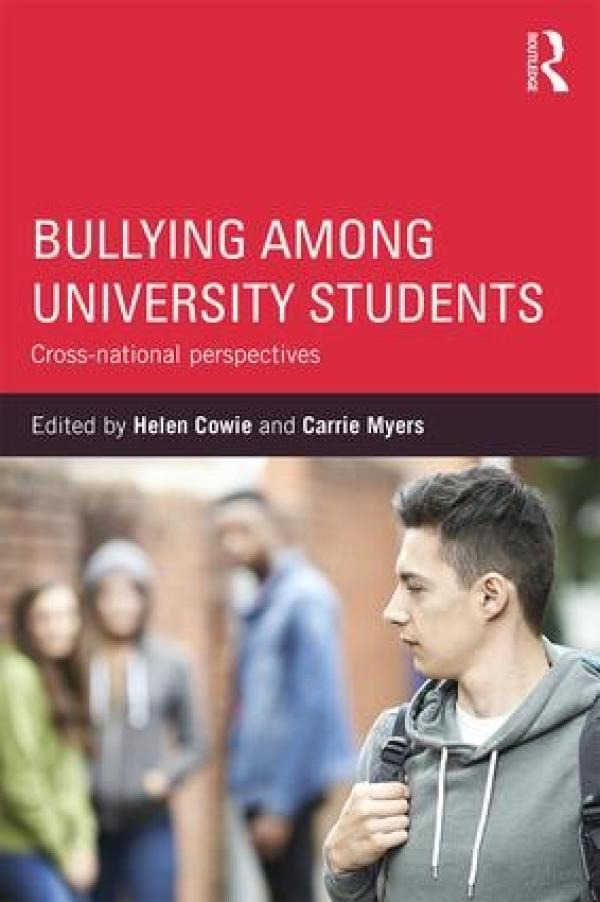
Helen Cowrie and Carrie-Anne Myers’ Bullying Among University Students studies bullying in universities worldwide, with contributors from educational psychology, criminology, counseling, media, and other disciplines. One insight of the volume is that we tend to address bullying as a relationship between the bully and the victim without addressing bullying’s social and institutional contexts. The introduction reminds us that university students occupy an ambiguous position, neither protected children nor employees. In the university, therefore, bullied students feel lost, reporting “that they do not know of any policies, systems, or avenues to help them” (3). The essays begin with the student experience, move to the nature of bullying, look at social context, suggest interventions and policies, and end with reflections, suggesting that universities might address bullying by coordinating communications between the students, staff, administrators, and student services and by using research on workplace bullying as a resource. The corporatization of higher education, valuing individualism and competition, may unconsciously generate a context for bullying, meaning that systems must be put in place to address bullying, including strong counseling. The writers align bullying with what they call “laddish” behavior – indeed, boys bully more frequently than girls – which Toni Pearce defines as a “‘pack’ mentality evident in activities, such as sport and heavy alcohol consumption and ‘banter,’ which were often sexist, misogynist and homophobic” (17-18). It includes sexualizing behavior toward women and intolerance of gay and transgender students and racial ethnic students, all vulnerable, which leads to harassment and violence. The essays examine multiple forms of bullying, including stalking and cyber-aggression, which occurs as “invisible” bullying (113). Drawing lines in these cases is a key, but difficult, act: when, for example, is online activity conversation, teasing, or bullying? One finding is that bullies tend to bully throughout their lives (36). Osman Tolga Aricak’s essay explores genetic and environmental causes of bullying and the impact on the bullies themselves. Aggression is an outward sign of complex issues like poor self- and impulse-control and narcissism. The bully and the victim can experience ongoing mental health disorders, including anxiety, depression, and isolation. “The Research Student Experience” chapter is informative for those of us supervising graduate students, unveiling the sometimes unconscious bullying in the power-laden supervisor-student relationship. Graduate students also occupy an ambiguous position, being students and teachers or workers, making them vulnerable. Graduate supervisors must be mindful of power, avoiding actions like giving excessive or unauthorized work to teaching assistants and using their research as the supervisor’s own. This collection offers immense insight into an understudied subject. One article on “Cross-Cultural Comparisons” reminds American universities that we have “some of the highest rates [of bullying] among the developed world” (135). Our cultural and economic diversity, insistence on free speech, and desensitizing media violence confuse notions regarding appropriate behaviors (135). Since there is not clear data on what works against bullying, a system-wide response is necessary.
At some point in one’s teaching career, perhaps every teacher is confronted by disruptive behavior from a student that interferes with the processes of teaching and learning. Many faculty are challenged daily by common disruptive behaviors ranging from using social media during class to acts of physical and psychological aggression. On occasion, faculty find themselves afraid of a student, yet rarely do teachers receive training for these situations. Many assume a “do-it-yourself” mentality, believing it to be one’s sole responsibility to handle what happens within the classroom. At most, faculty may discuss it with departmental colleagues, but often fail to report disruptive student behaviors to appropriate university officials. It is precisely this approach that Brunt and Lewis discourage in A Faculty Guide to Addressing Disruptive and Dangerous Behavior. They encourage faculty at community colleges, technical schools, and four-year colleges and universities to expand their categories of what constitutes disruptive and potentially dangerous student behavior, to manage such behavior with both sensitivity and firmness, and to learn when and how to make use of institutional resources for dealing with student conduct problems. The book is immensely practical, drawing upon the authors’ expertise as a university counseling center director and a higher education risk management professional. The issues and techniques discussed in each chapter are illuminated by case studies contributed by faculty and administrators from a wide array of institutions. Each chapter also includes discussion questions that could guide important faculty dialogue around these issues. In part one, Brunt and Lewis operationalize dangerous and disruptive behaviors, teaching faculty how to identify signs of potentially dangerous behaviors and to conduct threat assessments. The authors challenge professors’ tendencies to dismiss, ignore, or take an overly punitive approach to disruptive behavior. Yet they also recognize that contextual factors shape whether a situation is viewed as a crisis and what strategies will be effective. They introduce terms and university resources that ought to be familiar to all faculty, but probably are not. How many teachers know whether their institution has a Behavioral Intervention Team, Risk Assessment Team, Student Conduct Office, or equivalent? More importantly, do faculty know when and how to contact them? Part two focuses on student populations who present a particular challenge. This is the least informative section of the book, as the material on each population is sparse, usually two pages or less. Further, the authors’ approach is confusing. In some cases they identify nontraditional student populations with physical and mental health problems, generational characteristics, or life circumstances that may impede their academic progress and thus predispose them to acting out in frustration: military veterans, international students, millennial and older students, and distance learning students. In other cases, however, they problematize groups whom they describe as likely to be victims of discrimination: African Americans and GLBTQ students. For example, their explanation of the micro-aggressions that African Americans may experience on campuses is commendable, but they regrettably frame the problem as being occasioned by the presence of African American students rather than by the cultural myopia of White students. In part three, Brunt and Lewis advise faculty not to “reinvent the wheel” but rather to take advantage of campus resources for assisting students. They begin with a helpful description of FERPA, HIPAA, and Title IX regulations, clearly outlining the limits of and exemptions to privacy laws that faculty often perceive as obstacles to discussing student issues with colleagues. They then discuss the various resources available to faculty and how to make use of them. In part four, they review ten “core concepts,” that is, characteristics and skills that will assist faculty in managing their classrooms, reducing the likelihood of dangerous and disruptive behavior, and handling it effectively when it occurs. I highly recommend this book for postsecondary faculty. This is a book that needs to be read, but also needs to be discussed with colleagues. Many faculty will find similarities between the scenarios described in the case studies and issues confronted in their teaching experience. As a licensed psychologist, I have usually felt confident in my capacity to address most student issues, but reading this text helped me to recognize occasions when I may have missed clear student distress signals. It has prompted me to investigate the resources available on my own campus.