Resources

The debate about whether or not to engage in online education is over. However, the journey to doing online education well is just beginning. This video points our the reasons we should be embracing online education. It also gives a few pointers about one of the most popular forms of professor presentation, the screencast. Watch the screencast at this link.

Anyone who has been teaching for a while knows that stress is normal for our vocation. When stress is prolonged over a long period of time, we experience exhaustion. Online instruction can compound the effects of mental, emotional, and even physical exhaustion because of course design that extends the time for planning, preparing, and implementing a course. Managing Your Online Instruction I don’t feel like an expert on self-care, but I have learned some healthy habits to keep teaching online not only manageable, but rewarding. Here is what I have learned so far. 1. Plan ahead and give yourself ample time for course design in online instruction. The largest and most long-term online project I have tackled is, by far, reinvigorating my institution’s distant learners Greek language program. From designing and creating a two-course sequence to implementing and teaching it online, it was a project that lasted a full year. When I started, I had already taught beginning Greek in a traditional F2F on-campus classroom setting for over 10 years. Converting my existing F2F class into a new asynchronous course on the Canvas learning management system (LMS) was a challenge. I had a head start since I had already laid out the course content in my traditional F2F class. This spared me the extra stress and work of trying to plan the course from scratch. Instead, I focused on understanding best online instruction pedagogical practices and implementing new technology. I had to create and produce over 80+ instructional videos, learn how to use the video-conferencing technology for Greek tutoring, and design assignments that made use of Canvas’ full features which included online quizzes. The course design took the entire summer. 3 intense months. It would have taken longer if I had not the experience and past resources of having taught the class beforehand. Whatever you do, plan ahead. You need at least a month to plan out a course and another three to create it on your institution’s LMS. If you don’t give yourself ample time for course design, you will exhaust yourself from creating the course and not have much reserve to teach it. 2. Set aside a no-work day for yourself while implementing the course. Pick one day a week and let students know that on that day, you will be offline not answering any correspondence. We all need a Sabbath space in our weekly schedule to pull away from our work and rest. I have found Saturdays to be the best day off. It affords me time to spend with family and friends. Sundays never worked for me. They tend be days when students scramble to finish their assignments online prior to deadlines on Monday. Know what days work and don’t work for your schedule. Pick a Sabbath day and make it sacred. If you let students know ahead of time, they will honor your day off and expect a response to their queries later. 3. Recharge your motivation for teaching. What makes online instruction a rewarding experience for you? Some of my colleagues enjoy the research and reading that comes with preparing a class. Others, like myself, need a personal connection with students to stay motivated. Whatever the source of inspiration, turn back to it periodically to recharge your enthusiasm for the course. Take the opportunities to stay inspired as they arise. When I was attending an annual denominational event during the Winter break, I learned that a number of my online students would be attending the conference. We met at a local Starbucks simply to connect. We talked about all things Greek and New Testament. But I also learned about their stories and ministries. I heard what they loved about the course and why they wanted to learn the biblical languages. What they shared that day renewed my desire and motivation to teach. Mental exhaustion gave way to rekindled inspiration. I was ready to tackle the rest of semester. 4. Practice the spiritual disciplines faithfully. Here I’m writing to theological educators. We all have our favorite spiritual disciplines: a daily devotional, times of prayer, morning or mid-day offices, or walks for reflection and meditation. I have found walks an important way to reflect on my vocation and pray for students. Whatever your spiritual tradition, observe it faithfully and experience the grace to persevere through even the toughest of semesters.

I have just experienced a new first in my teaching career: This week I had to re-design a course for a face-to-face format from an online format. I recently switched jobs. After teaching for half a dozen years in a school that exists primarily online, I am now back in a residential context, working for a school that exists primarily on a brick-and-mortar campus. I have been invited to teach a course next year, and I thought it would be a simple matter to adapt one I had offered at my previous institution. So, without hesitation, I accepted the invitation. Then, the Registrar asked me if I could teach in the school’s evening program—one class session per week for 2’45”. Two hours and forty-five minutes?! I realized with a gasp that I no longer knew what I would do with such a sustained block of time. Lengthy lectures are a thing of my distant past. When I first started teaching online, I had to work to pare my presentations down to twenty minutes. Recently, I attended a workshop where I learned that the average student attention span--before the mind starts wandering--is something like nine minutes. “Limit your presentations to twelve minutes, max,” the leader admonished us, “and even then, make them funny or catchy in some way.” Discussion, of course, can use up a lot of minutes. But there, too, I have become accustomed to disciplined time management. I developed the habit of checking in to my online course discussions daily, spending only about thirty minutes monitoring and guiding each thread; an hour, max. Online courses have so many elements to attend to that online instructors learn not to get sucked too deeply into every discussion. I forced myself to recall what I used to do in the old days of classroom teaching because I had a vague memory of class sessions flying by with never enough time before students were stuffing their books into backpacks and dashing out the door. Oh, right: Debates. Case study exercises. Role plays. Problem-solving. Guest speakers. In-class writing. All of which, I realized, I had at one point modified for the online environment. Versions of these learning activities still populated my syllabi; it was just that they happened in smaller chunks, spread throughout a week rather than concentrated in an evening. In addition to how differently time gets used in online vs. face-to-face teaching, my conversation with the Registrar also brought to mind the difference between virtual and live presence. I realized that I would once again have to muster up the energy to regularly face a room full of live bodies. Would I have to stand on my feet in front of them the whole time? Would they sit there and stare at me? I recalled the adrenaline rush that always made my palms a little sweaty before walking into class and the dissipation that left me feeling drained for several hours afterward. For six years my body had been spared all that. You don’t get particularly nervous sitting in your familiar, quiet office reading discussion posts, watching videos, and answering emails. And if for some reason you do, you can always take a break and leave for a walk or a snack or even some errands, with no one becoming the wiser. Speaking of quiet, I started recalling how noisy classrooms could sometimes become. Or, worse yet, pin-drop silent. I sighed, remembering the dual agonies of having to cajole speech out of taciturn participants and having to serve as traffic cop during swift-moving exchanges where everyone talked at once. Like all students, online students naturally vary in terms of their participation levels, but the format makes it possible to require that all of them contribute at least the same minimum to every activity. As another blogger in this series put it, “Discussion dynamics online become more democratic when each student is equally invited and expected to contribute to conversation” (Miriam Y. Perkins, “How Teaching Online Enhances Residential Pedagogies: The Big Picture,” Online Teaching, Online Learning, February 12, 2019). I am confident that come next year when I am teaching again in a traditional classroom, I will re-adapt, and eventually relish the immediacy and liveliness and spontaneity it affords. But I am also reasonably confident that I will miss the steady, measured egalitarianism of my former online world, and the kind of teaching it made possible.
As an online instructor who understands the rigors of course design and management, I often wonder if it would be easier to livestream a class through video conferencing, rather than prepare an asynchronous course module by module. In a Hamlet-esque way, I ask: “whether ‘tis nobler in the mind to suffer the outrage of course design, or to storm through a sea of troubles by streaming?” In this post, I talk about the perils and advantages of video conferencing a class each week. First, the challenges and in conclusion, the draw. One, I’m terrible at multi-tasking and with video conferencing, the instructor has to teach the course content and manage the live stream. On my debut day of teaching a live-streamed course for 25 seminarians, several could not log in . Some had audio, but no video. Others had video, but no audio. I spent the first 30 minutes of class trying to get everyone functional. I called IT for help. It was rough. My recommendation is to meet with students a week before class starts to work out technical problems. Help students log in correctly and explain the essentials of video conferencing, such as how to mute the microphone or share their video screen. Make it fun! Prepare ice-breaker questions, ask students to take turns muting and unmuting their microphones, hear everyone’s stories, and share family photos from your desktop. Getting the kinks out of video conferencing in a pre-class session is far less stressful than managing tech hiccups on the first day. Two, how do you manage discussion among 25 people or more in a live-stream setting? If your video conferencing platform does not have a ‘breakout’ feature, then establishing an etiquette for dialogue is crucial. Everyone should have a headset-with-microphone set up to prevent hearing each other’s feedback when speaking. The more people in a session, the more likely one will hear static feedback and background noise. Ask students to keep their microphone on mute and only when someone is speaking should one enable the mic. If your video conferencing session has a ‘breakout’ feature, use it! When I was teaching at another institution last fall, the school paid for the full features of Zoom, a popular business conferencing platform. Zoom had a nifty feature: with a click of a button, it would divide the class into small groups. Zoom sent the students out of the main session and into their own private video-conferences. The instructor can set the number of groups and for how long they meet. When their breakout session ends, students are sent back into the main class. Then I had each group share briefly what they discussed and we continued our time together. Finally, with above two challenges alone, even the casual observer can understand that livestreaming a class is hard work. There is no flexibility in the delivery of the course content. Most of the course is delivered during the three hours the class meets each week. If the technology fails, that day’s session is lost. So are there any advantages? A few. With streaming, less work is done on course design. Some instructors might prefer to spend most of their time teaching the class during the term than designing the course module by module before the term begins. Most important, I do think that video conferencing provides a more immediate relational connection between the instructor and students. It helps me to see the students, talk with them face-to-face, interact with them each week, and watch them enjoy what they learn. I experience the same with an asynchronous class, but the process is slower. To stream or not to stream? I’m still deciding which is better. For now, it might be a tie.

Anyone who has developed an online course knows how important the design of the course is. Poorly designed courses make the course navigation difficult, causing unnecessary frustration and limiting the ability of students to achieve learning outcomes. The author of this book understands these difficulties. Drawing upon her own negative experiences with initial online offerings, she provides readers with important lessons on designing effective online experiences for both teachers and students. Davis suggests, rightly, that the reader should use the text like a workbook, drawing from the ideas presented in the text as the reader creates her/his own course in the platform the reader uses. She encourages readers to draw upon the backward course design model: begin with learning objectives, discern appropriate ways to assess those objectives, and then generate online learning activities that will enable success in the course. Such alignment will promote student success. The author provides an acronym, L.I.T.E., for the design framework she encourages. Readers should be sure to create clickable links to external content (L), integrate well the multimedia included (I), use typography and white space to enhance the legibility of the course (T), and embed the content at the point of need (E). She identifies four types of content pages that should be part of the design: landing page, navigation page, instructional page, and assignment submission page. Of course, most learning platforms will provide these. The key, she contends, is to create them in a way that achieves the course objectives and is user-friendly for the student. The remainder of the chapters illustrate how readers can develop the various components of a good online course, including images and videos, integrating multimedia, facilitating instruction and interaction, and the all-important assessment. Davis provides helpful hints regarding the tools included in software such as PowerPoint, like using it to download and edit images or to incorporate online media. She also points to a number of free online tools one can use to develop a course, such as the presentation tool Brainshark, and the interaction tool VoiceThread. At the same time, she cautions users not to incorporate too many technologies into the course. The focus should be on learning the content of the course, not on overwhelming students with too many technologies. As with any text, there are some limitations. Parts of the book require knowledge of html language. Many faculty do not know html language because they use software to develop their courses that does this automatically. In addition, for a book that emphasizes visual design, many of the illustrations are difficult to read, leaving the reader to wonder how well the text follows its own advice on legibility. Yet over all, the text is a useful step-by-step guide for developing an online course or for improving the visual design of existing courses.
Some higher education faculty might still be ambivalent about the long term impact on educational culture by the technological takeover, especially that this shift has taken place in a relatively short period of time. Few though would doubt the fact that we are in the midst of an innovative, technology driven, instructional change. Teaching Online’s main goal is to help us navigate this change. Based on ample research, the book argues that the change has reached a tipping point and is expanding. This is hardly surprising news. Taking some courses online during their program has become a common expectation of the current generation of students at seminaries and graduate schools of theology, not to mention the large increase in distance learning programs and enrollment. In addition to offering a comprehensive guide to the theory and practice of online teaching, Teaching Online also includes substantial chapters on developments in the theories and philosophy of education. This, in addition to situating teaching online within a long trajectory of change to instructional culture are among the key contributions of the book. Faculty views on learning change when they teach online, argues the chapter on “Views of Learning.” Higher education systems are facing new and significant challenges. “For hundreds of years, educators labored under the assumption that learning happened by way of an individual’s consumption of information and ideas.” Many philosophers of education, long before the time of online learning, starting with Paulo Freire in the 1960s, have challenged this view. However, the recent and widespread experience in online learning, which has now become mainstream, has clearly moved education beyond the traditional static concept. The difference is that this time the move to learner-centered educational systems is caused by technology. Online learning is offering the possibility of constructing ecosystems “in which each person is spreading his or her understanding among the pieces of information available in that ecosystem.” Students are becoming active agents in what one contributor to the book calls a “rhizomatic” learning process that has no fixed beginning or end, and is rather an ongoing experimentation and transformation (65-67). This is a great metaphor for theological education! Equally challenged by the spread of online learning are not only traditional philosophy and pedagogies, but also academic institutions themselves that might be losing control of the learning process (257). Teaching Online helps teachers tackle these changes and challenges. Furthermore, the chapters of Teaching Online offer valuable practical help in several key areas such as course structure and planning, the teacher’s persona in the online course, communication, student engagement and community of learning, and much more. One minor annoyance in the book is the format of the chapters. Most chapters include five or six page-long testimonies of professors sharing their experience on the topic of the chapter. While these are somewhat interesting and add information and liveliness to the book, because of the way they are inserted, they can be distracting and interrupt the flow of the chapter. One feels lost at times in trying to follow the flow of the chapter; perhaps the book is trying to implement the rhizomatic approach mentioned above! I was attracted to this book mainly because I am preparing to teach a totally online course for the first time, in the next academic year. I am glad I read it, and I strongly recommend it.
Ralf St. Clair’s instructive book on designing courses will provide helpful guidance to new professors and a meaningful review to those seasoned in the classroom, along with some potentially new material for those veterans. Divided into ten well-defined chapters, Creating Courses for Adults walks readers through the learning theory associated with the adult student population, as well as the practical logistics of designing different kinds of courses for different adult populations. The array of courses discussed range from online for credit instruction to non-credit onsite education for trade school students. Taking seriously the role and the needs of the professor and not just the students, St. Clair begins with a welcomed and affirming chapter, “All About You,” which includes a very helpful section entitled, “Why Who You Are and What You’ve Done Matters.” While this book accepts that teaching is about the students, the author accepts the often unappreciated fact that teaching is also about the needs of the professors, who feel a sense of vocation to this work. St. Clair operates out of the helpful notion that “nobody is an intuitive or completely natural teacher” (page xii), a claim that will challenge seasoned instructors to continue to plan and will encourage new professors with their often unarticulated sense of intimidation. Several chapters are especially rich in what they provide the planning process. Chapter three, “Context Drives Design,” makes distinctions among formal learning, non-formal learning, and informal learning. Adult learners may bring previous experience in formal learning to the classroom, since formal learning is education that leads to a diploma or certificate. They will certainly bring experience in non-formal learning, such as that experienced in an open-ended group, and informal learning, which refers to learning achieved through everyday activities. In fact, the latter two learning experiences can so shape the approach to education of adult learners that it becomes difficult for them to embrace a world of formal learning, even if it is adult-education friendly. For this reason, teachers must give some thought in course design to preparing students for the particular educational context that the course provides. St. Clair also offers helpful approaches to online learning. In addition to a useful bibliography of online course design material, St. Clair proposes that design issues in online education do not fundamentally differ from onsite education. Citing current literature that explains online course design, St. Clair concludes that the best literature provides questions for online course design that do not substantially differ from face-to-face education. While acknowledging that his conclusion will not be universally accepted, St. Clair nonetheless provides an affirmation that online education can be informed by the same theoretical approaches that guide other forms of education. Readers wanting an accessible approach to course design, grounded in both theory and application, will find St. Clair’s Creating Courses for Adults to be valuable. The book belongs in the collection of any teaching and learning center of higher education for its content and its current bibliography.
This compact guide on building online programs has practical tips for faculty and administrators in higher education who are at various stages of online delivery. While mostly aimed at beginners, the book has ideas for institutions in the first, second, third, and fourth generations of distance learning, whether it is just one course, one department, a program or online delivery is fully integrated into the university’s strategic plan. The authors share from personal experience, surveys of faculty and students, as well as best practices from accrediting bodies to assure the reader will enter the online delivery method with eyes wide open. The book also has helpful suggestions for administrators and instructors who have experience with online education, but are trying to move their program to the next level. After a brief history of distance education and its place within higher education, the authors cite a study by the Babson Survey Research Group indicating that 6.7 million students in 2011 took an online class (a jump of 9.3 percent from 2010) and one-third of college students had taken at least one online class (compared to less than 10 percent in 2003). The authors state many reasons for offering online classes: overcoming space limitations, reaching students who were not accepted in the traditional admissions process, non-traditional students and students with disabilities—who may not otherwise come to campus because of mobility or accessibility issues. Students also choose online programs because of the flexibility to study around family, work and personal commitments. Whatever their reasons for studying online, the book emphasizes the different study skills to succeed. The authors suggest that admission offices should find a way to assess readiness to assure student success and in best practice offer an orientation, ongoing support and an ample IT staff. The authors acknowledge that teaching will be different online than in the traditional classroom and administrators may find resistance from faculty. Therefore they recommend seeking faculty volunteers to teach online. According to a 2003 study, many faculty believe that teaching online requires more time than conventional teaching and a 2012 survey revealed that two-thirds of faculty believed that the educational outcomes were inferior to face-to-face teaching. Yet the authors estimate that between 25 and 33 percent of post-secondary faculty have taught at least one course online. Faculty also perceive advantages such as greater flexibility and reaching more and a different variety of students. Of course, faculty will have to make changes to relate to online students, for example Skype office hours, being socially present, while also managing student expectations for email correspondence. Once a class is prepared it is easier to teach again and can be taught by another instructor, however universities should have a clear policy of intellectual property rights. Other benefits of online teaching are greater attention to learning outcomes, methodology and assessment. This book is not a “how to” book for instructors to develop an online class, nor is it an exhaustive manual for administrators, but it is an excellent overview and beginners guide for administrators to learn the challenges and best practices of high quality online programs.
This volume consists of fourteen chapters designed “to provide a useful handbook on adopting interactive Web 2.0 tools that promote effective human-computer interaction (HCI) in ePedagogical practice for education and training” (xv). Each essay presents data for the consideration of educators and administrators who are preparing to be or who are actively involved in virtual education. Primarily, the contributors explore using Web 2.0 tools such as Blackboard/Moodle, Facebook, Twitter, YouTube, wikis, and blogs, but there is much more. The chapters are divided into four sections. The first contains essays to help the reader think clearly about methodology as it relates to the continual evolution of online education. The second section consists of essays focusing on differences between synchronous (everyone must meet at the same time either in physical or virtual space) and asynchronous learning (done on one’s own time, such as watching recorded lectures or using message boards to communicate with other students). The third section focuses on how educators might measure student development in a virtual environment. The final section is the most technical with essays dedicated to the use of software and online systems. This book does not offer quick-and-easy steps for one to follow toward successful ePedagogy. It is dense, heavily technical at points, and it requires readers to set aside time to read attentively. An educator of theological studies will have to creatively search for ways to transfer information to their own setting since none of the essays are directly related to this field. The essays are social-scientific in nature. The testing conditions and criteria are unique to each particular essay, taking place in geopolitical regions as distinct as Australia, Canada, Indonesia, Taiwan, the United States, and Vietnam. The diversity is promising, offering encounters with a wide-array of scenarios wherein Web 2.0 tools function. On the other hand, the principles offered cannot be understood in a vacuum without reference to context. This book may be best used as an occasional reference. In other words, it is not the type of practical book one would read through in a few sessions. The most useful part of each chapter for the casual reader may be the list of works referenced at the end of each study. These short bibliographies invite further exploration. In summary, readers will find insightful academic essays that will assist them in their professional development as educators in a virtual context. The essays are based on data acquired through rigorous research. The uniqueness of each case study requires the reader to actively sift universals from particulars in order to determine what information may assist them in their own work, and the technical nature of the book will require non-experts to familiarize themselves with much of the vocabulary.
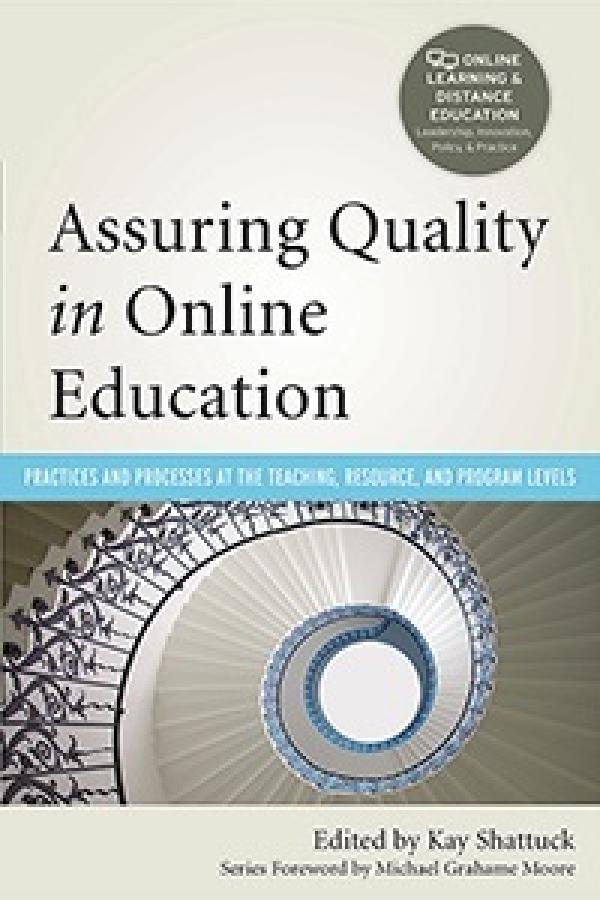
This volume engages current debates on establishing or maintaining quality online education, instructional practices, and educational innovation. The book is divided into four parts: (1) five essays on “overview and implications of practices and processes for assuring quality,” (2) six essays on “quality assurance and continuous improvement at the course design and teaching levels,” (3) six essays on “processes for assuring quality at resource and program levels,” and (4) two essays of “final thoughts.” Thirty-nine education practitioners wrote either single-authored or multi-authored essays for this collection of nineteen articles. Some of them direct online education, quality control, or program assessment. A few others serve in K-12 online learning programs. A couple of contributors hold communications or marketing appointments. Nearly all hold administrative educational leadership or are academic researchers or professors. Many of the authors work at institutions of higher learning located in Pennsylvania. Others teach at institutions located in Colorado, Illinois, Maryland, Pittsburgh, Virginia, West Virginia, Washington DC, and British Columbia. On the book’s coverage of topics, I expected to find and found, pieces about improving course design, determining effectiveness and faculty development, and reviewing culturally diverse student populations. Significant online education concerns are addressed in stand-alone essays: ethics, academic advising, learning analytics, knowledge management, contact hours in online education, and accreditation. The volume also includes a helpful essay on concerns about online accessibility (including reaching disabled persons), affordability, and accountability. Interesting contributions include “The Sloan Consortium Pillars and Quality Scorecard,” that is used to benchmark effectiveness, efficiencies, and innovation, and “The Power of a Collaborative, Collegial Approach to Improving Online Teaching and Learning.” Of notable mention is the careful attempt throughout to focus on issues related to: government – federal, state, and district levels, accrediting agencies, professional bodies, faculty, managers/administrators, controllers, assessors, and learners. Teaching Theology & Religion readers may find a number of relevant essays. The volume does not engage theological education or religious studies in the liberal arts. Still, discussions and principles raised are transposable to online religious education. Online religion studies and theology programs continue to become more popular. A 2012 study of online education in the United States shows that 70 percent of higher education institutions surveyed have recognized the critical importance of online education; 6.7 million students enrolled in at least one online course (I. Elaine Allen and Jeff Seaman, Changing Course, Babson Survey Research Group, Pearson Education, and Sloan Consortium, 2013). An August 2014 web search at www.GradSchools.com lists more than 150 accredited online religious programs: 51 doctorates, 138 masters, 22 certificates, and 7 hybrid programs. Religious community online has been empirically investigated (Heidi Campbell, Exploring Religious Community Online, Peter Lang, 2005). In time, religious educators will also study this phenomenon. Until then, religious educational administrators and leaders can contextualize insights from this volume with classical areas of program creation and evaluation in curriculum, instruction, institution, faculty, and student components, to provide innovative online educational program.