Resources
The task is impossible, yet ours to accomplish. Our students need us to shape our classrooms for a future we cannot foresee or anticipate. In the courses we design, our students need us to hone their voices, imaginations, and problem-solving abilities for a future that is unmappable yet will require their navigational skills for survival of our families, neighborhoods, and nation. The world powers are shifting before our very eyes, and we must teach to prepare our students for this change. A call for agency is not a call to act out or act up. Agency has more to do with activating the responsibilities and powers which came with faculty hire when we joined an institution with a commitment to mission. We are bound to the promise of educating – come what may.Typically, the mission of the school has to do with educating for the moment at hand, and with an eye toward the coming future. Faculty, as stewards of knowledge production, have a professional obligation to adapt, pivot, adjust so that education remains future minded – especially in a moment when the future will not look like the past. We are teaching in a moment when we do not have the luxury of thinking that adhering to established traditions will save schools or educate our people into the next fifty years. While we need those with agency to guide us into the new possibilities, the new approaches, the new sensibilities of education, too many school contexts have punished, jettisoned, or abandoned those with agency.Agency, or lack thereof, is one of the perennial themes discussed in gatherings of early career colleagues at Wabash Center. Colleagues invariably bring to the discussion their fears, misinformation, unarticulated needs, desires, and hopes. They disclose their disappointment and misgivings about institutional citizenship and the lack of ownership they feel for their own professional duties. When asked by the workshop leaders why they feel so disregarded, they say:“I assumed that my needs are just like everyone else’s. They (the administration) should know what I need without me asking.”“I don’t ask questions in meetings because I do not want to appear stupid.”“I don’t like to ask too many questions because I am new.”“I really think someone else knows the curriculum better than I do, so I leave it up to the senior scholars.”“I have decided to wait until I am – [tenured, promoted, finished with my book] – THEN I will start speaking up about the workings of the school.”“I do not want to ask for a faculty handbook because they might think I am causing trouble.”“When colleagues ask me to lunch, I say no. I don’t want the department head to think I am colluding with them.”“I say “yes” to every extra assignment. I don’t want colleagues to think I am unavailable or lazy.”“I don’t make use of the teaching center. I don’t want my colleagues to think I do not know how to teach.”“My only mentor is my dissertation advisor who retired three years ago. I do not want colleagues to think I need advice.”“I am going to pitch my idea for a new class after Dr. XXXX retires in two years.”“I do not vote in faculty meetings because I do not want colleagues to think I take sides.”“I wanted to say something, but I did not know how the colleagues would react.”These are the kinds of responses given by the fearful and the distracted. The lack of agency signals that there is a denial of authority, an abdication of responsibility, a giving away of power, a squandering of opportunity. As some of the most educated people on the planet we are asking permission to do the jobs for which we are depended upon. My fear is that now, in this crisis, we are incapable of shaping our classrooms for the unknown future — we might be, as my father would say, “a day late and a dollar short.” As educators, we are in a reckoning moment when we must take agency if our craft of teaching is to be relevant and worthwhile. Moving forward, we know that higher education will need to imagine, invigorate, and conjure up new schools as well as establish new approaches for entire systems of education. Professional timidity will sabotage these efforts. Faculty colleagues who have no agency, no forthrightness, no vision for the new, and who refuse or are unable to take authority for the job will only serve to further compromise the system and foreclose the freedom and creativity needed now and in the future. Leadership that is flexible, resilient, imaginative, and willing to convene open dialogue and struggle with challenging questions is what is needed as we press onward through the fog! Reflection QuestionsWhat are the obstacles to your own agency?How has your agency grown with the seasons of your career?What is at stake should your leadership go unvoiced?Who are your conversation partners for discussing this moment of crisis and the ways it is affecting teaching?Where are the open dialogues that address the new possibilities for the coming future?
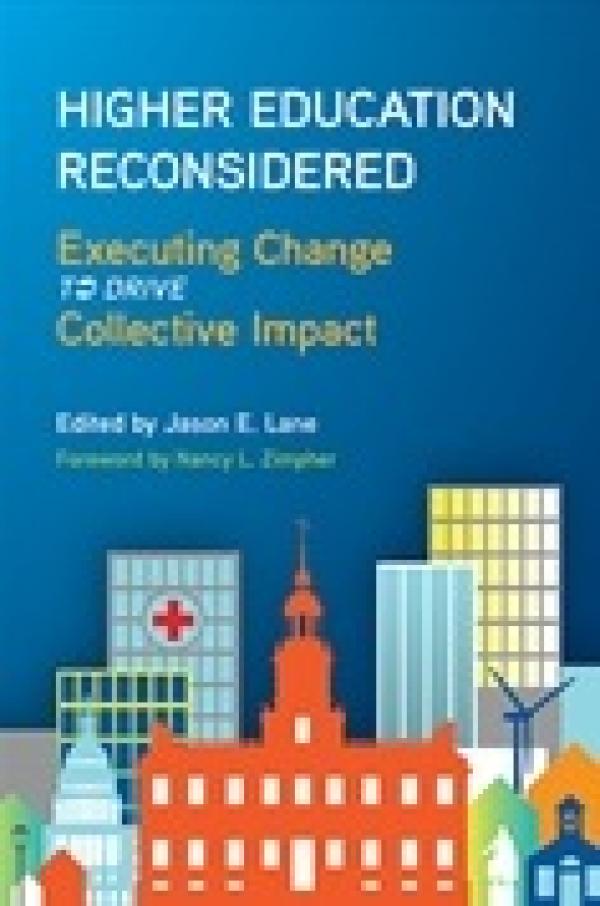
edicatopm“[I]f we can shift our way of thinking from isolated interests to collaborative goals and ultimately to collective impact, we can change the world,” writes Jason E. Lane in his introduction to Higher Education Reconsidered (6). Changing the world is an ambitious goal for a book of essays, but the authors and editor are convinced that the systemic economic and social inequality in our society can be addressed through systemic fixes to higher education attainment with practical tools that address the pathway from cradle to career (107). Read on their own, some of the essays seem to promote the idea that gathering and crunching data is a cornerstone of educational improvement. The book does not offer a direct critique of the present educational trend of data-driven assessment. However, the book may help teachers move beyond the rush to find quick fixes to education. The collective impact strategy it promotes is not easy or quick: bringing together a diverse group of leaders from various sectors to solve a common problem may be difficult and may involve finding unique strategies to address the problems at hand (12-13). The essay on change management by Scott Keller and Carolyn Aiken likewise moves beyond conventional wisdom and provides practical tips for successful organizational change (27-60). This collection of essays emerged from a conference at the State University of New York. In many ways, it reflects the context of a large public university system. At first blush, this seems rather different from the typical smaller private institutions where many religious and theological studies programs are housed. However, educators and administrators in religious and theological studies face many of the same challenges outlined in the book. They may particularly resonate with the need for systemic change to resolve issues of inequality. Religious and theological studies programs are often plagued by a lack of diversity among those who attain degrees, despite institutional goals that point in more inclusive directions. Adapting the insights of collective impact may be a helpful strategy for religious and theological education programs as they work toward identifying and promoting effective solutions to thorny educational problems in religious and theological studies. Undergraduate and graduate programs in religion and theology might work together across institutional boundaries to identify common educational strategies that contribute to student success. Faculty from various sub-disciplines of religion and theology might work together to identify ways to build students’ core knowledge. The book suffers slightly from the uneven quality and topical range of its essays, but that is nothing new for books that are the products of conferences. Readers may need to exercise some patience with examples and parlance drawn from business, healthcare, and large higher education systems. Altogether, it is a helpful book. I recommend it to educators and administrators looking for tools to lead change in religious and theological higher education.
During a recent conversation among deans they commiserated over how difficult it was to bring about changes in their schools. Despite their best efforts at communicating the need for change, cultivating support, and implementing strategies, change was happening too slow...
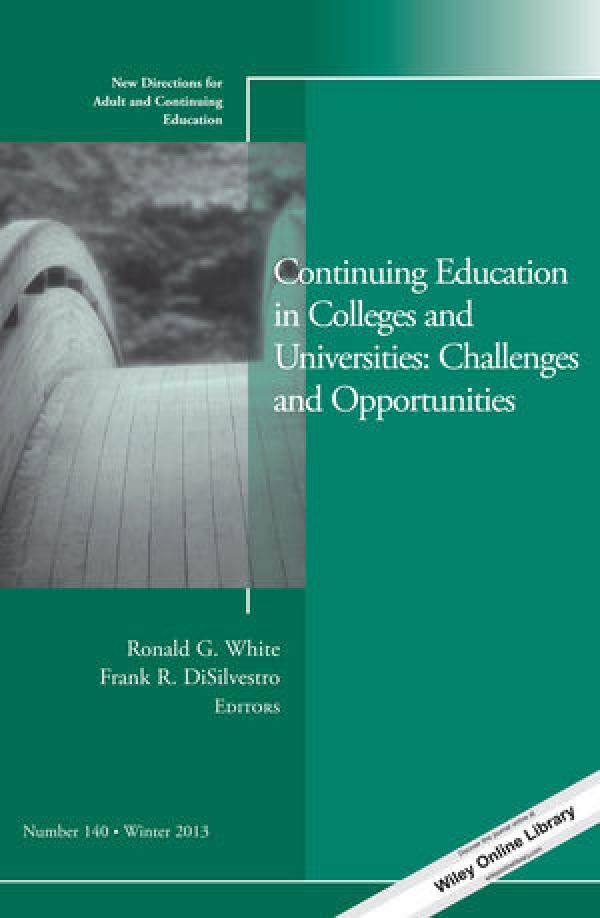
That continuing education (CE) was only recently added to many traditional programs makes it understandable that it has still to gain the respect of some departments in many colleges and universities. Certain trends – well-outlined in this book – have brought CE to the fore in the academy, and readers who have not recognized these trends will have to account for their institutions’ tardiness in catching up. Ten essays chart these developments, each exploring some facet of the CE phenomena. The essays are more practical than speculative; they orient the reader to relevant knowledge about current trends and how best to implement a state-of-the-art CE program. The economy and the technological boom are the major incentives for CE development, and the implications each has for such programs are well-covered in the essays. While disposable income has made CE attractive for the self-enrichment of a healthily aging population, retooling the present workforce to adapt to a changing economy indicates a significant need and opportunity for business and academia, respectively. Hence, CE’s profitability must be considered more closely, advantageous as it is for revenue-conscious higher education. Lisa Braverman’s essay explains why educators do well to note business practices (sometimes a loathed subject in academia), demographics, marketing, and innovation when designing CE programs. Nontraditional students will only increase in the near future, and effective marketing of CE will require innovation and nuance since marketing to nontraditional learners in the workforce differs significantly from traditional recruitment. To this end, some schools have enhanced their CE marketing departments, realizing that sophisticated use of social media and a better understanding of adult learners’ needs are more effective than the former “one size fits all” modes of recruitment based on criteria geared toward traditional students. Rebecca Nichols’s article addresses the role of the community college as a partner in economic development. Not only do these schools meet needs in retooling the workforce, but they also play a role in creating jobs. To this end, Nichols offers seven examples of innovative community college programs around the country. The essays acknowledge online education as the greatest recent innovation affecting CE. While nontraditional students continue to prefer brick-and-mortar campuses, they are opting for online education (38 percent by one survey) for its efficiency, a trend productive of increased revenue streams but one yet to gain more widespread acceptance and improvement of delivery. MOOC impact is considerable and is discussed in several of the essays. Another specific factor for CE is “Prior Learning Assessment” (PLA), or the acceptance of work and life experience (such as military service) in addition to or in lieu of “seat time” credit hours. While this practice is not new, Rebecca Klein-Collins and Judith B. Wertherin argue that it is fueled by adult learners’ need to complete a degree quickly and to attract older workers. Left unanswered are questions about the merit of “life experiences” that cannot be readily measured in any way equivalent to classroom assignments. Successful CE programs require the cooperation and understanding of their sponsoring institutions even as these programs keep in line with institutional missions. They also build lasting relationships with regional business, industry, and other entities requiring employees to keep updated certification. Such are the challenges and opportunities before CE programs everywhere.
One of the most important functions deans provide for their schools is helping to shape the culture of the school. Changing a culture is also one of the most difficult things to do. Steve Denning, author of The Leader's Guide...
Israel Galindo Baptist Theological Seminary at Richmond Theological school deans serve in the capacity of institutional change agents. By virtue of leading from the center, deans bring about change through vision, influence, and, by pushing against inertia. As a person...
Israel Galindo Baptist Theological Seminary at Richmond The relationship of the dean with faculty does not have to be adversarial, but it occasionally can be. Edwin Friedman wrote, “Living with crisis is a major part of leaders’ lives. The crises...
Israel Galindo Baptist Theological Seminary at Richmond Albert Einstein said, "Few people are capable of expressing with equanimity opinions which differ from the prejudices of their social environment. Most people are even inapable of forming such opinions." Every organization does...
Israel Galindo Baptist Theological Seminary at Richmond Bringing about organizational change isn’t rocket science, but it’s not easy either. Those deans who step into a leadership position that requires engaging in institutional and organizational development, in effect and by default,...
Israel Galindo Baptist Theological Seminary at Richmond At a recent conference on leadership I was again struck by how the level of energy (anxiety?) in the room increased when the topic focused on change. This is natural, of course, since...