Resources
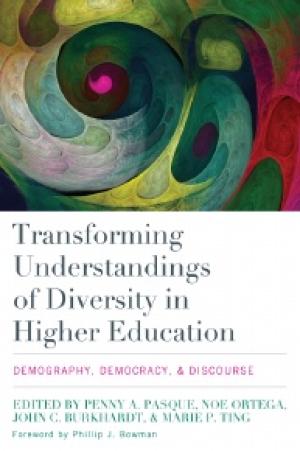
Click Here for Book Review Abstract: This exciting new text examines one of the most important and yet elusive terms in higher education and society: What do we mean when we talk in a serious way about “diversity”? A distinguished group of diversity scholars explore the latest discourse on diversity and how it is reflected in research and practice. The chapters trace how the discourse on diversity is newly shaped after many of the 20th century concepts of race, ethnicity, gender and class have lost authority. In the academic disciplines and in public discourse, perspectives about diversity have been rapidly shifting in recent years. This is especially true in the United States where demographic changes and political attitudes have prompted new observations - some which will clash with traditional frameworks. This text brings together scholars whose research has opened up new ways to understand the complexities of diversity in higher education. Because the essential topic under consideration is changing so quickly, the editors of this volume also have asked the contributors to reflect on the paths their own scholarship has taken in their careers, and to see how they would relate their current conceptualization of diversity to one or more of three identified themes (demography, democracy and discourse). Each chapter ends with a candid graduate student interview of the author that provides an engaged picture of how the authors wrestle with one of the most complicated topics shaping them (and all of us) as individuals and as scholars. Of interest to anyone who is following the debates about diversity issues on our campuses, the book also offers a wonderful introduction to graduate students entering a discipline where critically important ideas are still very much alive for discussion. (From the Publisher)
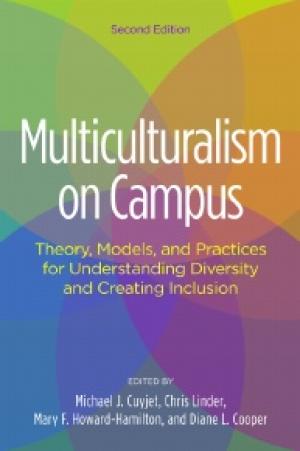
Click Here for Book Review The first edition of this book constituted a comprehensive resource for students of higher education, faculty, higher education administrators and student affairs leaders engaging with multiculturalism and diverse populations on college campuses. It was one of the first texts to gather in a single volume the related theories, assessment methods, and environmental and application issues pertinent to the study and practice of multiculturalism, while also offering approaches to enhancing multicultural programming and culturally diverse campus environments. This second edition retains the structure and vision of the first, introducing readers to the key theories and models for understanding the complexity of the students they serve, and for reflecting on their own values and motivations. It provides an array of case studies, discussion questions, examples of best practice, and recommendations about resources for use in the classroom. This edition includes a new chapter on intersectionality; updates several chapters, presents a number of new cultural frameworks and updated best practices for creating an inclusive environment for marginalized groups, and expands the third section of the book on cultural competent practice. (From the Publisher)
Click Here for Book Review Abstract:Thinking about teaching in educational terms has become increasingly difficult because of the conceptions of higher education that predominate in both policy and public debate. Framing the benefits of higher education simply as an economic good poses particular difficulties for making educational sense of teaching. Moreover, the assumptions about social mobility, usefulness, and the economic advantages of higher education, upon which these conceptions are based, can no longer be taken for granted. The chapters in this book all wrestle with understandings of education and teaching experiences in changing global, national, and institutional contexts. They explore questions of difference and privilege, the social transformation of teaching through transforming teachers, contestations of global citizenship and interculturality, learning and sensibilities of self-in-the-world, the relationship between programme content and student decision-making, divergent conceptions of learning in international education, and subject-centred approaches to embodied teaching. The book considers the value of disciplinary tools of analysis in addressing contextual challenges in developing societies, connections between pedagogies, autonomy and intercultural classrooms, and ways of countering the marketization of higher education through online teaching communities. This book was originally published as a special issue of Teaching in Higher Education. (From the Publisher)

Click Here for Book Review In Creating Citizens, professors and administrators at Auburn University’s College of Liberal Arts recount valuable, first-hand experiences teaching Community and Civic Engagement (CCE). They demonstrate that, contrary to many expectations, CCE instruction both complements the mission of liberal arts curricula and powerfully advances the fundamental mission of American land-grand institutions. The nine essays in Creating Citizens offer structures for incorporating CCE initiatives into university programs, instructional methods and techniques, and numerous case studies and examples undertaken at Auburn University but applicable at any university. Many contributors describe their own rewarding experiences with CCE and emphasize the ways outreach efforts reinvigorate their teaching or research. Creating Citizens recounts the foundation of land-grant institutions by the Morrill Act of 1862. Their mission is to instruct in agriculture, military science, and mechanics, but these goals augmented rather than replaced an education in the classics, or liberal arts. Land-grant institutions, therefore, have a special calling to provide a broad spectrum of society with an education that not only enriched the personal lives of their students, but the communities they are a part of. Creating Citizens demonstrates the important opportunities CCE instruction represents to any university but are especially close to the heart of the mission of land-grant colleges. In open societies, the role and mission of public institutions of higher learning that are supported by public subsidies are perennial subjects of interest and debate. Creating Citizens provides valuable insights of interest to educators, education administrators, students, and policy makers involved in the field of higher education. (From the Publisher)

Click Here for Book Review In Play in Creative Problem-solving for Planners and Architects, "play" is defined, explored and demonstrated as a critical catalyst in creative problem-solving processes. The book defines the current psychological research into play and creative problem-solving, explores the necessary integration of the two, and exemplifies for students and practitioners the use of play in creative endeavors; and the role that play serves in separating linear from creative problem-solving approaches. Play is explored regarding its elements (tools, skills, environment), characteristics (a free activity without failure) and attitude as it relates to and activates the creative process with the focus on urban design, planning, architecture, and landscape architecture. The book re-establishes the whole mind-body thinking process of play as a means of object-learning; to provide designers and planners with alternative ways of design-thinking; and to challenge the over-utilization of digital technologies in creative processes. Creative problem-solving requires an appreciation for ambiguity, uncertainty of outcome, complexity that leads to the discovery of novelty and innovation. The book incorporates examples and exercises in play activities related to the design and planning fields, and exercises related to play-tools and skills for students and professionals. It also defines terms used in play and creativity psychology; provides examples and structure for play and creative problem-solving activities; describes the type and use of appropriate play-tools; contains an extensive bibliography on play and creative problem-solving texts; and provides significant illustrations making it fundamental reading for students and professionals in urban design and planning fields. (From the Publisher)

Click Here for Book Review Well-established in some fields and still emerging in others, the studio approach to design education is an increasingly attractive mode of teaching and learning, though its variety of definitions and its high demands can make this pedagogical form somewhat daunting. Studio Teaching in Higher Education provides narrative examples of studio education written by instructors who have engaged in it, both within and outside the instructional design field. These multidisciplinary design cases are enriched by the book’s coverage of the studio concept in design education, heterogeneity of studio, commonalities in practice, and existing and emergent concerns about studio pedagogy. Prefaced by notes on how the design cases were curated and key perspectives from which the reader might view them, Studio Teaching in Higher Education is a supportive, exploratory resource for those considering or actively adapting a studio mode of teaching and learning to their own disciplines. (From the Publisher)
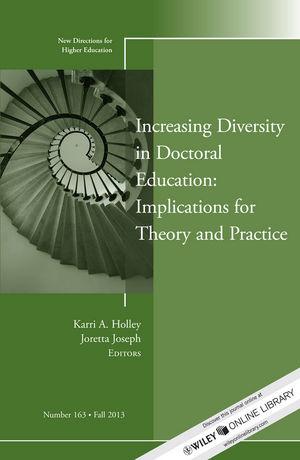
Diversity is defined as those numerous elements of difference between groups of people that play significant roles in social institutions, including (but not limited to) race and ethnicity, gender, socioeconomic class, sexual orientation, and culture. Since doctoral degree recipients go on to assume roles as faculty and educators, diversity in doctoral programs is significant. By supporting graduate diversity across the academic disciplines, universities ensure that the nation’s intellectual capacities and opportunities are fully realized. The authors consider diversity broadly from multiple perspectives, from race and ethnicity to institutional type, academic discipline, and national origin. They demonstrate how diversity operates through these venues and definitions, and hope to stimulate a conversation about a key aspect of American higher education. This volume is the 163rd volume of the Jossey-Bass quarterly report series New Directions for Higher Education. Addressed to presidents, vice presidents, deans, and other higher education decision makers on all kinds of campuses, New Directions for Higher Education provides timely information and authoritative advice about major issues and administrative problems confronting every institution. (From the Publisher)
Click Here for Book Review Abstract: The concern that the democratic purposes of higher education -- and its conception as a public good -- are being undermined, with the growing realization that existing structures are unsuited to addressing today's complex societal problems, and that our institutions are failing an increasingly diverse population, all give rise to questioning the current model of the university. This book presents the voices of a new generation of scholars, educators, and practitioners who are committed to civic renewal and the public purposes of higher education. They question existing policies, structures, and practices, and put forward new forms of engagement that can help to shape and transform higher education to align it with societal needs. The scholars featured in this book make the case for public scholarship and argue that, in order to strengthen the democratic purposes of higher education for a viable future that is relevant to the needs of a changing society, we must recognize and support new models of teaching and research, and the need for fundamental changes in the core practices, policies, and cultures of the academy. These scholars act on their values through collaboration, inclusiveness, participation, task sharing, and reciprocity in public problem solving. Central to their approach is an authentic respect for the expertise and experience that all stakeholders contribute to education, knowledge generation, and community building. This book offers a vision of the university as a part of an ecosystem of knowledge production, addressing public problems with the purpose of advancing a more inclusive, deliberative democracy; and explores the new paradigm for teaching, learning, and knowledge creation necessary to make it a reality. (From the Publisher)
Click Here for Book Review For directors of campus centers that have received the Carnegie Classification for Community Engagement, this book offers research and models to further advance their work. For directors starting out, or preparing for application for the Carnegie Classification, it provides guidance on setting up and structuring centers as well as practical insights into the process of application and the criteria they will need to meet. Building on the findings of the research undertaken by the author and John Saltmarsh on the infrastructure of campus centers for engagement that have received the Carnegie Classification for Community, this book responds to the expressed needs of the participating center directors for models and practices they could share and use with faculty, and mid-level and upper-level administrators to more fully embed engagement into institutional culture and practice. This book is organized around the purpose (the “why”), platforms (the “how”), and programs (the “what”) that drive and frame community engagement in higher education, offering practitioners valuable information on trends of current practice based on Carnegie Classification criteria. It will also serve the needs of graduate students aspiring to become the future professoriate as engaged scholars, or considering preparation for new administrative positions being created at centers. Co-published with Campus Compact. (From the Publisher)
Click Here for Book Review Abstract: The third edition of Patricia Cranton’s Understanding and Promoting Transformative Learning brings a wealth of new insight from the tremendous growth in the field during the decade since the previous edition. As in the previous editions, the book helps adult educators understand what transformative learning is, distinguish it from other forms of learning, and foster it in their practice. The first part of the book is dedicated to clarifying transformative learning theory and relating it to other theoretical frameworks. The author examines transformative learning from the learner’s perspective, and discusses individual differences in how learners go through the process. In the second half of the book, the focus is squarely on strategies for promoting transformative learning in a wide variety of adult and higher education contexts. Practitioners will be able to take ideas from the text and apply them directly in their teaching. Since 1975, transformative learning has become a core theoretical perspective in adult and higher education, and research has proliferated. In the past decade, adult education and especially transformative learning grew into a noticeably larger field. The numbers of undergraduate and graduate programs in adult education have increased and continue to increase as more and more individuals are seeking the expertise, skills, and training necessary to work with adult learners in higher education, business, industry, government, health professions, non-profit organizations, and community development. In addition, the number of programs in higher education (both undergraduate and graduate) that include courses in transformative learning has grown dramatically. These academic audiences use the book to further their understanding of transformative learning theory and practice. Drawing on the latest research as well as the author’s own teaching experience in both online and face-to-face courses, this new edition will be a vital resource for members of the transformative learning community, as well as those encountering the topic for the first time. (From the Publisher)
Wabash Center Staff Contact
Sarah Farmer, Ph.D.
Associate Director
Wabash Center
farmers@wabash.edu