Search Results
9326 results found using the following search criteria: .
A 2019 course by Peter Gottschalk at Wesleyan University considers religion "as a phenomenon . . . the meaning of 'sacredness' & 'the sacred' and question their comparative use" in various religious traditions.
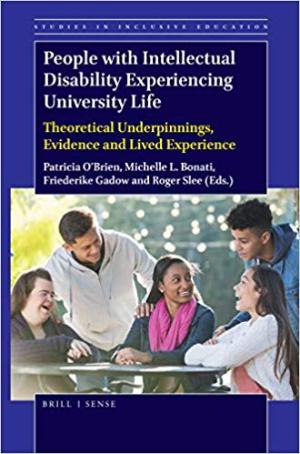
This book will introduce the reader to international perspectives associated with post-secondary school education for students with intellectual disability attending university settings. Examples of students with intellectual disability gaining their right to full inclusion within university settings are outlined, as well as the barriers and facilitators of such innovation. The four parts of the text will act as a reader for all stakeholders of inclusion at the university level. The first part examines the philosophical, theoretical and rights-based framework of inclusion. The second part provides evidence and insight into eight programs from across the globe, where students with intellectual disability are included within university settings. The third part consists of six chapters associated with the lived experiences of stakeholders in the programs profiled in Part 2. These stories are represented through the voices of former students of inclusive tertiary education initiatives, parents of adult children with intellectual disability who have participated in tertiary education, and lecturers who have taught students with intellectual disability as members of their courses. In the fourth part, critical issues are examined, including the role of secondary school counsellors, sustaining post university outcomes, transition from university to employment, inclusive university teaching approaches, and decision-making approaches to successfully implement a tertiary education initiative. The text concludes with a synthesis of the book themes and proposes calls to action with specific tasks to move the rhetoric of human rights into reality for adults with intellectual disability through an inclusive tertiary education.

On April 10-11, 2015 the University of San Francisco hosted the national conference, “Islam at U.S. Jesuit Colleges and Universities.” The overall aim of the conference was to examine the evolution of the mission, objectives, and identity of Catholic Jesuit colleges and universities in light of the expansion of the study of Islam and the growing presence of Muslim faculty, staff, and students on our campuses. (From the Publisher)
Barkley and Major have compiled an invaluable compendium of information about improving on traditional class lectures by including interactive elements. Like McKeachie’s Teaching Tips or Davis’ Tools for Teaching, this book can be read cover to cover or approached as a resource to consult when needed, as just about every page includes some practical suggestions for improving teaching and student engagement. The book opens with a two-chapter consideration of what the authors call a “Conceptual Framework for Interactive Learning.” These chapters examine the benefits and drawbacks of lectures and active learning strategies as well as the wide variety of each, arguing ultimately for an integrative model that takes advantage of the best of both approaches. The suggestions in these chapters and throughout the book are based on recent research rather than recourse to traditional arguments about the superiority of one modality over another. The ultimate strengths of this book, beyond the sheer volume of useful information, are its thoughtful mix of approaches and avoidance of a one-size-fits-all approach, all presented in concrete, actionable terms. This handbook is divided into three parts: the conceptual opening, twelve chapters on Engaging Presentation Tips, and eight chapters on Active Learning Techniques. The second two parts include 53 tips for creating engaging presentations and 32 suggestions for active learning techniques, most illustrated through specific examples. These are previewed at the beginning of each relevant chapter in a simple chart that directs reader attention to what each tip aims to improve and directions for implementing changes. Although it is impossible to itemize those tips here, it is indicative of the scope of the handbook’s broad coverage that the index includes subjects as diverse as voice modulation, metacognitive reflection, “dead wood words,” and background color of slides. Overall, Barkley and Major suggest many simple changes to the typical lecture that can result in more student engagement, such as how to devise a “power close” to any lecture; how to structure and practice presentations with, for instance, a “weatherperson” approach; and how to guide students in taking “sketch notes” during lectures. From “Guess and Confirm” to “Translate That!” to sticky note diagrams, these authors provide a wealth of possibilities to teachers and their students for making lectures interactive and engaging. The approaches in this book are meant to work across disciplines and teaching platforms, including online and hybrid modalities. It is not geared to beginning or veteran teachers but rather to any teacher who wants to improve the classroom experience for students and for themselves. The advice here is rich, practical, and based on research, experience, and common sense. This book seems ideal for individual use but also for any departmental faculty resource collection.
East and West have long struggled to coexist without detriment to cultural and religious beliefs. With growing globalization and immigration the issue of tolerance and acceptance of different viewpoints is of urgent importance and value. Books on this highly challenging and relevant issue attract the attention of a wide audience. Islamic Schooling in the West is clearly such a book. The authors of the book live and work in Australia. Specifically, Mohamad Abdalla founded three Islamic studies centers at Australian universities, Dylan Chown is a well-known researcher of Islamic pedagogy in the Australian educational environment, and Muhammad Abdullah has 25 years of teaching experience in Australian state schools. This does not mean the book is designed specifically for the Australian community; the book’s ideas and suggestions can be applied to Islamic schools in the West, provided the schools are open to renewal and improvement. Islamic Schooling in the West is a collection of work by contemporary educators and scholars who wish to both keep Islamic schools consistent with traditional Islamic philosophy and make them relevant and highly sought after. The desire to preserve traditional knowledge (2) within the Islamic paradigm and the need to be welcomed and accepted in Western society resulted in this practical manual on how to use modern teaching practice for the benefit of Islamic schools in the West. While some of the book’s chapters focus on specific educational experiences in Australia (for example, “Muslim Schools in Australia: Development and Transition” by Jan A. Ali and “The Importance of Islamic Studies from an Islamic Worldview in Australia” by Ibrahima Diallo), the majority of chapters can be applied to any Islamic school in a Western community. For example, the chapter “Islamic Pedagogy: Potential and Perspective” by Nadeem A. Memon and Mariam Alhashmi aims to challenge a common stereotype that Islamic education is about teaching religion only (169). Thus this book can be used in any Islamic school in the West – not just in Australia. In general, Islamic Schooling in the West is a book designed to promote the renewal of Islamic education in the Western community. In the twenty-first century, it is necessary to not only keep the traditions and pass down centuries-old knowledge but also to take advantage of updated educational practice and use contemporary teaching and learning techniques to overcome the difficulties Islamic schools face in the West. This book will be interesting for both scholars and teachers.

I titled this post after Trevor Noah’s introduction to the Black Panther film at the 2019 Oscars when he cited the Xhosa proverb, “Abelungu abazi uba ndiyaxoka.” Trevor translated it to mean: “'In times like these, we are stronger when we fight together than when we try to fight apart.” It turns out the proverb was an inside joke among South Africans who knew that he really said was, “White people don’t know I’m lying.” Ha! He got me, even though I’m of Korean descent. Nevertheless I still like the mock translation and the concept behind it. It is better to fight together. Some courses are a real challenge, and study groups are a strategic way for students to succeed. Here are some ways I think they make a difference in online education and some suggested practices. 1. Set up open virtual study hall hours online Many learning management systems (LMS) like Canvas integrate Zoom, Big Blue Button, or other video conferencing tools that allow instructors to create virtual rooms which are open 24/7. At any given hour during the day, a student can log into a room online and meet fellow classmates in a virtual study hall to collaborate on homework, prepare for quizzes, exchange notes, and discuss any aspect of the course. Even if one’s LMS does not include video conferencing as part of its platform, instructors can have students form their own Facebook or Google groups. The first step is to provide the virtual space for study groups to meet. Second is to help students organize. The easiest way is to coordinate groups based in the same time zones. It takes a bit of work, but using scheduling tools like Doodle can help manage competing calendars so everyone eventually finds common times to work together. 2. Assign group presentations where students collaborate and teach one another There is no faster way to have students learn from one another than to assign a presentation by small groups. In my New Testament courses, I often schedule student presentations on diverse topics on a weekly or bi-weekly basis. I put a sign-up sheet online using the discussion forums and lay out guidelines for the presentation in the syllabus. A week or two before a group presents, I meet with them through video conferencing, coach them on the topic, suggest readings, and ask them to meet on their own using the virtual study hall rooms. The presentations usually last about 8-10 minutes. Students use PowerPoint or Google Slides to video record their presentations using the tools provided by their LMS or with third-party programs like Screencast-O-Matic, and upload their video presentation onto the discussion forum for the class to watch. The rest of the class comments on the presentation by posting replies. Alternatively, if the course is synchronous, the group live-streams their presentation when we meet online. 3. Scaffold research projects and have students review one another’s work Especially with final research papers, I often “scaffold” the assignment by breaking up the paper into different parts and spread the due dates across the semester. I ask students to choose a paper topic, submit an initial bibliography, read the secondary literature and outline key points of debate, and step-by-step work on major sections of their paper until these sections are ready to be compiled together into a cohesive whole. Along the way, in small groups, students are asked to review one another’s work and receive suggestions for improvement. Peer suggestions cannot replace the feedback given by the instructor of the course, but I often find they offer a friendlier and easier way to receive critique. 4. Leave room for the random lone ranger and alternative assignments On occasion, a student might have such an unusual schedule that meeting together to do student-to-student collaborations is simply not possible. Such situations do not happen often, but when they do, I try to provide a fair alternative. I might, for example, ask a student to submit a short paper instead of working with other classmates on a video presentation. Whatever the substitute assignment, it’s important to be flexible. Successful student-to-student interaction requires that I take on a role other than “teacher.” The students teach themselves and one another. I plan, coordinate, and set up ideal virtual spaces for students to meet. Along the way, I learn from my students as well.
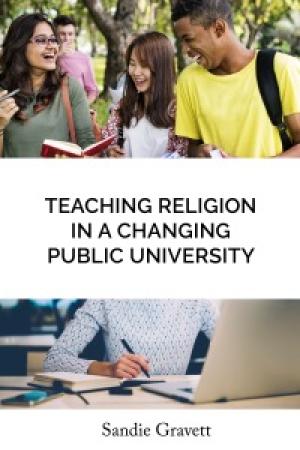
Teaching Religion in a Changing Public University reviews the teaching of religious studies in public universities, with exploration of the challenges and opportunities for the future. Dr. Gravett assesses the current status of the field within the challenges facing universities in general and humanities in particular as we move into the twenty-first century. She notes that: “Revolutionary changes in the higher education landscape call for sustained reflection on impact of these items on the structures in which academic work in religious studies happens and the conditions of faculty life. The advent of new educational technologies, the needs of more diverse student bodies, and alterations in the relationships between universities and communities also raise questions about how religious studies scholars and the programs they provide will evolve.” From this understanding, she provides a succinct and insightful analysis of the types of courses taught in religious studies programs and how these fare (or not) in new modalities impacted by technological change and digital learning. Dr. Gravett’s discussion of the challenges of an increasingly multicultural environment, with its religious pluralism, and the possible roles of religious studies scholars and programs, orient the reader toward present complexities and the potential of religious studies to not only survive but add increasing impact in the future. (From the Publisher)
As institutions seek to increase faculty diversity, adopt increased standards for faculty productivity, and become more aware of the benefits of extending mentoring beyond early-career, it’s crucial to bring rigor and definition to your department’s mentoring efforts. David Kiel, who worked with faculty leaders to design mentoring programs for all of UNC-Chapel Hill’s professional schools and the College of Arts and Sciences, draws on years of research and experience to bring you this uniquely comprehensive handbook. This book includes practical strategies from a wide range of institutions, from community colleges to research universities. (From the Publisher)

My most recent tweet (of almost ten thousand) was 40 weeks ago. My most recent Facebook status update (except for a brief "thank you" for birthday wishes in July) was 46 weeks ago. The previous three years, however, I have taught my main introductory course, "Introduction to the Hebrew Bible," as an open, freely-available, online event built almost entirely on social media, especially Twitter, WordPress blogs, and Google Docs. This was the Open Old Testament Learning Event, or "OOTLE." My use of social media in higher education was based on a belief in the power of making for learning, and on a utopian vision for the internet that was based on my own experience. Eventually, the failures of the major centralized social-media platforms to proactively account for systemic abuse of marginalized users led me to abandon our pioneer outpost of open learning, and to retreat with my students back into the familiar confines of "the devil I know," the closed learning management system or "LMS." Many educators will have some familiarity with the learning theory "constructivism" (sometimes "constructionism"). According to this model, learners do not simply "acquire" knowledge, but rather always "construct" knowledge by synthesizing their existing understandings with new information or insights. Less well known, however, is that according to a constructivist model, this knowledge-making is more likely to occur where learning happens socially and where learners collaboratively build artifacts that are publicly shared. As the internet age took hold, and learners began increasingly to build their knowledge in a world of information excess rather than a world of information scarcity, it was often remarked that content on the internet was composed by perhaps 1% of internet users. Perhaps 9% of users interact with this content, and some 90% only passively consume content. This is sometimes called the "1% rule" or the "90/9/1 rule." From computer science to the humanities, educators began to embrace the power of "maker culture" to unleash the potential of constructivist learning in individuals, and to remake the internet in the image of the whole body of its users. It was in this context that the use of social media in higher education began to spread like fire: classroom Twitter "back channels" or weekly synchronous "Twitter chats"; blogging assignments on open web platforms like WordPress; presentation or digital storytelling on YouTube; and Facebook groups and pages. Then in 2014 came "Gamergate," a campaign of organized harassment against female game designers and game enthusiasts, including frequent credible threats of sexual violence and murder. Gamergate provided a playbook for white supremacist organizations and eventually, it seems, even for Russian interference via "troll farms" in 2015-16 U.S. political discourse on Twitter, Facebook, and YouTube. ("Trolling" describes skillful, media-savvy practices in derailing or redirecting discourse, whether for pleasure, malice, or profit.) Even among social-media users apparently uninvolved in these large events, in became clear that the codes of conduct and anti-harassment policies dictated by the young, white "tech bros" of social media (Jack Dorsey of Twitter, Mark Zuckerberg of Facebook), could not provide marginalized users anything like the safe environment enjoyed by privileged users less likely to be targeted. This remains the case, skewed as these policies are toward favoring "free speech" in an absolute sense and leaving users to block malicious actors as best they can . . . only possible, of course, after the malicious acts have occurred. Even we relatively privileged users became accustomed to weary acknowledgements that "of course Twitter is a cesspool, but . . . " Eventually, "But. . . “ became for me, and for many educators in my circles, "But what?" and then "But nothing." It had become impossible to offer my learners a reasonable guarantee that they would enjoy equitable social-media experiences, regardless of how they chose to present their race, gender, sexual self-understanding, class, or other differences. As I consider shepherding learners again into the social-media space ("not yet, not yet"), I remain optimistic about decentralized platforms like Mastodon. It is clear that the "one size fits all" approach to codes of conduct and anti-harassment policies (as on Twitter and Facebook) is untenable. On Mastodon, a radical free-speech, no-holds-barred community can have its minimalistic code of conduct, while a more proactive, highly-moderated community can choose to federate with that group, or not. I have not given up on a commitment to learning via collaborative construction of publicly available artifacts, but I am once bitten . . .and will twice be shy of any monetized, centralized platform.

ePortfolios are web-based, student-generated collections of their work and reflections on their learning and growth. They are tools for students to synthesize and integrate their learning, inside and outside of the classroom, by critically reflecting on their academic and co-curricular experiences. I first learned about ePortfolios from George Kuh who visited our campus in the fall of 2016 and mentioned that they were the latest addition to the list of High Impact Practices that deepen student learning (https://www.aacu.org/leap/hips). As Bret Eynon and Laura Gambino note, ePortfolios can facilitate student inquiry into their own learning, reflection on their development and growth, and integration across disciplines, as well as curricular and co-curricular contexts (2017, 20). As repositories of student work, ePortfolios allow students to reflect on their academic learning at various stages of their undergraduate development. They facilitate critical reflection which has been theorized as a four-stage reflective cycle (presence in experience, description of experience, analysis of experience, and experimentation; Rogers 2002) or a three-step sequence (describing experiences objectively, examining experiences in light of learning goals, and articulation of learning that includes goals for future action; Ash & Clayton 2009). In ePortfolios, students can describe their work (research papers, leadership positions, etc.), analyze how it has contributed to their growth and development, and experiment with various future possibilities by tailoring their ePortfolios for different career paths and job opportunities. I have used ePortfolios in several different courses: first year seminars, upper-level seminars, directed individual study, and capstone courses. ePortfolios allow seniors and recent graduates to showcase their work, and they have been shown to improve performance in job interviews because students can readily recall what they have done over the course of their undergraduate career and cite specific examples of their transferrable skills. In my capstone course, I had students create a type of ePortfolio that included pages about themselves, their signature work, their co-curricular activities, their resume, and their contact information. On their signature work page, I had them describe their capstone project for the general public and reflect on what they had learned in their program. ePortfolios can be powerful for first year students as well. Some institutions, such as Indiana University-Purdue University Indianapolis (IUPUI) include ePortfolios within their first-year-experience programs. They have students create ePersonal Development Plans (ePDP) that enable students to increase awareness of themselves and others, set self-concordant goals, develop hope, and shape education and career plans (https://eportfolio.iupui.edu/). When students create ePortfolios in their first year, they can build on it over time, reflect on what they have learned at various points in their undergraduate career, and chart different pathways when their personal and professional goals change. They can generate robust repositories of what they have learned in their academic and co-curricular experiences. Not unexpectedly, the ePortfolios from my first year seminar were less developed than my capstone course. First year students, navigating new terrain and trying to get their bearings, reflected on what they did in high school and what they hoped to pursue in college. Some had clearly defined goals and career aspirations, while others were uncertain and open to various trajectories. But I think the ePortfolio served two important purposes: first, it clearly demarcated their new identity as a college student, and second, it allowed them to reflect on what they wanted to get out of their college experience in a private forum. Although most free ePortfolios–such as Weebly, Wix, and Wordpress–are public, subscription ePortfolio platforms such as Digication, Pebble Pad, and Taskstream allow students to keep their ePortfolios completely private, share with particular individuals (such as their instructors or classmates), share it within their university, or make it publicly accessible. Many students find such privacy to be novel. When I asked my first-year students if they kept journals or did any reflective writing, I was surprised when only one student raised her hand. The rest said that they used social media such as Facebook, Instagram, or Finsta (a hidden Instagram shared among friends). Instead of engaging in private reflection, they were posting and performing on public or semi-public websites. As a result, many found ePortfolios to be unfamiliar territory, because there was no clearly defined audience, with the exception of myself, who would check to make sure that they were completing their pages, awarding all or no credit. For upper-level seminars and directed individual studies, I have had students create ePortfolios that were more closely tied to the course content. A student researching Aikido created one as a public website with an introduction to Aikido, an annotated bibliography of scholarly resources, and reflections on his personal experience. For my Buddhism course, they reflected on what they learned in the course, uploaded their scholarly review paper, and also wrote about their research for a more general audience. Questions to consider: Do you feel familiar with and comfortable using the ePortfolio platform? What campus resources and support are available for you and your students? For what purpose do you envision using the ePortfolio–for students to reflect on a paper/project, learning process, or academic development? Does your course seek for students to integrate their learning across various contexts or over time? If so, how might you use ePortfolios for this integrative learning? What prompts might you include in your ePortfolio to encourage the kind of integration, reflection, and synthesis that you would like to see? For example, you might ask what insights they gained from an assignment, how it connects to other goals, or how it contributes to their understanding of the discipline or their career development. References: Ash, Sarah L. and Patti H. Clayton. 2009. Generating, deepening, and documenting learning: The power of critical reflection for applied learning. Journal of Applied Learning in Higher Education, 1(1), 25-48. Eynon, Bret and Laura M. Gambino. 2017. High-Impact ePortfolio Practice: A Catalyst for Student, Faculty, and Institutional Learning. Sterling, VA: Stylus. Rodgers, Carol. 2002. “Defining Reflection: Another Look at John Dewey and Reflective Thinking,” Teachers College Record 104, no. 4:842-866.