Resources

In Por Uma Educação Romantica (Papirus, 2003), Rubem Alves speaks about how he found his way to poetry. He describes how woundedness he experienced in life made him understand that literature, poetry, music, storytelling, and the visual arts were not only nutrients for violated and hungry bodies but also joy for anguished souls. He writes: “Science is fire and pans, indispensable kitchenware. But poetics is chicken and okra, delectable food for those who love this dish.” As an educator, storyteller, and world-maker, he was a compulsive fruidor de vita—he conjured new life into being. We have reached the end of a fourth semester touched by an ongoing pandemic that has brought so much loss and grief. Our families, our communities, and our learning spaces are filled with bodies that are carrying an overlay of stories, experiences, and memories that feel like webs spun out of un-rootedness, pain, and trauma. And I have been asking myself how to begin to undo the trauma that we have all metabolized. How can we redesign our classroom encounters, rituals, spiritual practices, and ways of knowing? How can we experiment with other ways of being, invent other vocabularies and grammars, other corporeal practices for grounding, creativity, and connection? I believe Rubem Alves would invite us to pay attention to the spaces where poetic inventions emerge—spaces of art making that are ripe with the potential to smuggle life, joy, and creativity back into these many landscapes of death. What kind of potent conjuring could happen if we cleaned our brushes, wiped our camera lenses, heated our welding tools, recovered our songs, dusted our instruments, located our yarn, filled our confined spaces with pulsating bodies that are not afraid to reinvent erotic grammars of playfulness and ritual, to heal these wounds? Art, as a way of feeling, knowing, and healing allows us to access what is hidden within our most intimate recesses. What our busy minds want to forget, our embodied artistic practices tend to re-member. From rage to grief to wonder, the arts help us touch, sense, and name our emotions and educate our affections while inspiring us to resist, denounce, agitate, heal, connect, and generate tools for speculative imagination, for integration of embodied, emotional, and intellectual knowledge. When we immerse ourselves in acts of creation, we have access to the visceral, the somatic life of the body: its reflections, limits, intuition, answers, desires, and needs. Through artistic languages, we can begin to weave the invisible back into the perceptible. Art also has the power to evoke, to create other possible worlds. And because of art’s power to provoke, we are able to sit with the trouble, to lean into instability, to practice unlearning, and to affirm our inherent capacity to be at once problematic and prophetic. In a way, and as Alves proposes, the arts remind us of the life that is buried beneath the weight of our responsibilities, our angst, and our pain. Sometimes, Alves affirms, life has to lay dormant for years, buried within our sepulchers… Sometimes life only has a chance after death. So, in the midst of the death that surrounds our days, weeks, and months, and the millions of lives lost to COVID-19, I share with you the work of an artist whose work has activated my classroom, reanimating and mobilizing teacher-learners to create otherwise, even in the face of impossibility. vanessa german describes herself as “a citizen artist who centers the exploration of human technologies that respond to the ongoing catastrophes of structural racism, white supremacy, heteropatriarchy, resource extraction, and misogynoir.” german’s work ranges from sculptures to performances, rituals, processions, installation, photography, and much more. As a way of sentir-pensar of the world, german’s work seeks to “repair and reshape disrupted human systems, spaces, and connections.” Her practice also engenders new models for being and becoming in the world that incorporate healing, creativity, tenderness, and collectivity to address our society’s most pernicious violences. In the work entitled Blue Walk, curated by Wa Na Wari, german staged what she named “” In the context of this pandemic and the interlocking systems of oppression, german’s performance invited participants to acknowledge “the holiness of the Black body on the living planet as a healing channel of release and power.” Performers touched, sensed, shared, and metabolized experiences of rage, grief, tenderness, laughter, and the need to rest. This particular pilgrimage was staged in September, during the Time-based Art Festival organized by the Portland Institute of Contemporary Art. Participants were invited to walk “in the power of the Blues. Moving in the power of Water, Creativity, and Dimensional Wholeness. The Ritual is the Goodbye Song and The Lifting Up Song. We learn this in a short period of togetherness pre-ritual. These songs are about listening, giving permission to the voice and the body, and taking up space and sky.” vanessa german’s potent performance enfleshes art as a way of feeling, knowing, and healing. Through storytelling, mixed media, assemblage of bodies, and textile, german mediates ritual and collective acts of togetherness to reclaim the right of Black people to share in power, spirituality, and presence. Non-Black participants are invited to witness, to be mindfully present, and to confront the ways in which we internalize and externalize anti-Blackness in our relations and lives. Collectively witnessing the work of artists such as german opens up a “capacity to relate deeply and respectfully across differences,” while maintaining a “receptivity to the unknown,” to borrow Laura Pérez’s language (Eros and Ideologies [Duke University Press, 2019] xx). Inherently polyvalent, these works have a tremendous power to connect, reverberate, and reveal what is hidden within our interiority. As sites for world-making and choreographing new possibilities of being, feeling, knowing, and healing, the visual arts can cultivate in us an orientation and openness toward wonder, mystery, and that which we have othered, forgotten, disposed of, or violenced. This pandemic, the ensuing uprisings, and the incapacity of governments to decently respond to the urgencies of our times have impacted us in ways that we cannot fully grasp at the moment. By inviting these works of art into our classrooms, learning communities, and academic spaces, I believe we can conjure new possibilities of life that allows us to sense and comprehend the world differently—even in the face of impossibility, interruption, and derealization. Works like Blue Walk are, indeed, nutrients for violated and hungry bodies as well as joy for suffering souls. *Photos by Tojo Andrianarivo. vanessa german, Blue Walk, curated by Wa Na Wari, September 2021, Portland Institute of Contemporary Art.
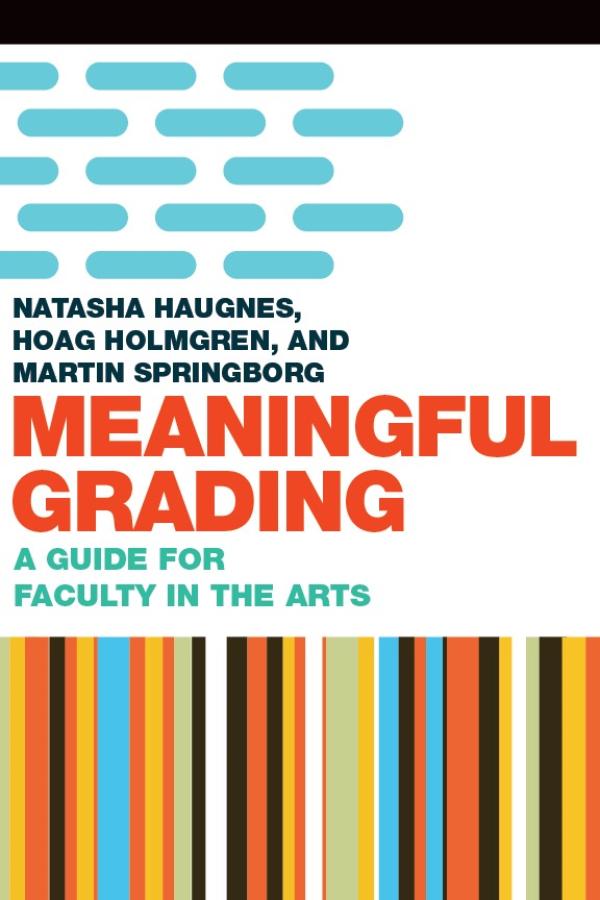
Meaningful Grading: A Guide for Faculty in the Arts provides a framework for continual improvement and deliberate practice in the area of course design, assignment creation, and assessment. Although this book focuses on faculty in the arts, its wisdom is accessible to all faculty in higher education. The authors argue that “strong teaching requires careful planning, even though the time constraints of academe do not always allow for it” (2). Therefore this book is comprised of fifty tips that can stand alone and/or work together to provide a cohesive pedagogical framework. Meaningful Grading is divided into three parts: (1) course design and preparation, (2) during the semester, and (3) post semester. The book begins by challenging the reader to examine their own beliefs and biases, know their educational context, and define what success will look like in their course (6-7). As I read this section, I was reminded that many faculty in higher education receive little to no training in pedagogy and course design. Haugnes, Holmgren, and Springborg argue that we must be intentional in our course design and that “grading, if it is to be meaningful to students, must be intentionally integrated into the whole course” (30). The authors focus heavily on ensuring that course goals, teaching and learning activities, and assessment (evidence of success) must work together to support student learning. The course design process is iterative and one will cycle through “all the legs of the tripod multiple times. . . until each is in alignment to help support deep learning” (33). Part two presents a series of tips that operate as “grab and go ideas in the middle of the semester” (65). This section provides advice on how to clearly communicate the goals and expectations that were crafted in part one. It also focuses on how to teach discrete skills and content as well as how to emphasize process over perfection. The authors suggest that it is important to identify what success looks like at multiple distinct points in the process in order to provide students with more meaningful feedback along the way. In addition, it is through the intentional use of field specific language in all communication with students (syllabus, critiques, meaningful feedback, and comments) that students are exposed to and are able to absorb field specific language and concepts. Finally, part three provides advice on how to engage in reflection on a completed semester in order to establish and improve meaningful grading practices. The first tip in this section encourages faculty to seek feedback from students and faculty colleagues during and after the semester in order to become a more effective grader. Although this feedback can include end-of-semester evaluations, the instructor is encouraged to seek additional and separate forms of feedback from students about fairness of grades, use of rubrics, and other course activities. The instructor is also encouraged to return to course goals and course activities to assess if goals were met and the process of grading was useful for both the instructor and the students. As a faculty member who is not in the arts (design, architecture, fine and visual arts, media arts, literary arts, printmaking, performance arts, etc.) but utilizes various forms of art in my lectures, course activities, and graded assignments, I found this text to be very helpful in expanding my knowledge of how to better incorporate and assess the use of art in a learning context where students may not initially see or value the ways in which art speaks to the content at hand. It also provided me a strong foundation on how to better communicate to students the ways in which what they are learning to master is a form of artistry. This book provides practical and accessible advice on how to design and execute a course in any discipline in higher education while simultaneously speaking to the unique nature of assessment in the arts. I believe it is an important read for all faculty regardless of discipline and experience level, and trust that it will help us more critically examine our pedagogical strategies and assessment methodologies.