Resources
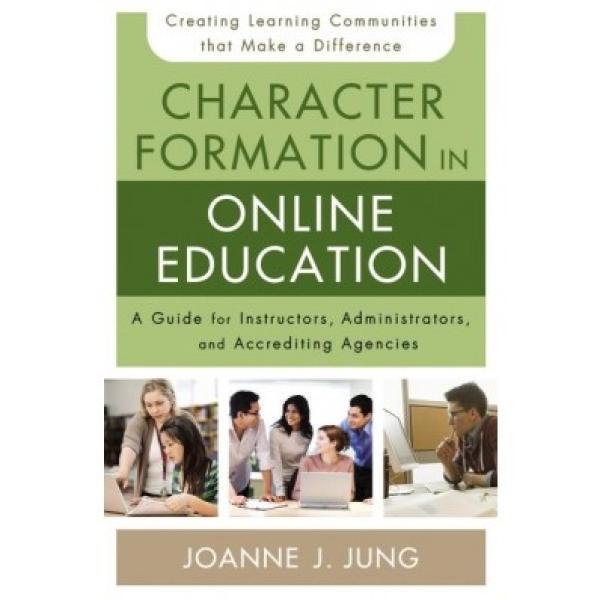
Joanne Jung’s overview of character formation in online education serves as an introductory resource for the topic. It is primarily intended to be a practical and accessible guide for faculty and administrators at religious institutions that offer online courses. Throughout the book Jung tackles the “skepticism among educators about character formation in online education” (15). The book examines various aspects of online learning and how it contributes to character formation. In the beginning section, Jung addresses the purpose of online education alongside best practices for online pedagogy. She provides an overview of Learning Management Systems, which house online classes, as well as an overview of the course design process, which involves working as a team with a curriculum and instruction expert. The second section discusses best practices of pedagogy within online courses, focusing on a holistic view of human personhood that drives one’s approach to character formation. Jung discusses practical means for using discussion forums, hybrid classroom formats, and social media toward the end of character formation, including an important chapter on integrating faith and learning. The final section addresses assessment and improvements that administrators and faculty can make to online courses in order to achieve learning outcomes for character formation more consistently. Jung also includes an accessible and informative glossary of terms relevant to online education. Faculty who are unfamiliar with teaching online courses will find this book a valuable help in beginning to teach and form character in online modalities. Administrators and accrediting agencies will find many sections useful for their purposes as well, especially chapter three on course design teams, chapter seven on the integration of faith and learning, and chapter nine on assessment. As Jung writes, her purpose in the book is to give “practical ideas for customizing your online courses and improving your pedagogical methodology, irrespective of your discipline” (9). One concern with the text is its basic, introductory approach. For faculty and administration who are experienced with online education, the book will be primarily review, albeit with a clear focus on character formation. Chapter seven on the integration of faith and learning and chapter nine on assessment are important exceptions, and they present insights for any institution concerned with character formation in education. Additional studies could help supplement and add insight to some of the essential points that Jung makes, particularly studies that focus on the creation, delivery, and assessment of learning outcomes specifically designed for the purpose of character formation. Such studies could engage resources on moral or character education and focus on the application of character formation research to online modalities. If one is looking for an introductory guide to forming character in the world of online education, this book provides resourceful and insightful suggestions toward best practices. In order to delve deeper into character formation for online education, there remains a need for further pedagogical study regarding the application of character formation research in general to online education in particular and regarding the means of facilitating character growth in the learning environments of online education.
The challenge of teaching an online course brings a measure of trepidation into the heart and mind of even the most experienced classroom instructor. The authors provide a resource for the online instructor to understand who online students are, how they learn, and how to help them achieve their educational goals online (vi). While they accomplish this objective in some senses, the constant repetition of themes detracts from its overall contribution and makes it difficult to recommend. The opening chapter explains the pros and cons of traditional versus online learning, as well as differences and myths of online instruction. The second chapter covers critical issues in online education and then offers success strategies and best practices for instructors. A short explanation of synchronous, asynchronous, and hybrid models and the pros and cons of each strategy, including the type of content best taught by each method, forms the third chapter. At this point, the reader is prepared to start delving into actual practices for online teaching but instead the authors repeat the content of the previous three chapters. Arguably they offer additional perspectives about online teaching and learning in the ensuing chapters, yet the material is so repetitious, one cannot remember the new focus because the text reads like a perpetual review of content. This practice continues for the next five chapters. The one exception is found in chapter 7 where the authors are more focused on specifics necessary for instructors to successfully begin a course with students – including examples of pre-course and early communication (130-131). Chapter 9 continues the specific and valuable contribution chapter 7 begins by looking at specific activities and skills online instructors need for developing critical thinking skills in students, including teamwork practices, and how to assess such learning. The final chapter identifies various strategies that help instructors to manage time well when engaging the demands of teaching online courses. Though partially redundant, the addition of specific tactics and illustrations make the book a helpful contribution. Overall, some helpful principles emerge clearly from the book to help a novice online instructor plan and prepare for a course. The samples provided are beneficial, though an experienced instructor may have been able to develop these on their own from the principles discussed. Unfortunately, in a few instances an example was given that was contrary to the summative advice given. For example, one of the communication tips, to avoid the use of all caps (135), was followed by sample messages to students that included all caps. While appreciating some concepts presented in this volume, this reader will continue to look for a better-organized and more step-by-step book for assisting online instructors.
Some higher education faculty might still be ambivalent about the long term impact on educational culture by the technological takeover, especially that this shift has taken place in a relatively short period of time. Few though would doubt the fact that we are in the midst of an innovative, technology driven, instructional change. Teaching Online’s main goal is to help us navigate this change. Based on ample research, the book argues that the change has reached a tipping point and is expanding. This is hardly surprising news. Taking some courses online during their program has become a common expectation of the current generation of students at seminaries and graduate schools of theology, not to mention the large increase in distance learning programs and enrollment. In addition to offering a comprehensive guide to the theory and practice of online teaching, Teaching Online also includes substantial chapters on developments in the theories and philosophy of education. This, in addition to situating teaching online within a long trajectory of change to instructional culture are among the key contributions of the book. Faculty views on learning change when they teach online, argues the chapter on “Views of Learning.” Higher education systems are facing new and significant challenges. “For hundreds of years, educators labored under the assumption that learning happened by way of an individual’s consumption of information and ideas.” Many philosophers of education, long before the time of online learning, starting with Paulo Freire in the 1960s, have challenged this view. However, the recent and widespread experience in online learning, which has now become mainstream, has clearly moved education beyond the traditional static concept. The difference is that this time the move to learner-centered educational systems is caused by technology. Online learning is offering the possibility of constructing ecosystems “in which each person is spreading his or her understanding among the pieces of information available in that ecosystem.” Students are becoming active agents in what one contributor to the book calls a “rhizomatic” learning process that has no fixed beginning or end, and is rather an ongoing experimentation and transformation (65-67). This is a great metaphor for theological education! Equally challenged by the spread of online learning are not only traditional philosophy and pedagogies, but also academic institutions themselves that might be losing control of the learning process (257). Teaching Online helps teachers tackle these changes and challenges. Furthermore, the chapters of Teaching Online offer valuable practical help in several key areas such as course structure and planning, the teacher’s persona in the online course, communication, student engagement and community of learning, and much more. One minor annoyance in the book is the format of the chapters. Most chapters include five or six page-long testimonies of professors sharing their experience on the topic of the chapter. While these are somewhat interesting and add information and liveliness to the book, because of the way they are inserted, they can be distracting and interrupt the flow of the chapter. One feels lost at times in trying to follow the flow of the chapter; perhaps the book is trying to implement the rhizomatic approach mentioned above! I was attracted to this book mainly because I am preparing to teach a totally online course for the first time, in the next academic year. I am glad I read it, and I strongly recommend it.
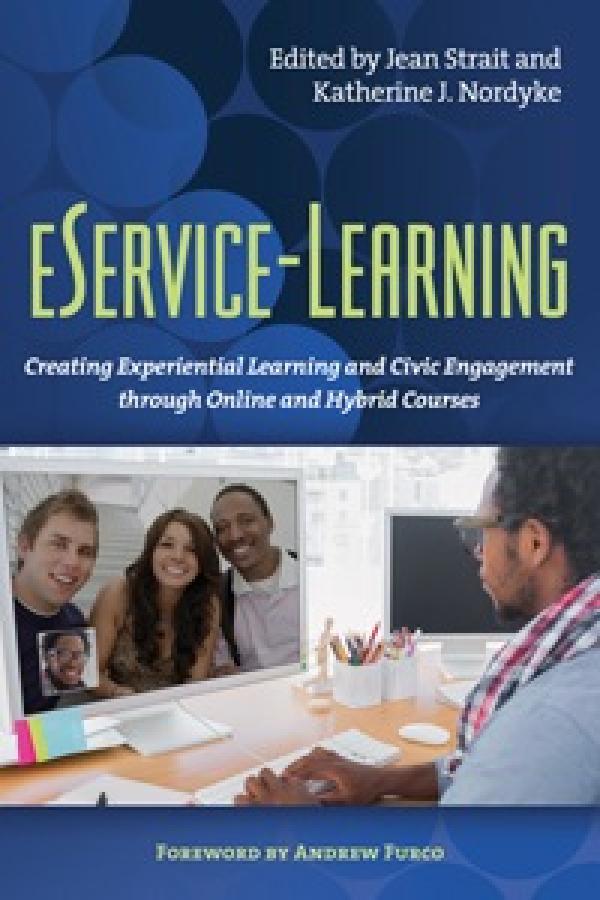
This bookadvocates civic engagement and service learning in higher education to provide students with transformative learning experiences. Linking service learning with online learning the authors present eService-Learning – a high-impact modality of learning for the twenty-first century. Contributors to the volume present research on teaching and learning as it relates to eService-Learning and provide best practices on how to incorporate eService-Learning experiences in courses and curricula. Divided into three parts, the first part of the book consists of four chapters setting forth “Essentials, Components, and Nuts and Bolts of eService-Learning.” Contributors present a rationale for civic engagement and service learning in higher education (7-19) and provide theoretical foundations for service and experiential learning, coupling both theory and practice to the emerging field of online learning (20-39). Authors guide readers in creating syllabi and learning experiences that facilitate the development of aptitudes and skills for service in online courses (40-57) and address the technology requirements for implementing eService-Learning (58-66). The second part, “Models for eService-Learning,” introduces readers to five different models for implementing eService-Learning as illustrated by universities that have implemented it at course or program levels. Models described leverage online and on-site learning in the following ways: (1) instruction online, service-learning on-site (69-88); (2) e-portfolio and reflection online, instruction and collaboration with service partners in class (89-104); (3) instruction and service partially on-site and online (105-118); (4) instruction and service conducted online (119-129); and (5) a mixed hybrid of models (130-143). Research in part two provides a critique and analysis of these five models of eService-Learning and step-by-step guidance for implementing each model. The third part, “Next Steps And Future Directions” provides advice to administrators and faculty interested in implementing eService-Learning at the course or program level. The first of two chapters describes the challenges that universities face if they question the relevance of higher education. The author skillfully argues that eService-Learning can reassert the relevance and worth of higher education in the twenty-first century (149-163). The final chapter expands the horizons of eService-Learning beyond the borders of higher education, suggesting possible applications for K-12 education, workplace training, learners with disabilities, and senior adults (164-166). This book is to be commended for articulating a rationale for including outcomes related to civic engagement and service-learning in higher education and best practices for using online technologies to implement eService-Learning in courses and curricula. A conspicuous strength is the description of various eService-Learning models. As such, the volume is particularly valuable for faculty and administrators in higher education.
This volume consists of fourteen chapters designed “to provide a useful handbook on adopting interactive Web 2.0 tools that promote effective human-computer interaction (HCI) in ePedagogical practice for education and training” (xv). Each essay presents data for the consideration of educators and administrators who are preparing to be or who are actively involved in virtual education. Primarily, the contributors explore using Web 2.0 tools such as Blackboard/Moodle, Facebook, Twitter, YouTube, wikis, and blogs, but there is much more. The chapters are divided into four sections. The first contains essays to help the reader think clearly about methodology as it relates to the continual evolution of online education. The second section consists of essays focusing on differences between synchronous (everyone must meet at the same time either in physical or virtual space) and asynchronous learning (done on one’s own time, such as watching recorded lectures or using message boards to communicate with other students). The third section focuses on how educators might measure student development in a virtual environment. The final section is the most technical with essays dedicated to the use of software and online systems. This book does not offer quick-and-easy steps for one to follow toward successful ePedagogy. It is dense, heavily technical at points, and it requires readers to set aside time to read attentively. An educator of theological studies will have to creatively search for ways to transfer information to their own setting since none of the essays are directly related to this field. The essays are social-scientific in nature. The testing conditions and criteria are unique to each particular essay, taking place in geopolitical regions as distinct as Australia, Canada, Indonesia, Taiwan, the United States, and Vietnam. The diversity is promising, offering encounters with a wide-array of scenarios wherein Web 2.0 tools function. On the other hand, the principles offered cannot be understood in a vacuum without reference to context. This book may be best used as an occasional reference. In other words, it is not the type of practical book one would read through in a few sessions. The most useful part of each chapter for the casual reader may be the list of works referenced at the end of each study. These short bibliographies invite further exploration. In summary, readers will find insightful academic essays that will assist them in their professional development as educators in a virtual context. The essays are based on data acquired through rigorous research. The uniqueness of each case study requires the reader to actively sift universals from particulars in order to determine what information may assist them in their own work, and the technical nature of the book will require non-experts to familiarize themselves with much of the vocabulary.
This volume engages current debates on establishing or maintaining quality online education, instructional practices, and educational innovation. The book is divided into four parts: (1) five essays on “overview and implications of practices and processes for assuring quality,” (2) six essays on “quality assurance and continuous improvement at the course design and teaching levels,” (3) six essays on “processes for assuring quality at resource and program levels,” and (4) two essays of “final thoughts.” Thirty-nine education practitioners wrote either single-authored or multi-authored essays for this collection of nineteen articles. Some of them direct online education, quality control, or program assessment. A few others serve in K-12 online learning programs. A couple of contributors hold communications or marketing appointments. Nearly all hold administrative educational leadership or are academic researchers or professors. Many of the authors work at institutions of higher learning located in Pennsylvania. Others teach at institutions located in Colorado, Illinois, Maryland, Pittsburgh, Virginia, West Virginia, Washington DC, and British Columbia. On the book’s coverage of topics, I expected to find and found, pieces about improving course design, determining effectiveness and faculty development, and reviewing culturally diverse student populations. Significant online education concerns are addressed in stand-alone essays: ethics, academic advising, learning analytics, knowledge management, contact hours in online education, and accreditation. The volume also includes a helpful essay on concerns about online accessibility (including reaching disabled persons), affordability, and accountability. Interesting contributions include “The Sloan Consortium Pillars and Quality Scorecard,” that is used to benchmark effectiveness, efficiencies, and innovation, and “The Power of a Collaborative, Collegial Approach to Improving Online Teaching and Learning.” Of notable mention is the careful attempt throughout to focus on issues related to: government – federal, state, and district levels, accrediting agencies, professional bodies, faculty, managers/administrators, controllers, assessors, and learners. Teaching Theology & Religion readers may find a number of relevant essays. The volume does not engage theological education or religious studies in the liberal arts. Still, discussions and principles raised are transposable to online religious education. Online religion studies and theology programs continue to become more popular. A 2012 study of online education in the United States shows that 70 percent of higher education institutions surveyed have recognized the critical importance of online education; 6.7 million students enrolled in at least one online course (I. Elaine Allen and Jeff Seaman, Changing Course, Babson Survey Research Group, Pearson Education, and Sloan Consortium, 2013). An August 2014 web search at www.GradSchools.com lists more than 150 accredited online religious programs: 51 doctorates, 138 masters, 22 certificates, and 7 hybrid programs. Religious community online has been empirically investigated (Heidi Campbell, Exploring Religious Community Online, Peter Lang, 2005). In time, religious educators will also study this phenomenon. Until then, religious educational administrators and leaders can contextualize insights from this volume with classical areas of program creation and evaluation in curriculum, instruction, institution, faculty, and student components, to provide innovative online educational program.
This edited volume of seventeen articles explores the impact of mobile technologies on the field of education. In the Foreword, authors Greg Levitt and Steven Grubaugh believe “we are at the forefront of a computing paradigm shift that will change how teachers and students interact with the world of educational connectivity, content, pedagogy, and learning” (xiv). Since the introduction of the first touch screen cell phones in 2007, mLearning [mobile learning] educators have been engaging the possibilities and potential of this technology for education. The editor argues that the capabilities of mobile technologies make “each student’s end user experience with mobile learning . . . much richer than it might be on a computer” (xiv). The authors represent a variety of disciplines including education, management, engineering, computer science, and instructional technology. The volume is divided into two sections. The first offers fourteen chapters on the theme of pedagogical applications for the best practices in mobile technology integration (xvii). These articles explore a variety of platforms including e-readers, i-Pads, GPS devices, and various mobile phones and tablets. These devices give mLearning “two distinct features… [one,] it allows educational processes to take place anywhere and at any time; and two, it includes any kind of handheld device which is small and easy to carry and that uses a communication technology” (194). Several articles engage BYOD [bring your own device] programs, new literacies, digital storytelling, microblogging, web 2.0 and 3.0, social media, and flipped learning. They examine the impact of moving from static information to interactive and socially connected, collaboratively produced information with Web 2.0 and 3.0 tools. They argue that mobile devices shift pedagogy from a teacher-centered classroom to a student-centered one (124). The second section provides three chapters on the subjects of social applications and tools for effective mobile technology integration (xviii). The articles examine user-generated content and the social implications of mLearning for global learning. Even though none of these articles specifically address theological education, mLearning will impact theological education in the near future. Seminaries and Schools of Theology have been slow to incorporate new technologies into instruction. However, as the text points out, the adoption rate of mobile devices worldwide has outpaced all past technologies including radio, television, desktop computer, and laptop computers (206) and theological education will need to address this societal change. The power and the challenge of mLearning is that it is constantly changing. What an author explores in an article today might be outdated by the time it is published. The epistemological questions and approaches of this text will remain valid for years, but the technological applications will only be valid for a few years. Designing a twenty-first century theological curriculum requires faculty to prepare students to live, work, and do ministry in an increasingly complex, technologically savvy world, and this volume is a good discussion starter. Two important technological issues are highlighted for schools to consider: what is their capacity to integrate mLearning devices with their existing platforms, and will the school provide the device or ask students to use their own (197). For administrators and faculty who want to investigate mLearning, chapter 13 “Quality Education for Children, Youth, and Adults Through Mobile Learning,” and chapter 14 “The Changing Roles of Faculty and Students when Mobile Devices Enter the Higher Education Classroom,” provide an excellent introduction to the field, suggest implications for pedagogical practices, and outline advantages and challenges of this technology for learning. This book is recommended for theological libraries which support institutions with online education programs.