Resources
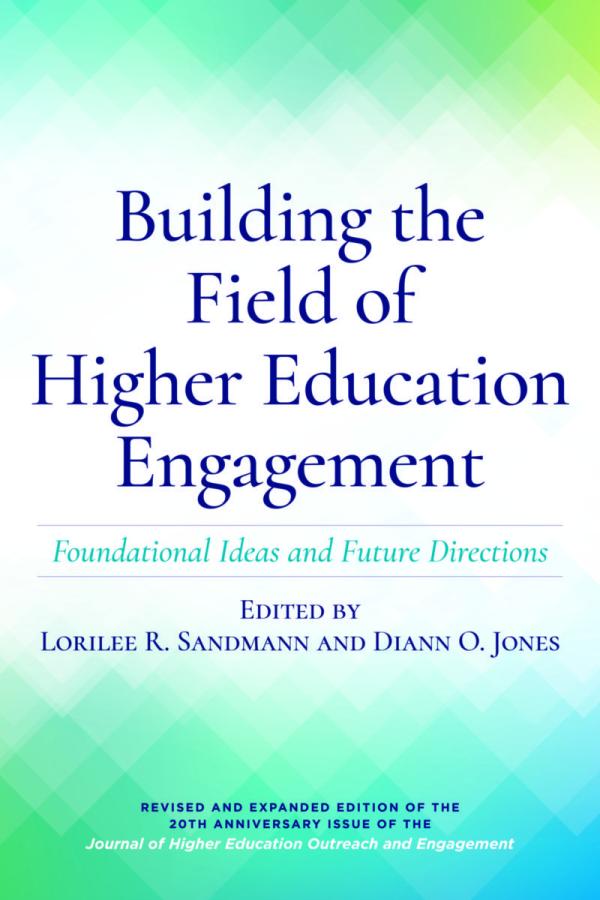
Building the Field of Higher Education Engagement: Foundational Ideas and Future Directions presents twelve landmark articles from 1996-2012 that contributed significantly to the emergence of the field of engagement. Along with the articles, the book presents updated commentaries and responses by the original authors or noted scholars to the questions they proposed. The format of this publication is thoughtful as each chapter presents conversation-provoking questions about engagement across academic disciplines. In addition, Chapter 13 is a prospective look into the future. Nine authors provide their insights to what engagement may look like in the next two decades. This book is valuable to those in the specific field of religious education as it strives to rethink the work of the academy. Lorilee Sandmann states that colleges and universities remain one of the greatest hopes for intellectual and civic progress because they search for answers in light of pressing problems (xiii). Furthermore, higher education in its highest ideals is committed to the scholarship of engagement. She defines engaged scholarship as a mutual relationship between academia and the community that leaves a positive legacy for all partners (xiv, 196). These concepts challenge established notions about higher education. First, this book examines the most foundational values of education. Engagement should be built from these values and not the expectation to do research and achieve tenure. As a result this creates ripples in the culture and expectations of the academy so that a new or revised model for higher education may emerge. Second, this book challenges the way educators see themselves and how they are to engage the community. The community has come to view them as ivory tower elites. Conversely, this volume challenges institutions and educators to participate in outreach to the community at large. The text provides several interdisciplinary examples of outreach. It is important because it generates conversations about the role of faculty and their role in outreach. This is a valuable contribution as the book also gives suggestions on how engagement and outreach can be measured so as to be included in the tenure process. Another valuable idea is the notion that knowledge is now non-linear. It was expected that the academy would study, research, and provide solutions for the world. The consequence is that the academy does not answer the questions the community is asking. In a non-linear world, the community has knowledge. The academy must necessarily be more engaged in the world that surrounds it. Through interdisciplinary dialogue, the text provides valuable insight into these conversations. For theological educators this is an important book because it provides language to understand the complex relationships between the community and the academy; as well as that between faculty and administration. It causes the reader to reimagine the requirements of tenure and the meaning of higher education in a fast-changing cultural milieu. This book conceptualizes the changes in the work of the academy so that one is better prepared to engage an institution’s culture and values so that it may be more true to education’s highest ideals and values.
Death is all around us. The palpable feeling of impending loss, grief, dread, doom, and despair has gripped our families, our nation and the world. With each passing day, there are increased numbers of positive diagnoses, hospitalizations, and loss. It feels as if we have been snatched up into the sci-fi novels of Octavia Butler. We are on the inside of an apocalyptic narrative. We, the global community, in this pandemic moment, are walking through the valley of the shadow of death. Mental health professionals are part of the teams of experts who are working tirelessly during this pandemic. Societal shuddering and quarantine have meant an increase in domestic violence, self-harm, and child abuse. There has been an uptick in all the forms of mental illness. Sustained periods of terror, trauma, and isolation shred our imaginations. The pressure of this moment will drive some people mad. The corporate value of rugged individualism is not serving us well in this moment. The myths of the lone ranger, the solitary winner, the underdog triumphing against all odds, are box office favorites. In the past, we have preferred the lone achiever, we have favored the one winner, and have envied the one, most prized, beauty. In this moment of pandemic, the ideologies which promote “I, me, mine” are failing us. Slowly we are awakening to, and becoming desperate for, “we, y’all, us, everybody.” The pandemic will be interrupted by a vaccine and/or by a cocktail of medications which will more rapidly quell symptoms. In the meantime, let us steady our fear, anxiety, hopelessness and despair by revitalizing our notion of community. We know all life affects all other life. Martin L. King, scholar and activist, said it this way, “We are caught in an inescapable network of mutuality, tied in a single garment of destiny. Whatever affects one directly, affects all indirectly.” The poignancy of this truth was made vivid for me and my students when we traveled to West Africa. Many communities in West Africa welcomed me and my students many times over many years. While learning in the homes and schools of othered persons, my students and I were immersed in the life saving and unfamiliar practices of ubuntu. Ubuntu is a communal value of connectedness, radical care, hospitality and inclusion. Ubuntu means simply – “all-of-we-are-one.” It means, “I cannot know myself apart from you. And you cannot know yourself apart from me.” I means, “If we are not, I am not.” When Ghanaians greet a friend in the market place the question is not “How are you?” This question, in the practice of ubuntu, has no merit or meaning. The question about the welfare of a single person apart from kith and kin seems absorb in the ubuntu philosophy. The greeting, “How are you?” infers that you could be some way that your people are not. Or that the circumstances of your people are not your circumstances. In the practice of ubuntu, the report and disclosure of your wellbeing is a report of the wellbeing of your people. So, the greeting in the marketplace is “How is it?” The response is - “We are well.” The response is in the plural. In ubuntu, if your mother is well - you are well. If you brother or sister are on hard times – then you are on hard times. If your aunt or uncle had a victory, then you had a victory. How you are is how they are – because “all-of-we-is-one.” Ubuntu is bubbling up all around the USA. People all over the country are finding ways, while honoring physical distancing and quarantine, to build community, find community, be community, support community, live as if we are one community. Neighborhoods are having cocktail parties while each neighbor stays on their own porch. Synchronous on-line experiences like concerts, card games, birthday parties, yoga, cooking lessons, and writing sessions are easing the feelings of loneliness and the strain of being alone. Streamed and recorded worship experiences are connecting disconnected souls. Experiencing community, being part of something bigger than oneself, knowing that you are connected to neighbor, fictive kin, family and co-workers helps all of us cope and survive in these death dealing times. In ubuntu, individualism is replaced with empathy, forgiveness, mutuality, and a feeling of deep connection with all that is. The Wabash Center, in our nimbleness and responsiveness, has reached out to our participants asking, “How is it?” We have heard from our colleagues the many ways they are sustaining and building community. We have also listened to laments from persons in the academic community who feel neglected, overlooked, and lonely. We have heard colleagues say, with relief in their voices, – thank you for checking on me, because no one in my school has reached out to me. Friends, the life of the mind cannot be a life of isolation unto death. Check on your colleagues – just say, “How is it?” And – as important - do not be afraid to reach back when you receive a call. Participating in activities of community will beat back the fear, the anguish and the trepidation. The devastation of the pandemic will be felt for years. Together (and not apart) we will survive. In the words of Toni Morrison -- "This is precisely the time when artists go to work. There is no time for despair, no place for self-pity, no need for silence, no room for fear. We speak, we write, we do language. That is how civilizations heal." Let community building be our artistic message. Let the composers among us write songs celebrating the marvel of community. Open the old cookbooks for cocktail formulas and recipes to reconnect with the ancestors. Make quilts in virtual sewing bees for the babies born at this peculiar time; knit shawls for those who are now widowed. Relieve a parent who is home schooling by writing poetry with their children on Facetime. Map the vegetable garden you will soon plant and ask your neighbor which veggies would they like planted. Find a way to create something for someone else knowing this gesture of care and thoughtfulness will radiate out to everybody. And when the blues come (as they will) – write the words of lament, despair and hopelessness, express the uncertainty and rage, make vivid your messiness and unbalance and sorrow. Then share it with someone else – a neighbor or friend - to help them release their pain. And so – the question, I suppose, is “how is it with me?” I am both overjoyed and overwhelmed. I am so grateful to the Wabash Center staff for their maximum flexibility in a time when we could have gone dormant. We transitioned to working remotely while at the same time scrambled to create needed resources for our participants. We created a dedicated web-page for online teaching resources, tripled the number of podcasts, hosted digital check-in conversations for more than 20 workshop groups, created a Facebook page and started live webinars. We are creating a page for artistic expression and dedicated blog column for online teaching. I am overjoyed about my staff’s dedication and hard work. We have gotten feedback that our efforts are helpful in this moment of disenfranchisement. My overwhelmed-ness is that I started the job of directing the Wabash Center just three months ago; I am still disoriented. Then, last week, I was informed that in my circle, three friends are diagnosed with COVID-19; the wife of a friend died on Wednesday, and the brother of another friend died of cancer on Sunday. Both families are in grief and in upheaval because the funerals will be livestreamed. In the spirit of ubuntu – we are overjoyed, we are new to our job and overwhelmed, we are grieving the loss of loved ones and incensed because a livestreamed funeral is inadequate to hold our sorrow. Even as I write this, I have a keen sense of my community gather around me - calling daily, checking-in regularly – finding ways to be together through this chaos.