Resources
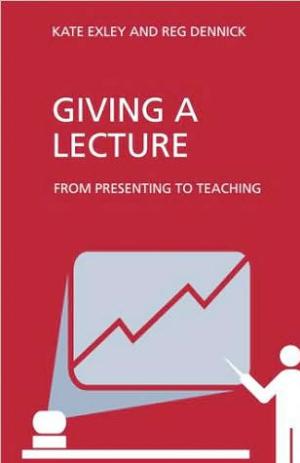
The second edition of Giving a Lecture builds upon the reputation and success of the Key Guides for Effective Teaching in Higher Education series. It is an excellent resource for those new to teaching at the University and College level and for those who just want to reflect upon and refresh their lecturing practice. The best selling first edition has been fully revised, and this edition continues to cover all the basics on how to go about lecturing while maintaining its jargon-free and accessible style. New lecturers will find the second edition equips them with the essential tools and guidance for delivering a successful lecture, and explains exciting new developments along with the fundamentals of lecturing. Addressing a number of rapid developments that have occurred since its first publication in 2004, the second edition provides: * A new chapter on podcasting and e-lecturing * Much more on the effective use of PowerPoint * Guidance on using interactive handsets to promote active learning and engagement * Consideration of the role of Lectures in problem based learning (PBL) courses * An expanded chapter that addresses current diversity/inclusivity issues * A fresh look with new Illustrations * Updated 'Recommended Reading and Web-Resource' sections This handy guide uses a multi-disciplinary approach based on sound educational theory to provide clear guidance and engaging ideas on giving a memorable and motivational lecture. Readers will find its straightforward approach is both readable and very practical, and new University and College Teachers, Graduate Teaching Assistants, Part-time Tutors, Teaching Clinicians and Practitioners, together with those interested in educational and staff development, will find this book provides them with all the guidance they need to lecture with confidence and skill. (From the Publisher)
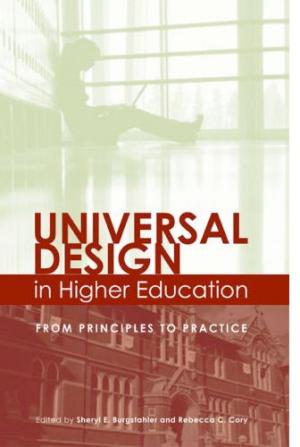
Universal Design in Higher Education is a comprehensive guide for researchers and practitioners on creating fully accessible college and university programs. It is founded upon, and contributes to, theories of universal design in education that have been gaining increasingly wide attention in recent years. As greater numbers of students with disabilities attend postsecondary educational institutions, administrators have expressed increased interest in making their programs accessible to all students. This book provides both theoretical and practical guidance for schools as they work to turn this admirable goal into a reality. It addresses a comprehensive range of topics on universal design for higher education institutions, thus making a crucial contribution to the growing body of literature on special education and universal design. This book will be of unique value to university and college administrators, and to special education researchers, practitioners, and activists. Universal Design in Higher Education looks at the design of physical and technological environments at institutions of higher education; at issues pertaining to curriculum and instruction; and at the full array of student services. It concludes with a thorough consideration of how to institutionalize universal design at higher education institutions. (From the Publisher)
This book brings together essays that explore Indigenous ways of knowing and that consider how such knowledge can inform educational practices and institutions. Indigenous Knowledges is resiliently local in character and this poses a distinct contrast to the international, more impersonal system of knowledge prevalent in Western educational institutions. In the words of Mi'kmaq scholar Marie Battiste - a leading proponent of Indigenous Knowledge and a contributor to this volume - Indigenous Knowledge expresses "the vibrant relationships between the people, their ecosystems, and the other living beings and spirits that share their lands." Indigenous Knowledge and Education argues that such knowledge has much to offer schools and students in the United States and beyond. This volume examines a wide range of Indigenous cultures and educational settings, including Native American, Haitian, Mexican, African, and Australian. Uniting all are three themes exemplified by many Indigenous cultures: struggle, strength, and survivance--the later a notion of survival that emphasizes remembrance, regeneration, and spiritual renewal Each of these themes is explored in a rich array of articles and capped with new essays by Marie Battiste, Gregory A. Cajete, and Bryan McKinley Jones Brayboy. A wide-ranging and persistently stimulating volume, Indigenous Knowledge and Education casts contemporary theories and debates about education in a new--and essential--light. (From the Publisher)
Journal Issue.
Opinion. Discusses the interplay among religion, education and multiculturalism in reshaping conscience. Persistent premise that not only salvation but also civilization was not possible without Christianity; Relaxing of exclusivism by the Vatican Council II to reach out to other faiths.
New technologies provide tools to reconstruct education as we undergo dramatic technological revolution and enter a new millennium. In particular, multimedia technologies, like CD-ROMs and Internet websites produce new resources and material for expanding education. In examining the Shoah Project—which documents the experiences of survivors of the Holocaust—, we demonstrate how this project provides important tools for historical and religious education, as well as making the reality of the Holocaust vivid and compelling in the contemporary moment. It is within this context that we discuss how multimedia can provide an important supplement to multicultural education, bringing the experiences of marginal and oppressed groups to the mainstream. Yet we also argue that effective multimedia education also requires historical contextualization, the skills of media literacy, and engaging pedagogical presentation in the classroom to make such new technologies effective as a supplement to traditional classroom and print-based education. Hence, we show how educational technologies, such as those produced by the Shoah Foundation and the UCLA Film and Television Archives, can help reconstruct education for the next century.