Resources
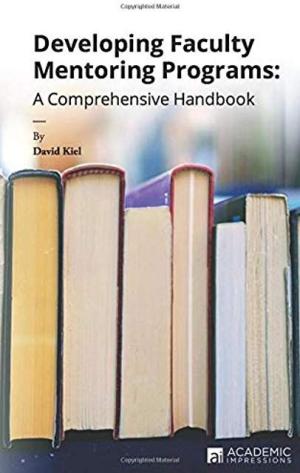
As institutions seek to increase faculty diversity, adopt increased standards for faculty productivity, and become more aware of the benefits of extending mentoring beyond early-career, it’s crucial to bring rigor and definition to your department’s mentoring efforts. David Kiel, who worked with faculty leaders to design mentoring programs for all of UNC-Chapel Hill’s professional schools and the College of Arts and Sciences, draws on years of research and experience to bring you this uniquely comprehensive handbook. This book includes practical strategies from a wide range of institutions, from community colleges to research universities. (From the Publisher)
My most recent tweet (of almost ten thousand) was 40 weeks ago. My most recent Facebook status update (except for a brief "thank you" for birthday wishes in July) was 46 weeks ago. The previous three years, however, I have taught my main introductory course, "Introduction to the Hebrew Bible," as an open, freely-available, online event built almost entirely on social media, especially Twitter, WordPress blogs, and Google Docs. This was the Open Old Testament Learning Event, or "OOTLE." My use of social media in higher education was based on a belief in the power of making for learning, and on a utopian vision for the internet that was based on my own experience. Eventually, the failures of the major centralized social-media platforms to proactively account for systemic abuse of marginalized users led me to abandon our pioneer outpost of open learning, and to retreat with my students back into the familiar confines of "the devil I know," the closed learning management system or "LMS." Many educators will have some familiarity with the learning theory "constructivism" (sometimes "constructionism"). According to this model, learners do not simply "acquire" knowledge, but rather always "construct" knowledge by synthesizing their existing understandings with new information or insights. Less well known, however, is that according to a constructivist model, this knowledge-making is more likely to occur where learning happens socially and where learners collaboratively build artifacts that are publicly shared. As the internet age took hold, and learners began increasingly to build their knowledge in a world of information excess rather than a world of information scarcity, it was often remarked that content on the internet was composed by perhaps 1% of internet users. Perhaps 9% of users interact with this content, and some 90% only passively consume content. This is sometimes called the "1% rule" or the "90/9/1 rule." From computer science to the humanities, educators began to embrace the power of "maker culture" to unleash the potential of constructivist learning in individuals, and to remake the internet in the image of the whole body of its users. It was in this context that the use of social media in higher education began to spread like fire: classroom Twitter "back channels" or weekly synchronous "Twitter chats"; blogging assignments on open web platforms like WordPress; presentation or digital storytelling on YouTube; and Facebook groups and pages. Then in 2014 came "Gamergate," a campaign of organized harassment against female game designers and game enthusiasts, including frequent credible threats of sexual violence and murder. Gamergate provided a playbook for white supremacist organizations and eventually, it seems, even for Russian interference via "troll farms" in 2015-16 U.S. political discourse on Twitter, Facebook, and YouTube. ("Trolling" describes skillful, media-savvy practices in derailing or redirecting discourse, whether for pleasure, malice, or profit.) Even among social-media users apparently uninvolved in these large events, in became clear that the codes of conduct and anti-harassment policies dictated by the young, white "tech bros" of social media (Jack Dorsey of Twitter, Mark Zuckerberg of Facebook), could not provide marginalized users anything like the safe environment enjoyed by privileged users less likely to be targeted. This remains the case, skewed as these policies are toward favoring "free speech" in an absolute sense and leaving users to block malicious actors as best they can . . . only possible, of course, after the malicious acts have occurred. Even we relatively privileged users became accustomed to weary acknowledgements that "of course Twitter is a cesspool, but . . . " Eventually, "But. . . “ became for me, and for many educators in my circles, "But what?" and then "But nothing." It had become impossible to offer my learners a reasonable guarantee that they would enjoy equitable social-media experiences, regardless of how they chose to present their race, gender, sexual self-understanding, class, or other differences. As I consider shepherding learners again into the social-media space ("not yet, not yet"), I remain optimistic about decentralized platforms like Mastodon. It is clear that the "one size fits all" approach to codes of conduct and anti-harassment policies (as on Twitter and Facebook) is untenable. On Mastodon, a radical free-speech, no-holds-barred community can have its minimalistic code of conduct, while a more proactive, highly-moderated community can choose to federate with that group, or not. I have not given up on a commitment to learning via collaborative construction of publicly available artifacts, but I am once bitten . . .and will twice be shy of any monetized, centralized platform.

ePortfolios are web-based, student-generated collections of their work and reflections on their learning and growth. They are tools for students to synthesize and integrate their learning, inside and outside of the classroom, by critically reflecting on their academic and co-curricular experiences. I first learned about ePortfolios from George Kuh who visited our campus in the fall of 2016 and mentioned that they were the latest addition to the list of High Impact Practices that deepen student learning (https://www.aacu.org/leap/hips). As Bret Eynon and Laura Gambino note, ePortfolios can facilitate student inquiry into their own learning, reflection on their development and growth, and integration across disciplines, as well as curricular and co-curricular contexts (2017, 20). As repositories of student work, ePortfolios allow students to reflect on their academic learning at various stages of their undergraduate development. They facilitate critical reflection which has been theorized as a four-stage reflective cycle (presence in experience, description of experience, analysis of experience, and experimentation; Rogers 2002) or a three-step sequence (describing experiences objectively, examining experiences in light of learning goals, and articulation of learning that includes goals for future action; Ash & Clayton 2009). In ePortfolios, students can describe their work (research papers, leadership positions, etc.), analyze how it has contributed to their growth and development, and experiment with various future possibilities by tailoring their ePortfolios for different career paths and job opportunities. I have used ePortfolios in several different courses: first year seminars, upper-level seminars, directed individual study, and capstone courses. ePortfolios allow seniors and recent graduates to showcase their work, and they have been shown to improve performance in job interviews because students can readily recall what they have done over the course of their undergraduate career and cite specific examples of their transferrable skills. In my capstone course, I had students create a type of ePortfolio that included pages about themselves, their signature work, their co-curricular activities, their resume, and their contact information. On their signature work page, I had them describe their capstone project for the general public and reflect on what they had learned in their program. ePortfolios can be powerful for first year students as well. Some institutions, such as Indiana University-Purdue University Indianapolis (IUPUI) include ePortfolios within their first-year-experience programs. They have students create ePersonal Development Plans (ePDP) that enable students to increase awareness of themselves and others, set self-concordant goals, develop hope, and shape education and career plans (https://eportfolio.iupui.edu/). When students create ePortfolios in their first year, they can build on it over time, reflect on what they have learned at various points in their undergraduate career, and chart different pathways when their personal and professional goals change. They can generate robust repositories of what they have learned in their academic and co-curricular experiences. Not unexpectedly, the ePortfolios from my first year seminar were less developed than my capstone course. First year students, navigating new terrain and trying to get their bearings, reflected on what they did in high school and what they hoped to pursue in college. Some had clearly defined goals and career aspirations, while others were uncertain and open to various trajectories. But I think the ePortfolio served two important purposes: first, it clearly demarcated their new identity as a college student, and second, it allowed them to reflect on what they wanted to get out of their college experience in a private forum. Although most free ePortfolios–such as Weebly, Wix, and Wordpress–are public, subscription ePortfolio platforms such as Digication, Pebble Pad, and Taskstream allow students to keep their ePortfolios completely private, share with particular individuals (such as their instructors or classmates), share it within their university, or make it publicly accessible. Many students find such privacy to be novel. When I asked my first-year students if they kept journals or did any reflective writing, I was surprised when only one student raised her hand. The rest said that they used social media such as Facebook, Instagram, or Finsta (a hidden Instagram shared among friends). Instead of engaging in private reflection, they were posting and performing on public or semi-public websites. As a result, many found ePortfolios to be unfamiliar territory, because there was no clearly defined audience, with the exception of myself, who would check to make sure that they were completing their pages, awarding all or no credit. For upper-level seminars and directed individual studies, I have had students create ePortfolios that were more closely tied to the course content. A student researching Aikido created one as a public website with an introduction to Aikido, an annotated bibliography of scholarly resources, and reflections on his personal experience. For my Buddhism course, they reflected on what they learned in the course, uploaded their scholarly review paper, and also wrote about their research for a more general audience. Questions to consider: Do you feel familiar with and comfortable using the ePortfolio platform? What campus resources and support are available for you and your students? For what purpose do you envision using the ePortfolio–for students to reflect on a paper/project, learning process, or academic development? Does your course seek for students to integrate their learning across various contexts or over time? If so, how might you use ePortfolios for this integrative learning? What prompts might you include in your ePortfolio to encourage the kind of integration, reflection, and synthesis that you would like to see? For example, you might ask what insights they gained from an assignment, how it connects to other goals, or how it contributes to their understanding of the discipline or their career development. References: Ash, Sarah L. and Patti H. Clayton. 2009. Generating, deepening, and documenting learning: The power of critical reflection for applied learning. Journal of Applied Learning in Higher Education, 1(1), 25-48. Eynon, Bret and Laura M. Gambino. 2017. High-Impact ePortfolio Practice: A Catalyst for Student, Faculty, and Institutional Learning. Sterling, VA: Stylus. Rodgers, Carol. 2002. “Defining Reflection: Another Look at John Dewey and Reflective Thinking,” Teachers College Record 104, no. 4:842-866.
In the late 1980’s, the church I served had a large staff and a sanctuary worthy of rental for the filming of a professional TV Christmas special. On an otherwise humdrum day in March, word that Stevie Wonder was in the sanctuary spread like wild fire around the staff offices. Along with the gossip, came the foreboding reminder that staff were not to enter the space since it was being rented. Never having been one to follow foreboding reminders, I used my master key to make my way down the back stairway and into the sanctuary through a little known and rarely used door. The sanctuary was abuzz with a TV camera crew, producers, musicians, and many persons I could not identify. I made myself invisible and sat in a pew behind Vanessa Williams. I looked at the chancel–sure enough, Stevie Wonder was at the keyboard. The Harlem Boys Choir was gathered around the piano and sprinkled in the pews and chancel area. I was wide-eyed and amazed. What a moment! In not-too-long, the men Stevie Wonder was talking with left the chancel. Stevie Wonder started playing the keyboard. He looked up from the keyboard and called over to the church’s organist who was seated on the organ bench. Stevie Wonder said, “I feel like Malott’s Lord’s Prayer.” This piece of music is considered one of the music standards of African American church musicians; every church musician worth his/her salt knows this piece. The organist paused, called over to Stevie Wonder and asked, “Do you have the sheet music?” A nervous hush-your-mouth fell over the enormous room. It was one of those rare moments when the shock was so great things seemed to go into slow motion. Some of the shock came from the fact that a professional musician asked a blind man for sheet music. The rest of the guffaw came from the pronouncement that a professional church musician could not play this standard without reading it from sheet music. As providence would have it, the director of the Harlem Boys Choir had heard Stevie Wonder’s request and the organist’s embarrassing response. The Director pointed to one of the boys who was standing on the chancel steps. The boy, dutifully and without hesitation, ran to the piano and began playing Malott’s Lord’s Prayer. As soon as Stevie Wonder heard the piano sound, he joined in on keyboard. That afternoon, I sang Malott’s Lord’s Prayer with Venessa Williams, Stevie Wonder, and the Harlem Boys Choir. A few camera people and producers sang too. It was a triumphant moment of Christmas in March! Gardner Taylor, considered an extraordinary preacher, would leave his sermon manuscript, which he had spent the entire week poring over, in the middle of his desk, then go into the pulpit and preach. He would preach his sermon relying upon his preparation and the movement of the Holy Spirit. The reason we know this to be the case is that he never entered the pulpit with anything but a Bible in his hand and there are reams of Dr. Taylor’s sermon manuscripts. My former colleague, Otto Maduro, would lecture from post-it notes–only 3 or 4 for an hour lecture. Never did I see him stand and read aloud from a manuscript and always did he give an impassioned and informed lecture. About ten years ago I decided I knew the materials in my introductory course well enough that I would no longer use a manuscript for lectures. The first couple sessions, I was afraid I would forget something or leave out some vital aspect of theory. What I discovered was that rather than reading to my students, I began to talk with my students as I lectured. Without a manuscript, I was able to be present with them in a significantly different way. Being untethered from a manuscript allowed me to come from behind the podium; allowed me to watch their expressions and pay closer attention to their breathing; allowed me to think fresh thoughts as I talked. My glitch then and now is when a student wants me to repeat something verbatim. I say, “Hmmmm . . . I was not listening to myself.” Then a student (there is always one) who takes copious notes repeats what I said and we move on. Teaching without a manuscript allows me to gather-in previous conversations, items in the news, and the temperament in the room. I can have moments of scripted thoughts and I can have moments of improvisational musings which ground the discussion in the here-and-now. When I am free from a manuscript I can help students in meaning-making with the inflictions of my voice, the gestures of my body, based upon what I know of their own life experience. It makes me more agile, more dexterous, more in-tuned with a conversation between us rather than information from me to them. Lecturing without a manuscript has changed the tempo and rhythms of my teaching. I linger over notions when students signal they need more time and move quickly through items for which students signal they understand. I feel I have a better rapport with them because I am not focused on the page in-hand. I feel more free to teach. After doing this for ten-plus years, I am convinced that by the end of the semester I have covered as much or more intellectual terrain as I did when I had a manuscript. Like the piano-playing boy in the Harlem Boys Choir–there are some intellectual standards that I know, and letting go of the manuscript makes me better able to perform what I know with conviction and percussion. I can play it on cue, not in a mechanical or rote fashion, but in the moment and for the people who are also there to play. We learn, in these moments, to listen for each other. Highly respected musicians make it their craft to read the notes as printed, as intended by the composer, as expected by the listening audience when they are knowledgeable and ridged. The great work of composing music or writing a manuscript is not to be overlooked or belittled. Playing the music without interpretation, without deviating – trying to get it perfect--is a respected form, discipline, practice. Even so, there are genres of music and kinds of musicians who lift their heads from the sheet music and dare to interpret, dare to make the music their own in every moment. I want to teach, not toward the illusion of perfection, but toward authentic expression of my own voice, my own “take,” – exposing my students to my own spiritual authenticity. I suspect the boy who played for and with Stevie Wonder that day is now a man who still remembers that remarkable moment. I hope he is a man who still knows how to say “yes” to improvisation and the grace which comes with letting go.
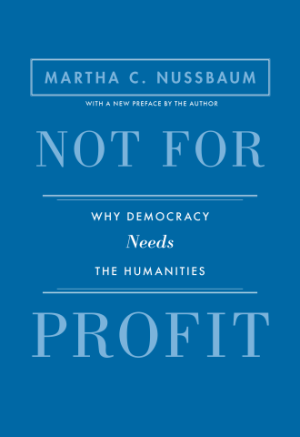
In this short and powerful book, celebrated philosopher Martha Nussbaum makes a passionate case for the importance of the liberal arts at all levels of education. Historically, the humanities have been central to education because they have been seen as essential for creating competent democratic citizens. But recently, Nussbaum argues, thinking about the aims of education has gone disturbingly awry in the United States and abroad. We increasingly treat education as though its primary goal were to teach students to be economically productive rather than to think critically and become knowledgeable, productive, and empathetic individuals. This shortsighted focus on profitable skills has eroded our ability to criticize authority, reduced our sympathy with the marginalized and different, and damaged our competence to deal with complex global problems. And the loss of these basic capacities jeopardizes the health of democracies and the hope of a decent world. In response to this dire situation, Nussbaum argues that we must resist efforts to reduce education to a tool of the gross national product. Rather, we must work to reconnect education to the humanities in order to give students the capacity to be true democratic citizens of their countries and the world. In a new preface, Nussbaum explores the current state of humanistic education globally and shows why the crisis of the humanities has far from abated. Translated into over twenty languages, Not for Profit draws on the stories of troubling—and hopeful—global educational developments. Nussbaum offers a manifesto that should be a rallying cry for anyone who cares about the deepest purposes of education. (From the Publisher)
Click Here for Book Review This book would be especially helpful for educators and administrators hoping to equip their students with theoretical tools and practical exercises aimed at “bringing to light dynamics of power which privilege conformity” and “revealing the normally occluded dynamics of dominant discourse”(6). It is also a resource for those who see themselves occupying hybrid spaces; those who acknowledge a multiplicity of knowledges and competing and intersecting realities and experiences, who interrogate and trespass boundaries, and, overall, who strive to “see” the water in which they swim. - Katherine Daley-Bailey, University of Georgia Reflexivity and Critical Pedagogy highlights the essential nature of reflexivity in creating sites for transformative possibilities in education. The book argues that seemingly intractable epistemological inequalities are embedded within educational structures and processes and also contends that perspectives which define knowledge as a unitary truth are essentially inadequate to address current global problems. Further, it argues that people and ideas traditionally positioned outside the academy are vital to developing more effective educational interventions. This volume stresses the influence of dominant societal discourses in creating and sustaining particular and limited definitions of knowledge. It also explores their power in delineating acceptable processes of knowledge dissemination. These discourses, whether consciously or otherwise, indwell teachers, learners and policy-makers as well as educational structures and organisations. It proposes reflexivity as the key component needed to combat such forces and one that is an essential ingredient in critical pedagogy. (From the Publisher)
A well-worn, often-told tale of woe. American higher education has been secularized. Religion on campus has declined, died, or disappeared. Deemed irrelevant, there is no room for the sacred in American colleges and universities. While the idea that religion is unwelcome in higher education is often discussed, and uncritically affirmed, John Schmalzbauer and Kathleen Mahoney directly challenge this dominant narrative. The Resilience of Religion in American Higher Education documents a surprising openness to religion in collegiate communities. Schmalzbauer and Mahoney develop this claim in three areas: academic scholarship, church-related higher education, and student life. They highlight growing interest in the study of religion across the disciplines, as well as a willingness to acknowledge the intellectual relevance of religious commitments. The Resilience of Religion in American Higher Education also reveals how church-related colleges are taking their founding traditions more seriously, even as they embrace religious pluralism. Finally, the volume chronicles the diversification of student religious life, revealing the longevity of campus spirituality. Far from irrelevant, religion matters in higher education. As Schmalzbauer and Mahoney show, religious initiatives lead institutions to engage with cultural diversity and connect spirituality with academic and student life, heightening attention to the sacred on both secular and church-related campuses. (From the Publisher)
This edited volume draws together educators and scholars to engage with the difficulties and benefits of teaching place-based education in a distinctive culture-laden area in North America: the United States South. Despite problematic past visions of cultural homogeneity, the South has always been a culturally diverse region with many historical layers of inhabitation and migration, each with their own set of religious and secular relationships to the land. Through site-specific narratives, this volume offers a blueprint for new approaches to place-based pedagogy, with an emphasis on the intersection between religion and the environment. By offering broadly applicable examples of pedagogical methods and practices, this book confronts the need to develop more sustainable local communities to address globally significant challenges. (From the Publisher)
I spent most of my early teaching online trying to figure out how to make key aspects of residential teaching and learning—interactive lecturing, organic discussion, respect for diversities—possible in online contexts. I’ve sometimes wondered: “Will teaching online at some point begin to enhance what I think I already know about teaching well residentially?” The answer is yes. And the scope is surprising. Most educators work out their teaching pedagogy and practices in residential spaces. How educators teach is shaped by how we were educated, mentored, and seasoned by residential teaching practices. So it is natural to picture a one-directional flow of impact: finding adaptive ways to bring the best of good residential teaching into online course design. Yet the enhancements can flow in reverse, making room for fruitful bi-directional cross-fertilization. There is more to say, but here is a big picture view to whet the appetite. Supporting More Equitable Conversations: Teaching online has matured the strategies I use for fostering more robust and equitable conversations in the residential classroom. Discussion dynamics online become more democratic when each student is equally invited and expected to contribute to conversation. In those moments, the peer-to-peer learning intensifies because all voices are heard even in the midst of sometimes hard gender and racial dynamics. In residential spaces, minority, international, and women students frequently aren’t given adequate space to enter into large group conversations. And some of the brightest male and female students process internally or in writing. I know the power of each student’s voice because I read assignments. But the most trenchant student perspectives in a residential course are often not heard by peers. Online teaching has prompted me to experiment with residential teaching strategies that mimic the more democratic online discussion. One successful strategy is to invite every student to write three sentences on a discussion topic; then open the discussion with each student selecting and reading the sentence of their choice. Another tactic is to have a less vocal student “unlock” a discussion with a first word on the topic, and another less vocal student “close” the conversation with the concluding word. Resourcing Complex Life Contexts: Online teaching has also widened my view of the resources students bring to a residential classroom from their own backgrounds and life contexts. Online course assignments and learning activities ask students to connect what they are learning to their professional, personal, or cultural contexts. This makes learning more meaningful and applicable, and expands the contextual awareness of both peers and educators. Residential classrooms are full of the same kinds of resources which often go untapped. I have become more intentional about utilizing free-writing moments in class or pair and share opportunities for students to connect learning to their life contexts. In residential course assignments I am now more explicit about expecting and rewarding innovative connections to life contexts that expand the contextual awareness of the entire class. Prioritizing Desired Competencies: Teaching online has also challenged me across teaching contexts to be more explicit not only about what I want students to know, but what I want to see students be able to do. For example, in an online theology course I want students to learn how to respectfully engage one another online around complex aspects of Christology. I realized I had a similar “hidden” objective in the residential version of the course which is now in the syllabus. Prompted by online experimentation, I have also reframed some residential course objectives as desired competencies a student must demonstrate by the end of a course. For example, I added three prayer competencies in a residential course on Trinitarian themes: a well-crafted pastoral prayer, a memorized scriptural benediction, and an unscripted blessing and anointing. In these competencies, students could see the beauty and pastoral impact of Trinitarian language. And I could celebrate and more accurately evaluate not only maturing knowledge but also new capacities and skills. Respecting Complex Life Contexts: In residential courses I am now more intentional about respecting students’ time by selecting strong but accessible readings, scaffolding assignments with straightforward expectations, and affirming good communication around the life challenges impacting their learning. Online courses are tailored to professional and working adults who must multitask across layered responsibilities: child or elder care, volunteer work, job commitments, full or part-time pastoral leadership, and graduate theological education. I remind students online that my own life is similarly complex. Mutual kindness and reasonable expectations are essential; I do not expect them to be online 24/7 and I deserve the same consideration. This has alerted me to the ways in which all of my students, including residential, are adults with complex life commitments and circumstances. I need to honor time on all sides and promote clear and open communication in both kinds of teaching spaces. These are some of the ways fruitful bi-directional cross-fertilization can happen between online and residential spaces of teaching and learning. There is much more to say. Stay tuned.
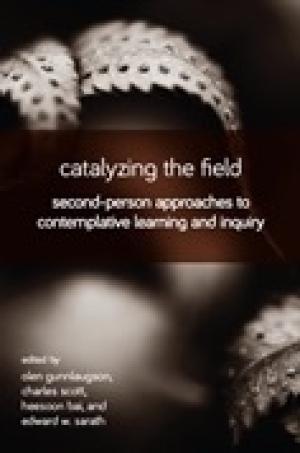
A rich collection of essays about the inner, shared experiences of participants engaged in second-person approaches to contemplative practice. Catalyzing the Field presents a diverse series of applied case studies about the second-person dimension of contemplative learning in higher education. As a companion volume to the editors’ previous book, The Intersubjective Turn, the contributors to this book explore various pedagogical scenarios in which intentional forms of practice create and guide consciousness. Their essays demonstrate that practice is not only intellectual, but somatic, phenomenological, emotional, and spiritual as well. Along with their first book, Contemplative Learning and Inquiry across Disciplines, the editors craft an essential body of work that affirms the fundamental importance of contemplative practice in institutions of higher learning. (From the Publisher)