Resources
The period 2002–2012 saw remarkable developments in multifaith education at American theological schools. Looking ahead, multifaith education in theological schools is poised to enter a new phase of broad engagement and development. This essay focuses on three aspects of the practice of multifaith education in seminaries. It first presents a brief historical overview of the initiatives and institutions that pioneered multifaith education in theological schools. It then summarizes findings from surveys, reports, and collegial gatherings about the pedagogy of multifaith education. Finally, eight questions for practitioners of multifaith education seminaries to explore in the future are offered.
Jesus and Mary have been called simultaneously a bridge and a gulf between two massive, complex religion-communities. In spite of this – and in spite of obvious distinctions between instructional venues such as a church's adult education program, a seminary classroom, or a required university theology course – a fairly consistent set of strategies work well when helping Christians understand Jesus and Mary as Muslims known them. Gaining such familiarity is useful preparation for Christians' eventual appreciative conversation with Muslims.
The authors developed and co-taught a course on Korean indigenous spiritualities designed primarily for Korean Christians to reflect on whether such spiritualities might hold resources for their religious lives. Engaging students directly with the spiritual practices, texts, and representatives of the traditions, the course encouraged students to voice their understandings of these traditions on their own terms, and the extent to which they might hold resources for Korean Christianity. Starting each class session with pair discussions (in Korean, if desired), and then sharing the pair responses with the larger class for fuller discussion gradually developed intracultural interreligious openness to the Korean indigenous heritage. Two non-Korean students brought “outsider” questions and responses to the conversation. Students reported that the learning experience was successful and valuable.
Many theological schools use short term travel as a way to foster interfaith education. Due to their experiential, holistic, and intense nature, travel seminars focused on the promotion of interfaith learning can shape a future religious leader's outlook on religious communities across the course of her entire career. In this article I explore the pedagogical dimensions of travel seminars as a tool for interfaith education through the lens of a travel seminar to Israel and the occupied Palestinian Territories.
Seminary education is adjusting to the global realities of inter-religious encounter. An increasingly important element of equipping seminarians must be the ability to embrace two dimensions of mature faith; (1) deep convictions related to their own faith, and (2) genuine civility in their engagement with others. The practice of convicted civility is best learned experientially through participative assignments and close contact with people of other faiths. The article explores an approach by which students are encouraged to develop the capacity and skills to both address the faith issues that divide us and to respond to social issues that require the exercise of civility to live together peacefully. The experience of Fuller Seminary, an evangelical, multidenominational, and multiethnic institution provides a context for educating seminarians for convicted civility in a multifaith world.
This essay argues, as its title suggests, that learning that is both comparative and theological can be an ordinary – possible, beneficial, even necessary – part of theological education and, like other fields of study, may be incorporated in the curriculum in ways that meet practical curricular needs. Once the professor has undertaken the initial, minimal learning, teaching comparatively can become a natural and integral part of any seminary course. The study of the other is not exotic or in a class by itself; if we can study our own religious tradition today, we can study others as well. The thesis is argued in several parts: (1) interreligious diversity is integral to the context of contemporary faith; (2) comparative theology engages diversity in an intentionally theological way and needs to be distinguished from other disciplines; (3) a comparative theological approach aids in the process of ensuring that attention to diversity is integral to theological education; (4) teaching comparative theology is not different from teaching other forms of theology. None of this, I suggest, requires a liberal or pluralist theological starting point.
This reflection offers a glimpse into a Masters' level practical theology course in “wisdom formation” for its potential implications and contributions in multifaith education. Instigated by an unexpected companionship between the two instructors – an eighth-generation rabbi, leader of CLAL (the Center for Learning and Leadership) and a Presbyterian practical theologian in a free-standing United Methodist seminary – this elective course was developed for Christian and Jewish ministry students, though it eventually evolved into a required Masters of Divinity course in theologies of religious pluralism and interreligious/intercultural encounter. The course's structure and implementation are described, followed by difficulties faced and potential implications for multifaith education, specifically those in disciplinary formation, institutional stewardship, and the diverse contexts and questions for teaching and learning.
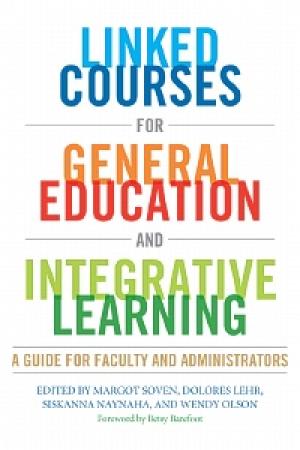
Click Here for Book Review Abstract: Research indicates that of the pedagogies recognized as “high impact”, learning communities – one approach to which, the linked course, is the subject of this book – lead to an increased level of student engagement in the freshman year that persists through the senior year, and improve retention. This book focuses on the learning community model that is the most flexible to implement in terms of scheduling, teacher collaboration, and design: the linked course. The faculty may teach independently or together, coordinating syllabi and assignments so that the classes complement each other, and often these courses are linked around a particular interdisciplinary theme. Creating a cohort that works together for two paired courses motivates students, while the course structure promotes integrative learning as students make connections between disciplines. This volume covers both “linked courses” in which faculty may work to coordinate syllabi and assignments, but teach most of their courses separately, as well as well as “paired courses” in which two or more courses are team taught in an integrated program in which faculty participate as learners as well as teachers. Part One, Linked Course Pedagogies, includes several case studies of specific linked courses, including a study skills course paired with a worldview course; a community college course that challenges students’ compartmentalized thinking; and a paired course whose outcomes can be directly compared to parallel stand-alone courses. Part Two, Linked Course Programs, includes a description of several institutional programs representing a variety of linked course program models. Each chapter includes information about program implementation, staffing logistics and concerns, curriculum development, pedagogical strategies, and faculty development. Part Three, Assessing Linked Courses, highlights the role of assessment in supporting, maintaining, and improving linked course programs by sharing assessment models and describing how faculty and administrators have used particular assessment practices in order to improve their linked course programs. (From the Publisher)
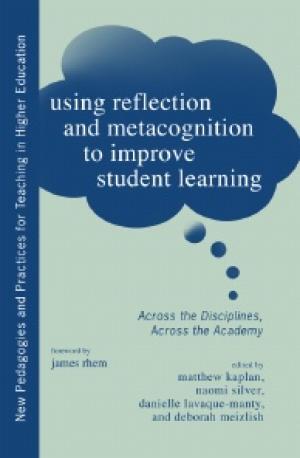
Click Here for Book Review Abstract: Research has identified the importance of helping students develop the ability to monitor their own comprehension and to make their thinking processes explicit, and indeed demonstrates that metacognitive teaching strategies greatly improve student engagement with course material. This book -- by presenting principles that teachers in higher education can put into practice in their own classrooms -- explains how to lay the ground for this engagement, and help students become self-regulated learners actively employing metacognitive and reflective strategies in their education. Key elements include embedding metacognitive instruction in the content matter; being explicit about the usefulness of metacognitive activities to provide the incentive for students to commit to the extra effort; as well as following through consistently. Recognizing that few teachers have a deep understanding of metacognition and how it functions, and still fewer have developed methods for integrating it into their curriculum, this book offers a hands-on, user-friendly guide for implementing metacognitive and reflective pedagogy in a range of disciplines. Offering seven practitioner examples from the sciences, technology, engineering and mathematics (STEM) fields, the social sciences and the humanities, along with sample syllabi, course materials, and student examples, this volume offers a range of strategies for incorporating these pedagogical approaches in college classrooms, as well as theoretical rationales for the strategies presented. By providing successful models from courses in a broad spectrum of disciplines, the editors and contributors reassure readers that they need not reinvent the wheel or fear the unknown, but can instead adapt tested interventions that aid learning and have been shown to improve both instructor and student satisfaction and engagement. (From the Publisher)
This report analyzes longitudinal enrollment trends in theological schools, using data collected by the Commission on Accrediting of the Association of Theological Schools (ATS). It is intended to provide information that will help theological schools and the religious communities they serve as they plan strategy and attempt to manage enrollments. It also serves as a backdrop for the comprehensive study of seminary students, On Our Way: Pathways to Seminary (2013), which provides an in-depth look at the experiences and influences that lead students to seminary. (From the Publisher)
Wabash Center Staff Contact
Sarah Farmer, Ph.D.
Associate Director
Wabash Center
farmers@wabash.edu