Resources
Almost twenty-five years ago a small, liberal arts college began a journey into critical pedagogies, both in some classes and at the departmental level. Students and faculty engage in department work together--setting curriculum, assessing programs, planning events, and rotating chairing of meetings. We are attempting to engage in transformative leadership with each other, as we re-imagine what a truly radical, democratic department would look like.
My teaching goals reflect my expectations that my students will change the world. I want my students to have profound consciousness of love, of themselves as capable beings, of the beauty of creation. I want to instill in them with the necessity to fight for the oppressed, uplift the downtrodden, and conspire with the voiceless for a place in the societal decision-making. I want them to be cunning enough to avoid the shallow passions of those who would exploit their talents, squander doing good, and misuse their power. I want them to be wise. With these ideals in mind, I design into every syllabus the notion of the body. There are few things more sacred and more political than the human body. Intentionally engaging the body to learn, while simultaneously making the politics of the body part of the course conversation, is a critical way to get to my lofty teaming aims and kindle my student’s passions. Wisdom depends on the body. A metric I use to assess in-class learning activities is the degree to which I have engaged all the senses of the body in a semester. If, by the end of the semester, I have not engaged all the senses multiple times and in multiple ways, I deem my cache of learning activities for that course as weak. When I engage all the senses multiple times throughout the semester, I notice students’ depth of understanding is higher. I carefully design activities for seeing, smelling, touching, hearing, and feeling, not because of student’s varied learning styles, but because a multisensory encounter is more interesting and is more satisfying to the curiosity. Giving adults permission and opportunity to learn with their bodies is an act of resistance against the current body politics which would deem the body only as a commodity. And it’s more fun than just sitting still. I am well versed in shaping courses that point to and analyze the ugliness of the hegemonic politics. A notion which oftentimes intrigues my students while studying the politics of the body in the USA is the ways our bodies are used as indicators of inferiority and superiority. It is thought that to gaze upon a body, one can determine who is male, white, straight, and wealthy. Continuing, it is also thought that to gaze upon a body one can determine who is female, not white, not straight, disabled, and poor. This delusion is perpetuated by the bad science portrayed on some TV shows. There is an episode of CSI where the coroner, while investigating a crime scene, uses a caliper to measure the width of the nose of a charred body and informs the detectives that the deceased victim was African American. Disputing this kind of ignorance about the body and race/gender/class/sexual identity politics is the stuff of marvelous classroom discussions. This semester I wanted to shape a course and a conversation that was a teaching of love, self-worth, dignity, acceptance, and belonging for the personal body, for bodies of knowledge, and communities as bodies of persons. The course is entitled “Reading Deeply.” I selected one book for us to read for an entire semester. The book we are ruminating over is Remnants: A Memoir of Spirit, Activism, and Mothering by Rosemarie Freeney Harding with Rachel Elizabeth Harding. It is a multi-genre memoir that vividly demonstrates an integrated life of deep spirituality and activism. I want my students to be exposed to the wisdom of this text in hopes that they will emulate this wisdom. A thematic thread in the memoir is of healing, wellness, and care for the body. Pressing students to deeper engage body/identity politics, the first assignment is to create a wellness plan and fulfill that plan throughout the semester. Students reported-in about their plan last week. While each woman was making her report (all the students are women), the other students listened with remarkable tenderness. There was an air of respect and regard as each woman told us of the focus of her plan, the rationale for the focus, and the activities she would pursue over the semester for healing, fitness, balance, and rest. The projects were about living into their best selves by disrupting the patterns of ignoring, abusing, or neglecting their bodies. The plans included stopping some habits and starting new habits. In all cases the women were excited about being given course space to consider her own body and contemplate the question, “do you want to be well?” Asking students to live-into the principals of our reading rather than just “think about” the reading is their preference for learning. Their reporting felt reverent. At the end of the semester, they will report-in again telling the story of attempts at self-care and healing. The political is always personal. In studying the harm, violence, and inhumanity of identity politics it feels right, needed, even provocative, to teach students to value their own bodies, to respect the enfleshed. The power of love to create a more humane world undoubtedly includes care of self, nurture of body – a tending to the soul. In the memoir (pp 39-40), Rosemarie recounts the words of her mother after recovering from a near-death experience: “…. Listen, Rose. When you die, there is nothing, nothing there but love. Everything else is gone.” “Hmm.” I listened. “Nothing but love,” she said again. “So while we’re in this world, we have to do whatever we can to love people, to love this world, to take care of all that’s in this world. Because that’s all that matters, the love.” I closed my eyes briefly. The impact of my mother’s words made me sway ever so slightly where I sat. “Hmm.” She was ready to get into bed. She was pulling the covers over her shoulders when she said it to me again, “Now don’t forget, Rose. There’s nothing left but love. That’s the most important thing. That’s what you need to know.”
Discussions of world citizenship that elide the challenge of grappling with religious worldviews expose a covert intolerance at the very core of secularism, calling into question the “liberality” of liberal education. The ethical imperative of engaging with different worldviews not only demands that religions be taught, but also raises questions regarding how religious worldviews should be taught.

A conservatory of music in my hometown annually brings to campus a famous singer who leads a master class for its voice students. This is a ticketed event open to the public and regularly draws a large audience. It’s simply fascinating to watch the singer teach. One by one, students come on stage, they perform pieces they have practiced for the occasion, and she offers her critique. Occasionally she offers a mini-lecture on some aspect of singing but mostly she makes students work certain sections of their pieces over and over, all the while offering correction, advice, and support. The audience hears how their music – which sounded pretty good, to begin with – improves with her coaching. While a master class is not the same thing as a studio, the two pedagogies share certain features. In my experience, teachers of religion and theology rarely make use of studio pedagogies; this book made me realize that we should. Studio pedagogy is typically defined by the following elements: lengthy design sessions conducted in large spaces where materials are readily available and works-in-progress can be publicly and permanently displayed. Instructors roam the space, stopping at individual desks to offer feedback that gets intentionally overheard by nearby students. Lectures and discussions are rare; studio pedagogy relies instead on coaching, modeling, correcting, responding, affirming or questioning choices, and occasionally offering on-demand content instruction. It combines authentic learning theory, constructivism, socialization into a profession, and the theories behind flipped classrooms and communities of practice. It shares features of other student-centered pedagogical approaches such as problem-based learning and service learning, although it focuses more on the process of students taking iterative steps toward a final, deliverable product of their own choice and making. This book is an edited volume presenting fifteen narratives by design instructors describing the studio courses they teach in fields like architecture, interior design, and instructional design. Contributors describe the joys, challenges, concerns, and vulnerabilities they have experienced through this sort of teaching. Overhearing their honest confessions and reactions is one pleasure of reading this book, and it gives the reader a taste of what being in a studio is like. This volume is also designed like a studio in that its editors explicitly eschew analysis and summary, preferring instead to “curate” the narratives and let readers draw their own conclusions. Indeed, religion and theology teachers might have to work hard to relate this book to their contexts. It will be most directly applicable to those in field education and those teaching certain kinds of performance or design – preaching, worship, ritual, or religious architecture. Yet its implications are valuable to all who are intrigued by non-native pedagogies. As I read, I kept asking myself, “Why do we keep our critique of student work private?” As one contributor points out, it is often when budding academics begin to share our work publicly that we take it more seriously, find it more gratifying, and believe it has value. Why shouldn’t our students experience the same?
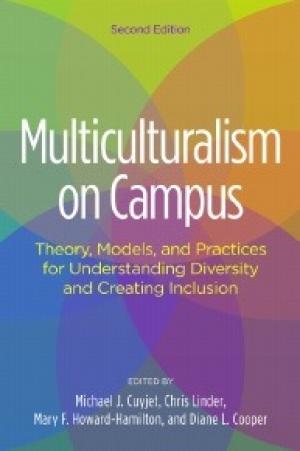
The Introduction to the second edition of Multiculturalism on Campus states that the book’s purpose is to provide “a comprehensive resource for students, faculty, and higher education administrators about multiculturalism and diverse populations on college campuses”(1). In addition to that goal, the second edition sets out, successfully, to give “greater voice to students who are not part of the dominant cultures” (1). The format includes clear and succinct case studies that assist in revealing the experiences of each group of these students on college campuses. Authors include discussion questions at the end of their essays to assist in processing the material and to move the conversation forward. Arranged into three perspectival parts with substantive essays addressing “Awareness of Cultural Issues,” “Information on Cultural Populations,” and “Critical Consciousness of Cultural Competence,” the book itself is a model of diversity and inclusion insofar as each essay can be understood as a roadmap for those who are just beginning to engage with the topic of multiculturalism on college campuses or it can serve to enrich and affirm the understandings of those who have been working in the area of student development and multiculturalism. The essays in the section on “Awareness of Cultural Issues” address foundational questions through the application of sociological, psychological, and student development theories. The discussions related to describing multiculturalism and understanding the effects of oppression on student development (Chapters 1 and 2) are filled with insights that can be related to the foundational concepts which have helped to shape curriculum in social justice and Catholic social teaching. In Part Two, descriptions of the various cultural populations that enrich our college campuses accurately reflect the diverse picture that exists today. Chapters on gender – “Men and Women” (Ch. 12) and “Lesbian, Gay, Bisexual and Transgender Students” (Ch. 13) – as well as the “Adult Student” (Ch. 14), “Students with Disabilities” and “Religious and Spiritual Diversity among College Students” (Ch. 15 and 16) are extremely helpful in presenting a dynamic picture of the reality that is the American college campus today. The information in these chapters is supported with data and cultural insights. Studies cited in each of the essays in this second section serve as significant entry points for further research while at the same time enlightening the newcomer to the diverse cultural context that shapes the lives of today’s college students. The abundance of information contained in the essays may seem overwhelming at times. However, each essay concludes with recommendations and discussion questions that provide support for the development of action plans that focus on inclusion. The questions assist students, faculty, and administrators with engaging in constructive critical discourse that leads to effective strategizing. Part Three addresses the ways in which the development of “Critical Consciousness of Cultural Competence” can occur. In this section, we come to understand that an intersectional framework is necessary for successful progress in developing the critical consciousness needed to engage in the work of inclusion and diversity. The work of social justice education is noted as holding the key to effecting change or progress in this area (384). The concept of an intersectional framework as presented here can be of assistance to those of us who are teaching courses in Catholic social teaching or peace and justice, as it demands the same competencies as those expected from the application of Catholic Social Teaching. The mastery of content along with the recognition of intersection of the various cultural contexts that inform the lives of students is something that needs to reverberate throughout the curriculum in higher education if we are to move forward as a society. The creation of inclusive campuses is the first step in bringing about real societal change and Multiculturalism on Campus is a valuable tool in making that happen.
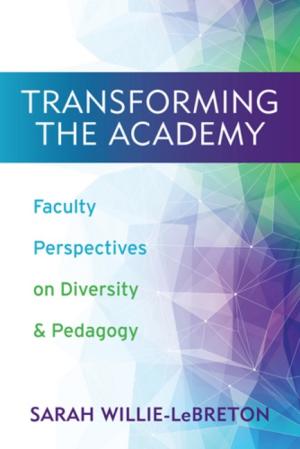
As diversity initiatives become more prominent in higher education, this volume features the perspectives of faculty on the progress and challenges of a diverse academy. The first-hand accounts shared through these autoethnographies manage to be simultaneously thought-provoking, memory-inducing, and pedagogy inspiring. Rather than a superficial treatment on numerical diversity when whiteness and its privileges are normative, this collection focuses on difference, but difference in this sense is not presented one-dimensionally. The editor offers, “When we focus on difference, rather than race, class, gender, disability, or sexuality only, we come to understand how each of these characteristics fits into the oppression/privilege paradigm much more clearly” (4). The book is organized by two overarching themes. In Part One, “Challenging Classrooms,” the authors describe the multiple ways and meanings of having their credibility or classroom authority challenged or accepted. For example, as the first and only professor, your very presence may be triggering for students, resulting in recognition, awkward expression, and then resistance. Student evaluations may indicate “pleasant surprise” that a Black professor “so smart and articulate” (51), and that the student didn’t really listen at first because expectations of a Black person went unmet. The chapters in Part Two, “Witnessing Protest,” acknowledge that college professors often teach life lessons in addition to the subject matter and that we may undergo transformations ourselves as we guide and mentor students through life situations, and as we bear witness to the experiences of students and colleagues. The contributors not only share their experiences as teachers, they also recall memories of being students themselves, including the impacts of shifting individual and collective identities. They describe resilience in the face of presumed incompetence, unwelcoming classroom environments, and unfavorable course evaluations. Challenged by their own recognitions, authors allowed their heightened awareness and sensitivity to inform self-reflection. For example, a student’s persistent inquiry about a contributor’s background and the kinds of schools that she attended resulted in the importance of recognizing her own “class privilege.” However, with that recognition came the worry that she “unconsciously wielded” that “privilege in order to combat racial stereotypes.” Another contributor raised the issue of the reluctance of embracing disability as diversity in the academy, offering that as “abject other,” disability is “viewed through frameworks of pathology and abnormalcy rather than those of identity and human diversity” (115). An accommodation as seemingly simple as making sure that the classroom community angled their bodies so that a student could read their lips created a richer learning environment for everyone. Throughout the narratives, there are pedagogical recognitions that lead to suggestions and models of small adjustments making meaningful impact. Students come with their own perspectives and should be encouraged to see themselves as “co-creators” of their educational experience (58). In a demonstration of the power and subtleties of language, one contributor instituted the “ouch” rule, whereby an offended person can say “ouch” and then pause for analysis of the offense (61). Some pedagogical insights arose from the students’ interpretation of and engagement with assignments. For example, in a photography self-portrait assignment, one student proactively cast herself in three stereotypes of Black women that she had often confronted, prompting visible discussions in effort to “redirect misperceptions” (78). The audience that may be reached by this book is wide-ranging, from graduate students to administrators and board members. All may benefit from the profoundly vulnerable, yet honest viewpoints offered.
It was my first semester teaching about 10 years ago in a seminary. Our class of about 35 students was into the second week of the semester and I was speaking about the complicity of the United States in the attack of 9/11. In the midst of my talk a student raised his hand and I asked him to speak. He proceeded to offend me in many ways: telling me I was not from this country and that I shouldn’t be in the US, much less teaching. After he was done, I was possessed by an anger that took away my ability to think. In the midst of it all I remembered that I was wearing a microphone so a student with impaired hearing could listen to my talk. I then went to the back of the class and asked the student to speak again into the microphone so the other student could hear. It was during this movement from the front to the back of the classroom that I gained some clarity. I got very close to him so he could use the microphone that was on my chest and I said, “Can you please say it all again so Mary can hear what you said?” I was so close to him I could feel his breathing. He was so surprised that he started stuttering and said only 20% of what he said the first time. And then we had to continue the class. We became opponents of each other and it was a very strange, fearful, and awkward semester. The current political atmosphere in this country is one made of confrontation. We address each other with the goal to win the battle, and in some or many ways, to annihilate the opponent. There is a certain pleasure not only in winning an argument but in depriving somebody from their own joys. Many polarities in our society are based on the assumption that these important issues can preserve or eliminate the very possibility of life. Whites see minorities as a threat to their social position, and even their lives; minorities see whites as owning a privilege and control of things-supremacy- that impedes them from living fully and even existing; heterosexuals see queer people as a threat to the nuclear family, ‘normal’ social composition and God’s design; queer folks see these heterosexuals not only limiting their social rights, but also endangering their very lives. Be it race and ethnicity, economics and class, sexuality and gender, we seem to locate ourselves in opposition and from those places we fight for our very lives. Classrooms are not exempt. Teachers and students come from the corners of those sides and may reproduce in class the same divisions experienced in society. Readings become ideological brainwashing, free speech is endangered on both sides, and taking a position offends someone. The results can be disastrous. It is not difficult to foresee uneven power discussions becoming a screaming contest with the aim being to wound the opponent. But also, there are discussions that produce silent harm in their aftermath. A friend of mine told me that her president asked faculty for ways to help her school to improve in terms of diversity. When my friend, somewhat naively, pointed out some aspects of the institution and its life that were alienating for minority persons, the discussion in the meeting skirted the issues she had raised and failed to recognize the problems. The next year, my friend didn’t get tenure because the president had felt personally offended in that meeting and said he couldn’t trust her anymore. In a culture that often does not know how to deal with conflict, where offense and injury are seemingly inevitable when we discuss difference and litigation is the only vocabulary we know to solve disputes, how do we model a culture of mutual appreciation and begin to create spaces where people can speak what they need to and, at the same time, be challenged regarding what they say? Marcia Y. Riggs in her article “Loves the Spirit”: Transformative Mediation as Pedagogical Practice,[1] gives us wonderful tools to create a space where dialogue is fostered instead of debate. She says: “The concept of dialogue is critical to intercultural communication because it is more than simply conversation; it is communication that nurtures relationship. This is the case because dialogue is based upon mutual respect and listening and learning from one another over time; “earning such respect comes through a willingness to accept the ‘other-ness’ of others.”[2] Dialogue creates a possibility for many voices to contribute, but debate opposes one person over another. Surely, we can’t go into dialogue with the naïve feeling that we need to be nice to one another. Surely we can’t be unaware of the power dynamics and tensions always present in organizations and schools. Fearful sentimentalities when pronounced through pedagogies formed out of the fear of conflicts easily succumbs to other fears lurking in the space and end up avoiding the very issues that we are supposed to discuss. The same thing happens with “safe” pedagogies that tend to create safe/artificial spaces where people only speak what is “non-threatening” and the very issues at stake continue in a latent mode. We need pedagogies of courage that help us confront each other fully by creating forms of trust and recognition, offering tools and programs that do not work from fear and don’t aim at simply checking the proper list of mutual respects. Just recently I was in a classroom in my seminary where my colleague who teaches a difficult class allowed students to ask, talk, and make mistakes, fundamentally practicing honesty. Fiery conversations with fiercely made arguments can be just as fine to engage if what is at stake is an idea and not the dignity of a person, or a people. Surely ideas can put people’s dignity under attack, and it can be tricky sometimes to distinguish between “mere ideas” and the dignity of a person. Especially in some subject areas. However, it is the practicing of pedagogies of courage that gives us the awareness to feel, listen and speak, or see, judge, and act. We must learn to live in rough planes of uneven ideas, disjointed and opposed worldviews and stay there, breathing within our differences with the intent of, perhaps, mutual relations. A very difficult task. As I write this article I wonder what I would do if someone like that student of mine, who must surely be against the Deferred Action for Childhood Arrivals (DACA) program, would come to my class again. The extinguishing of this program has deeply affected me. Now that I have tenure in a very liberal institution and have a better sense of myself, would I have patience with this student? Would I be able to create a space where this student could thrive as much as he would be challenged and respected? I don’t know . . . . My ethicist friend asks me: What is teaching for? What can happen in the classroom that is important, that expands the world for students, and for us as teachers? How can we create classroom communities that practice justice in the same ways that we want our larger community (neighborhood, city, country) to be more just? Perhaps we can try to think about our opponents not as people to be thrown away or put down (how different would I be from my very opponent who wants the same?) but rather, as part of my own wellbeing. I cannot allow myself to be reduced to my opponent in regard to their ideas and propositions. But I must know that we are made of the same human material, the same vices, horrors, joys and honors, the same desires to destroy and to build. To acknowledge the humanity in those whom I can easily despise and would enjoy seeing their demise, is the first step into this space of some commonality. For those with some power, it is getting closer that empowers us rather than running away. My people made me strong to face our enemies and I am with them for them. Without fear! I simply don’t have the possibility to run away! I must face them while I don’t need to eliminate them! While I can’t stand the president of the United States and all that his administration is doing, I cannot just say, “Well, his term will end soon.” While he is a threat to the very condition of life for my people, all the minorities, and the earth, I can’t demonize him! I can’t demonize him even after I read Ta-Nehisi Coates' essay "The First White President"[3] and his sharp while contestable, yet fundamental analysis of what the president represents. I can’t dehumanize him even though I have enough content and rhetoric to do it easily. I cannot allow his white resentment and grievance to make me work from my own resentment and grievance. I am not spending time dealing with an anger he wants me to feel, thus preempting my criticism and action and defusing my strength. I will engage in other forms of feeling that he does not expect. I will move closer to him and I will breathe next to him a different breath! Until he moves or is moved away! In fact, he is teaching me so many things and challenging me to think in ways I had not done before. In this way, he is actually making me feel stronger to contest him and his administration in more thorough and unforeseen ways. The weirdest thing: he is empowering me with opposite signs! I don’t want to destroy him! I once heard Professor Orlando Espin say this: “You cannot free somebody by dismissing and destroying someone else.”[4] So I won’t do it! But if you ask me, “Can you fight this man and his administration?” I will say it out loud. “Oh yes! Oh yes, I can!” In the words of Dietrich Bonhoeffer, recently remembered by Rev. Dr. Serene Jones and Rev. Dr. Kelly Brown Douglas:[5]“We are not to simply bandage the wounds of victims beneath the wheels of injustice, we are to drive a spoke into the wheel itself.” In order to drive a spoke into the wheel we need to get closer, even very close, to our enemies and listen to them. That is what that microphone in my neck taught me. I got closer to my student and he changed. As I also changed. It is from this closer place that we gain our strength and we are able to see somebody else’s humanity. From that place we listen, agitate, contest; we confront and radically change things and people. Perhaps the Buddhist monk Thich Nhat Hanh, who coined the term “socially engaged Buddhism” can help us see us in a multitude of places, names, and situations. He helps us name all of our names: Please Call Me by My True Names Don't say that I will depart tomorrow— even today I am still arriving. Look deeply: every second I am arriving to be a bud on a Spring branch, to be a tiny bird, with still-fragile wings, learning to sing in my new nest, to be a caterpillar in the heart of a flower, to be a jewel hiding itself in a stone. I still arrive, in order to laugh and to cry, to fear and to hope. The rhythm of my heart is the birth and death of all that is alive. I am a mayfly metamorphosing on the surface of the river. And I am the bird that swoops down to swallow the mayfly. I am a frog swimming happily in the clear water of a pond. And I am the grass-snake that silently feeds itself on the frog. I am the child in Uganda, all skin and bones, my legs as thin a bamboo sticks. And I am the arms merchant, selling deadly weapons to Uganda. I am the twelve-year-old girl, refugee on a small boat, who throws herself into the ocean after being raped by a sea pirate. And I am the pirate, my heart not yet capable of seeing and loving. I am a member of the politburo, with plenty of power in my hands. And I am the man who has to pay his "debt of blood" to, my people, dying slowly in a forced labor camp. My joy is like Spring, so warm it makes flowers bloom all over the Earth. My pain is like a river of tears, so vast it fills the four oceans. Please call me by my true names, so I can hear all my cries and laughter at once, so I can see that my joy and pain are one. Please call me by my true names, so I can wake up and the door of my heart could be left open, the door of compassion. [1]Riggs, Marcia Y., ““Loves the Spirit”: Transformative Mediation as Pedagogical Practice,” 2016 111 E. Ott Marshall (ed.), Conflict Transformation and Religion, DOI 10.1057/978-1-137-56840-3_8 [2] Ibid, 113. [3] Ta-Nehisi Coates, The First White President. The foundation of Donald Trump’s presidency is the negation of Barack Obama’s legacy. https://www.theatlantic.com/magazine/archive/2017/10/the-first-white-president-ta-nehisi-coates/537909/?utm_source=fbb [4] Dr. Espin also emphasizes that “among unequal people, if to make victims free from bondage requires to hurt the dominant abusive dictatorial oppressor, I don’t have ethical problems with that.” [5]We Condemn President Trump’s DACA Betrayal, https://utsnyc.edu/condemn-president-trumps-daca-betrayal/
One of my previous blog posts mentioned the significance of storytelling and how I love sharing stories of my own travel to help students imagine the world of the classroom subject and, hopefully, to inspire students to travel and experience this world for themselves. As most teachers can testify, some of the greatest moments of being a teacher involve learning how knowledge that was conveyed within the classroom leads students to new learning experiences beyond the classroom. For example, it is quite wonderful when one receives word from a former student who decided to travel to places that were shared in the classroom setting – places like Fez, Cairo, or Lahore. Just this summer a former student, originally from Serbia, sent a message that he had visited Shiraz, Iran, and mentioned how he remembered my lecture on this beloved city. As teachers, we all have favorite lectures and one of mine is on Shiraz. In it, I help the student to explore how a city can become not only an intellectual center and intercultural capital for convening scholars from many disciplines and identities, but also a home to “immortal” poets and saints who became known as “friends of God.” In this blog post and my next, I want to describe why it is so important to teach about such cities, which were renowned for their “Houses of Knowledge,” eternal gardens, and magnificent shrines. I begin my lectures on these cities by mentioning how when a student leaves home he or she starts to reflect more about his or her parents and home. It is often only when we leave our home that we become more curious about who we are, where we came from, and how our own family fits into the larger world. I then share my own story of how at their age (entering into university) I started to learn more about my father’s heritage and eventually I took a trip to Iran with my father that would change my life. Why? Shortly after the trip, my uncle, himself a professor of entomology, mailed me a package containing a most intriguing book, written entirely in Persian by a great-great-great grandfather during the 1800s. Folded into the center of the book was a remarkable Islamic cosmological map drafted by yet another grandfather from six generations back. As I share this map with my students, I then tell my students that for the last 20 years I have been trying to decipher the metaphysical and symbolic content of this spiritual map, and to gain a firmer grasp of how this content synthesized centuries of Sufi Muslim thought about two arcs of the soul’s journey through a multi-layered cosmos – an arc of emanation, and an arc of return. In sharing the physical map I am able to explain a variety of aspects of living in a traditional Islamic city like Shiraz. For instance, the map represents a pre-modern understanding of the world and the cosmos where everything is a symbol and there are multi-layered meanings to reality itself. This helps me explain how many Muslim theologians and philosophers understood metaphysics in terms of different levels of reality which might be deciphered through such diverse means as letter mysticism, numerology, astrology, and contemplation of passages from sacred texts as well as inspired poetry. I mention how the map itself was intended to provide a symbolic representation of the soul’s journey through unseen as well as visible dimensions of the cosmos. Having been produced by a respected religious leader in Shiraz generations ago, the map speaks not just to the ideas of the author but also to the larger spiritual and cultural milieu in which he lived. It conveys how Shiraz was a center for learning not only metaphysics but also physics and astronomical observation. I share with my students how the map’s shape is in the form of an astrolabe, a scientific as well as navigational instrument for measuring the altitudes of celestial bodies. I then show them an astrolabe that I found in Shiraz which is very similar in design to the map. With the astrolabe, I am able to explain a variety of amazing scientific contributions, inventions, and innovations that were made by Muslim astronomers, such as Abd al-Rahman al-Sufi (d. 986) and Qutb al-Din al-Shirazi (d. 1311). I also point out that the map has poetic verses inscribed on it in writing that reflects the artistic forms of calligraphy. Once again, I have the opportunity to offer my students a window into a traditional world of Islamic culture, within which the great poets of a city or region would play a major role in defining unique aspects of that place’s heritage and identity. I note that for Shiraz the preeminent poets were Hafez and Sadi, whereas other cities had their own patron saints and poets. I mention how the shrines of these two poets remain among the most celebrated spaces in the city to this very day, establishing a link between past and present.
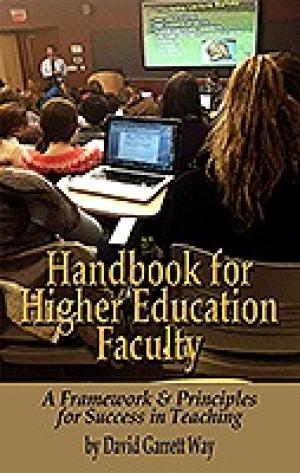
As a second year professor at a graduate institution of higher education, David Garrett Way’s Handbook for Higher Education Faculty: A Framework and Principles for Success in Teaching helps me understand my role as a faculty member in higher education. Way’s work synthesizes his forty years of teaching experience with the hope that he can help beginning educators with practical teaching knowledge (6). Way’s goals are to prepare his readers to accomplish a multitude of tasks. First, readers will be able to successfully execute their teaching plans in and out of the classroom. Second, educators will encourage deep and lasting learning in students. Third, educators will effectively assess learning as an authentic process while also documenting all efforts throughout their career. Finally, educators will be prepared to be evaluated by others (13). Way puts forth his plan in seven well-executed chapters. In Chapter 1, “Teaching and Identity” (15), Way uses the maxim that teaching is to lecturing as being is to doing. Teaching is a larger concept than lecturing and being is a larger concept than doing. The integration of all of these concepts is conversation. Since teaching is about generating conversations, Way proposes that we must understand who we are as beings living in specific identities. While thinking through some teaching techniques such as “warming up” (25) and “think-pair-share” (26), Way uses these concepts to help educators take inventory of their own individual styles and evolving personal theory while putting conversations with students into practice. Chapter 2, “Reflection and Teaching,” examines the dialogue that educators have between their “Espoused Theory” and their “Theory-in-Use” (32). In essence, Way believes that as educators, we must approach our pedagogy with a theory that we want to embrace (such as fostering dialogue) while being aware when our espoused theory goes awry (such as dominating class time with lecture, thereby squelching dialogue.) In essence, our thinking around our teaching takes continuous time and reflection. Chapter 3, “The Role of Higher Education in Society” (45), asks one of the most important questions in Way’s work: “(w)hat risks will you be willing to make in your career to remain true to your strongly held values?” (54). Assuming that the humanities and sciences must both engage with society for the betterment of society, Way does not want educators waking up twenty years into a career and asking “How did I get here? Why am I doing these things?” (55). In Chapter 4, “Preparing to Teach” (57), Way thinks through the macro and micro dimensions of prep work in overall course design and individual class sessions. Reviewing best practices in macro and micro design, Way argues that backwards course design (a concept borrowed from engineering) prompts an educator to begin by deciding what students must accomplish by the course’s end. I found the example of Cornell’s James Maas’s use of varying the stimulus very enlightening. Varying the stimulus in his case means recognizing that the average person’s attention span starts to drift after 10-15 minutes (67). Accordingly, Maas may lecture for ten minutes on an abstract concept and then move to a concrete activity for students to engage. In Chapter 5, “Creating Effective Learning Experiences” (71), Way examines how educators can plan and execute plans to the point that students desire meaningful and sustained learning that is “transforming, sustained, emotionally charged, surprising, painful, empowering, and fulfilling” (72-73). Way argues that an effective learning experience is a “kind of space – physical, emotional, psychological, intellectual and even spiritual” (73). In Way’s experience, role-playing and simulation are two methods that accomplish this. Student assessment occurs over time while evaluation is the final cumulative process of assessment. Chapter 6, “Assessing Student Learning and Providing Effective Feedback” (87), provides principles for planning, assessment, rubric development, and peer evaluation. Way concludes his book with Chapter 7, “Professional Development: Document and Measuring Progress” (105), as the culminating push for teachers in higher education to begin accumulating documents and engaging in events that provide a framework for modeling pedagogical growth. While I thoroughly enjoyed reading and pondering deeply my own pedagogical frameworks, principles, and early experiences in teaching, I was left wondering if there could be a follow up to Way’s text that addresses the gendered nature of teaching. A recent study on student evaluations (“Student Evaluations of Teaching [Mostly] Do Not Measure Teaching Effectiveness” by Anne Boring, Kellie Ottoboni, and Philip Stark) suggests that student evaluations are systematically biased against women. As an African American female professor in higher education, I have already felt the ways gender impacts teaching identity in my own educational experiences. I wonder if there are specific tools, frameworks, and principles that provide female faculty and faculty of color a blueprint for pedagogical success. Notwithstanding this, I enjoyed reviewing this important work that is crucial for early career faculty.

If a title reflects a book’s content, then this work is a particularly good case in point. The authors consistently refer to various real-life examples from the sphere of education in order to highlight the importance of attitudes and dispositions. While thus staying true to the book’s title, the authors additionally share pieces of wisdom from the field informed by years of experience. Education is a service industry. Educators and trainees are called to serve and not to be served. While this may seem like commonsense, the authors remind readers that commonsense is not all that common and the problem of entitlement is not as uncommon as one would like it to be (26). In this light, the authors make the case for the assessment of dispositions along with accompanying narratives that will address the issue in a professional and timely manner (38). While offering critical feedback, however, coordinators and instructors are simultaneously encouraged to keep in mind the need for reassurance, support, and empathy for students who are teacher candidates. The book is filled with humor, allowing readers to let their guards down a little and see the need for inculcating professionalism in work settings. The authors narrate accounts of students in training who cite seemingly legitimate reasons for absences only to be caught – thanks to social media – going on cruises. The authors offer other cases, such as those who try to outmaneuver school buses pulling out of parking lots just to get ahead. Then, believe it or not, are those who speak inappropriately to students, including saying, “You don’t like my jacket? Well, your momma liked it last night” (42). Working with future educators, the authors argue rightly, necessitates being proactive. While entitlement and lack of professionalism are matters of utmost concern when working with teacher candidates who are adults, these very adults also have particular lives that bring up questions of shelter, work-school balance, adequate food, parenting and other familial responsibilities. “Can you be proactive? Yes! Should you be proactive? Yes! Does it take time? Yes! Does it take work? Yes! Is it worth it? Absolutely!” (47). Through such series of questions and responses, the book presents a wealth of material in a readily accessible manner to teacher educators. Educators are warned that perfectionism may come at the cost of unsustainable superficiality. Reminding educators that “we are they,” the authors note that “what we create together will ultimately serve our students, schools, and communities” (55). The emphasis on creating together means that authentic, professional, and healthy relationships and partnerships are acknowledged as being at the heart of a successful field education experience (55). Such relationships and partnerships need constant tending and care, much like a garden (54-55). As readers make their way through the book, a realization soon emerges. Transcending the this-is-my-obligation attitude in order to come to a place where “we make promises and keep them” (59) is key. Commitment, talent, and care for the educational setting are tested by problems, dispositions, and attitudes (77). Anyone interested in navigating these realities would benefit from engaging this work.
Wabash Center Staff Contact
Rachelle Green, Ph.D.
Associate Director
Wabash Center
greenr@wabash.edu