Resources
The field of biblical studies lends itself well to decentered online learning – a kind that uses active learning to engage primary texts and their interpretations. Not only does such an approach work well in online and hybrid formats, it more readily welcomes readings that are more contextual, constructive, and collaborative. Three aspects best characterize a decentered approach to active learning online: an orientation toward primary texts, collaborative inquiry, and enhanced learner initiative. This essay describes the significance of each in turn, along with naming some best practices. I argue that this approach not only shifts focus toward learners and the learning environment, it works particularly well for teaching Bible courses online and in hybrid formats where interpretation of primary sources is the fundamental goal.
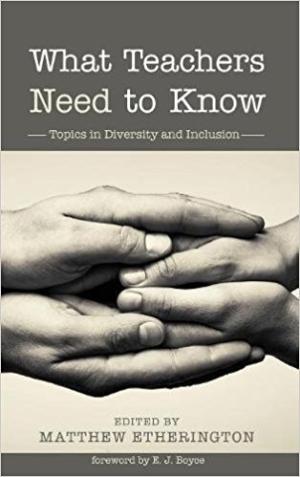
What Teachers Need to Know (Etherington, 2017) is a substantial text defining the diverse and inclusive experiences of contemporary education systems. The book is a compilation with three major parts: “Ethics,” “Inclusion and Teacher Management,” and “Worldview and Story.” Each chapter provides reading questions for use in a classroom setting or for deeper reflection. This is well-suited for an audience in higher education, especially for readers who could share personal experiences with diversity and inclusion topics after a practicum or time teaching. I would recommend this book for a post-graduate education library. The first part, “Ethics,” includes works by Sherick Hughes, Martyn Rouse, Jonathan Anuik, Chet Bowers, Eva Maria Waibel, the editor, Matthew Etherington, and James Dalziel. There is quite a range of topics in this section, but the Wabash Center reader might be particularly interested in Anuik's essay on faith-informed discourse. It is a study about the influence of missionary education on Indigenous beliefs, and how that reaches into Canadian public education today. It compels the reader to contemplate whether church and state can truly be separate in an educational context when there is such a significant inheritance of practice and values from a period dominated by religious influence. Part Two, “Inclusion and Teacher Management,” includes works by Peter J. Froese, Ken Pudlas, Lucinda Spaulding, Karen Copeland, Bruce Shelvey, and Ken Bradley. Spaulding's essay reflects the current shift of attention to patterns of bullying and puts forward the mechanisms school communities can provide for the resiliency of the students. Other essays in this section discuss topics such as mental health, special needs, and even bring in the parents' view on these issues as they exist in the educational system. This is an exceptional collection of essays on inclusivity. The third and final part, “Worldview and Story,” includes works by the editor, Matthew Etherington, Edward R. Howe, Adam Forsyth, Leo Van Arragon, Christina Belcher, and Cynthia à Beckett. This section has the most obvious correlation to religious studies within educational contexts. Topics include: tolerance, science and religion, and epistemology. This section could serve as an excellent initial reading for students in a practical theology or other contemporized religious studies capstone course. This book might not be a comfortable read in a public classroom, but maybe that is exactly why it should be read. Etherington's compilation offers academic theological reflection for secularized educational contexts. This book could be useful in a range of contexts. It may be particularly helpful to new teachers, parent associations, pastors of students, and community leaders.
As many of the contributors to Teaching Interreligious Encounters point out, interactions with people of diverse religious commitments are becoming more frequent in the workplace, in civic affairs, and in many neighborhoods. Consequently, there is a need to help individuals develop the attitudes and aptitudes that will enable them to conduct those encounters in an informed, respectful, and personally satisfying fashion. This volume argues that education, particularly in the undergraduate classroom, can make a substantial contribution to preparing individuals to understand and participate effectively in a religiously diverse society. To that end, the contributors offer an array of resources, comments on course and assignment design, and concrete strategies to show students how to conduct themselves in and learn from “interreligious encounters.” Precisely what is entailed in such encounters and how they are to be enacted and understood receive a variety of answers throughout the book. At times, whatever lines might separate interfaith engagement from interreligious encounters, and either from comparative theology, and all of them from comparative religion do not appear in sharp focus. Some authors appear to use at least several of those terms as rough equivalents, while others strive to define their terms very clearly. For example, Eboo Patel and Cassie Meyer propose that “interfaith or interreligious studies is concerned primarily with the interactions between lived religious and nonreligious actors and communities” (300). Thus, they differentiate it from “comparative religions, comparative theology, and world religions” which they see as being less concerned with actual relationships and interactions. But several contributors cite with approval Francis Clooney’s statement that comparative theology “entails the interpretation of the meaning and truth of one’s own faith by means of a critical investigation of other faiths” (see 45), which would bring it closer to Patel and Meyer’s understanding of interfaith and interreligious studies. How to construct courses, course modules, and individual assignments to promote what Patel and Meyer call “interfaith literacy” receives a lot of attention. Joshua Brown, for example, describes and analyzes a course on political theology that uses examples from Christianity and Chinese religions. Jonathan Edelman provides a detailed consideration of the Bhagavad Gita as a theological text. Other authors focus more on pedagogical strategies. In one of the more interesting contributions, Devorah Schoenfeld and Jeanine Diller describe how they use the Jewish process of hevruta to encourage students to disagree with each other in their interpretations of texts while still remaining in conversation, recognize disagreements within and among religions, and value interreligious disagreement. Emily Sigalow and Wendy Cadge make a clear and strong case for the value of using case studies in teaching about interreligious encounters, something that several other contributors also mention. Most of the contributions emphasize that students can learn something personally valuable and meaningful from studying and especially participating in interactions with people who have religious commitments different than their own. This volume offers a rich set of suggestions about how to design and structure such learning opportunities.

“The definition of slow looking is straightforward,” writes Shari Tishman, “It simply means taking the time to carefully observe more than meets the eye at first glance" (2). Imagine taking students to an art museum and focusing on just one painting. You would be taking the time to support your students in looking, really looking at art. Can they list everything they see in the painting? Could they identify twice as many items if you gave them more time still? Does the painting look different if they move closer or change their angle? Are there interesting juxtapositions of objects, shapes, or colors within the painting? These questions are natural to slow looking. It is a rewarding classroom practice and an indispensable aspect of method in theological and religious studies. This book was written “with educators in mind” and it contains many practical ideas on how to use slow looking in the classroom. Examples range across disciplines: Virginia Woolf’s observations concerning “The Mark on the Wall,” zoological sketches of a caracal cat, and the mechanical intricacies of an old-fashioned office stapler, among others. Drawing on previous research, Tishman examines three dispositional tendencies involved in slow looking: ability, inclination, and sensitivity (145). Sensitivity is particularly critical; this is the capacity to employ slow looking in the appropriate context. As educators in the humanities seek to more clearly articulate the lasting benefits of our work, this careful examination of slow looking as an important lifelong skill is timely. The beauty of this title is its ability to focus on the benefits of slow looking as educational practice in a deep way. Many excellent books on pedagogy adopt a wide scope. They pull their lens back and look at course planning or broad curricular systems. Slow Looking has much to offer courses and curriculum, but Tishman is adept at returning continually to the exercise of slow looking to reveal its complexity and practical efficacy from different vantage points. According to Tishman, slow looking is a “learned capacity” foundational to critical thinking (7). Foundational, yes, but it should not be thought of as synonymous with critical thinking or be conceptually absorbed by critical thinking. Slow looking is its own discrete process. Tishman explains, “Slow looking is not primarily judgment oriented, though its fruits certainly inform good judgments. Rather, slow looking emphasizes deferring judgment in favor of apprehending the complexity of how things are at the moment” (149). There are three types of complexity: complexity of parts and interactions (anatomy, for example), perspective (different physical or conceptual vantage points), and engagement (interplay between perceiver and perceived). Teachers will already see how parsing complexity in this way can lead to extended classroom reflection on a given subject of observation and the process of looking itself. Slow Looking strikes the perfect balance between practicality and philosophical depth. Tishman writes fluidly and moves easily among descriptions of classroom technique, phenomenological analysis of observation, and the intellectual history of student-centered education. Slow Looking will be a continual source of inspiration in my own teaching and scholarship – it is highly recommended.
Several years ago, I was expecting a guest speaker in one of my courses. To prepare for the colleague’s visit, I asked my students what questions they had for the person. Silence. And not a quizzical silence, just a dead silence. I tried to prime the pump by repeating the guest’s research agenda as well as the topics of our course’s conversation. The response by students was underwhelming – the not so faint sound of crickets could be heard. I signaled my dismay by using a displeased tone of voice and reminded the students that they must have questions. In distress, a woman blurted out, “I don’t have any questions!” I realized she meant that she did not have any deficits. She thought questions only signaled what she was supposed to know, but did not. Questions, for her, were a confession of inadequacy, unpreparedness, and ignorance. I had failed to teach that questions were tools of curiosity and a method of inquiry to interact with the guest lecturer. Since that moment, I have been trying to cultivate and nurture student curiosity. In this journey, I have learned that what I am curious about is not necessarily what my students are curious about. I have learned that some students have no curiosity for classroom learning because their energies are tied up in modes of survival, credential earning, and the distractions of family and wage earning. These students are difficult to gather-in. I have learned that students have been told that their genuine curiosity is without merit, so they have learned not to voice their real questions or pursue their authentic passions. I have learned that some deep, marvelous curiosity is voiced in a language/vocabulary that is academically unsophisticated and I have worked to train my ear to hear these curiosities. I have challenged myself to “think like my students” and try to anticipate the kinds of questions and inquiry they will levy toward a reading or learning activity. I want to align with them and use their inquiries as starting points. I’ve had some success with this tactic – but it’s not easy. Mostly I’ve learned that students are so eager-to-please that when I tell them they are to formulate their own genuine curiosity about a topic – they do. Last semester I had two kinds of assignments in my seminar. First, the students were to consider the assigned readings, then like jazz musicians, riff off of the author’s argument. I called them Riff Reports. The instructions were to bring to the class a report about what the reading sparked in their thinking and imagination. I challenged them, “Bring your own insights, curiosity – do not repeat the reading, do not report the reading. Consider your own passion, interests, situations, then build, expand, add your voice, perspective, and idiosyncrasies to the conversation.” At the beginning of the semester, I modeled in class sessions what I meant by Riff Reports by doing my own version of riffing off of the readings. In my three-hour session, I would do a one-hour riff, then two students, each taking 30 minutes, would riff off of the same reading. This would give the class three riffs from one reading – a cornucopia of meaning and wonder! Second, by the end of the semester, the students completed a Curiosity Report, building off of the reading, their Riff-Reports, my Riff-Reports, and the conversations we had in class sessions. The Curiosity Report could culminate in a critical reflection essay or it could be a creative portrayal. Regardless of its final embodiment (the student’s choice), the report had to include a method of inquiry which addressed the student’s own curiosity. Students were invited to explain why this curiosity was important to them and their people. They had to sit with the librarian to create a bibliography, interview experts, and go on field trips to visit the locales needed to satisfy their inquiries. By mid-semester, students gave oral reports about their topics, questions, and inquiry methodology. By the end of the semester, students gave an expanded presentation and then handed in a written form. Watching and helping students formulate their own curiosity was a very different way to teach than telling them what was important, critical, or required in the disciplinary canon. Helping them develop, unearth, and investigate their own agendas was not the same as performing my passions, thoughts, and ideas for them at the front of the class. Witnessing their process of being inspired by our reading, then taking a kernel of their own idea and working it up into a full project, was very meaningful to me. This witnessing gave me a real sense of reverence for their ability to think, create, and hope – I felt as if I was witnessing beauty. In every case, students selected topics that were personally relevant, intimately related to their life circumstances, and in some cases, life-giving. Our librarian called me to comment on the breadth and uniqueness of their topics and how interested he was to help students who were interested in inquiry. In two instances, I sent students to talk with faculty colleagues whose research interest matched the students. In both instances, the conversations were generative for both student and colleague. Finding like-minded thinkers feels like water in the desert. At the risk of romanticizing the experience, I did have one student who, in my opinion, got lost in the process. The student preferred being told what to do and how to do it. When that was not the task, the effort needed for discovery and self-motivation was too much. The student was able to articulate a fascinating question of inquiry, but could not follow through on investigation and creative research methodology. Pursuing curiosity requires time for introspection, consideration of on-going context and conversation, and the where-with-all to investigate. Structuring classrooms for student curiosity seems like a no-brainer, but it has taken me many years to get here.

In graduate school, I spent a year teaching at San Quentin State Prison while writing my dissertation. I loved my Religion and English classes at the prison and frequently remarked to friends that teaching incarcerated men, many of them in their mid-thirties or beyond, was strikingly similar to teaching 18-22-year-old undergraduates at UC Berkeley. “They make the same excuses about why they couldn’t do the reading,” I loved to tell fellow graduate student instructors. The students, those on the inside and on the outside, also often struggled over the same points – how to write a persuasive thesis, how to conduct research, how to understand unfamiliar religious practices. Eventually, I found a job at Rhodes College in Memphis, TN, and left both Berkeley and San Quentin behind. After several years at Rhodes, a colleague invited me to teach in another prison education program, this time a “great books” program at the West Tennessee Women’s Prison. I jumped at the chance and offered to cover the Hebrew Bible. Strategically, I decided to teach the two books I was already teaching to Rhodes undergraduates in my Feminist Biblical Interpretation class: Ruth and Esther. This suggested several advantages: I would already be prepared for what the students would have to say about the texts, what directions the conversation might take, and I thought women might be interested in reading texts where female relationships, like that between Ruth and Naomi, are foregrounded. I entered the first class at WTWP confident in what would happen. I had just taught Ruth to my traditional undergraduates a week before and the Rhodes students had had excellent discussion, especially about Ruth and Naomi and their relationship (Ruth, you’ll recall, is urged by her mother-in-law Naomi to leave after her husband dies; Ruth replies with the famous words, “Where you go, I will go; Where you lodge, I will lodge; your people shall be my people, and your God my God. Where you die, I will die— there will I be buried” [Ruth 1:16, NRSV]). My Rhodes students were open to the possibility of queer readings of Ruth and Naomi – generally, they were interested in finding and ferreting out pockets of homoeroticism in the text – though also critical of Naomi as “a whiner.” Ruth, meanwhile, seemed less a loyal friend or lover than a burden – “like someone else’s pet you have to take care of,” as one student put it. The women at WTWP were also very enthusiastic to talk about Ruth, but they had different understandings of the relationships in the text. They were, on the whole, far more sympathetic to Naomi and “what she’s been through.” They were mostly (though not entirely) reluctant to see the relationship between the two women as homoerotic, but they placed great value on reading it as a strong friendship. Ruth and Naomi had each been through a great deal. They needed each other. This experience of teaching the same text in two very different groups was a valuable pedagogical reminder to me about the dangers of making assumptions about students and how they will respond to the text. It was also useful in thinking about trauma. Many incarcerated women are survivors of trauma, especially violence and sexual violence. Incarceration challenges family bonds and strains relationships. All of this is well known. What I did not realize until teaching Ruth in prison, however, was the unique hermeneutic perspective it gives students into the text. These women read the book with greater empathy, and with greater attention to the dynamics of its relationships. They understood why Ruth and Naomi needed each other. (Relatedly, when we read Esther the following week, they took a dim view of the men in the text, especially Ahasuerus for his sexual exploitation of women and Mordecai for his strategic exploitation of his niece Esther. These readers intuited what scholars such as Nicole Duran and Randall Bailey have argued, that the book of Esther is a work of male exploitation). The traditional undergraduates at Rhodes have their own traumas, and these too influenced their reading. College students are especially attuned to the fraught relationships between children and parents -- this came across in their reading of the book. Sexual exploration is also a cause of interest, as well as anxiety, in college -- these readers were more open to the possibility of queer romance in the text. The traumas that shape our lives shape, as well, how we read texts. This is a simple lesson, but one that the students in my two Ruth classes helped me understand better.

Time and time again, I find that successful online students are those with skills of self-direction, self-regulation, and time-management. Self-directed learners determine their learning needs, set learning goals, locate and access suitable resources for learning, manage their learning activities, monitor and evaluate their performance, and reflect on and reassess their learning strategies. Self-directed learners have skills of self-regulation—this encompasses concentration, self-awareness, self-discipline, time-management, delaying gratification, and self-assessment. However, as Sandie Gravett notes in her blog post, students often feel ill equipped for self-directed learning (https://www.wabashcenter.wabash.edu/2018/09/becoming-a-better-teacher/). How do we encourage students to assume responsibility for their learning and become self-directed learners? It takes more than signposts and reminders. For many years, I signaled the importance of these skills by linking to websites such as "What Makes a Successful Online Student" which states: “With the freedom and flexibility of the online environment comes responsibility. The online process takes a real commitment and discipline to keep up with the flow of the process.” I also encouraged them at the beginning of the semester to write down all of their deadlines in a scheduler. I would even email them reminders each week. And still, I found some students fail simply because they fell behind: they prioritized other courses and responsibilities, or they procrastinated and left it until a later time that never came. Online environments can exacerbate tendencies towards procrastination and distraction. We can find endless rabbit holes online that fuel procrastination and undermine our efforts at self-discipline (as Tim Urban humorously depicts in his popular blog post on procrastinators, https://waitbutwhy.com/2013/10/why-procrastinators-procrastinate.html). We are also prone towards continuous partial attention–the process of paying simultaneous attention to numerous sources of information, but at a superficial level. Unlike multitasking, which is driven by a desire to be productive and efficient, continuous partial attention is motivated by the desire to continuously connect and be connected in an effort not to miss anything. As Linda Stone remarks, “It is an always-on, anywhere, anytime, anyplace behavior, and it involves an artificial sense of constant crisis” (https://lindastone.net/qa/continuous-partial-attention/). Our students have a fear of missing out (“FOMO”), and their attention is often interrupted by notifications and alerts on their cell phones. Although we have no control over our students’ behavior and whether they will ultimately succumb to the pull of distraction and procrastination, we can incorporate various activities in our online courses to encourage them to develop skills of self-directed learning. For example, you can facilitate greater self-awareness of their study habits and learning strategies by assigning introspective writing exercises where they answer questions such as: What tasks am I currently procrastinating? Is it because I’m unsure of how to do them, or afraid of doing them poorly? What activities do I gravitate to when I procrastinate? (Nilson 2013, 83) Here I share a few strategies drawn primarily from Linda Nilson’s Creating Self-Regulated Learners: Strategies to Strengthen Students’ Self-Awareness and Learning Skills (Stylus, 2013). Again, self-regulation refers to a sub-skill of self-directed learning: how students approach learning tasks in our online courses. You can introduce them to self-regulated learning from the outset by assigning a reading such as Robert Leamnson’s (2002) article, “Learning (Your First Job)” available through the University of Georgia Center for Teaching and Learning: http://www.ctl.uga.edu/uploads/main/mainLearningYourFirstJob.pdf. It begins by emphasizing that learning is “not something that just happens to you, it is something that you do to yourself,” and then shares strategies for focusing attention, managing one’s time, studying, and preparing for exams. You can encourage students to set goals for their learning by having them write a paper at the beginning of the course entitled “How I Earned an A in This Course” (Zander and Zander 2000). This exercise encourages students to envision concrete and attainable goals for their learning, and it also gives you a sense of their hopes for the course. You can have students revisit them at the end of the semester, reflecting on the extent to which they followed their strategic plan, when, how, and why they might have strayed, and how this impacted their actual performance in the course. You can help them self-test their understanding of the course materials through reflective writing and visual mapping tools. You can do “learning logs” where they identify the main points of each reading, what they found most surprising, what they found most confusing, and why they found it confusing (Bean 2011). Or you could have them write double-column notes on the readings: one column with substantive notes similar to those of “learning logs” but another for their personal reactions (feelings, attitudes, values, beliefs, perspectives, prior knowledge, changes in their way of thinking). (Nilson 2013, 27) You can have them test their understanding through “mind dumps,” where they write down all they can remember about the readings, videos or podcasts, or have them create visual study tools that map out, integrate, and structure what they’ve learned (Nilson 2013, 33). After you give students feedback on their work, you can have them complete meta-assignments that ask them to explain what they think our feedback means (Nilson 2013, 56), or write a letter to the next class about the paper or project: how to prepare for tackling the assignment, what strategies to take, what missteps to avoid, and the value of the assignment (Nilson 2013, 56). Finally, you can have students reflect on their learning through course “wrappers”: at the beginning of the course, students write what they think the subject matter or discipline is about, how it’s done, and why it’s important, and then at the end of the course they revisit those questions and compare their answers (Nilson 2013, 87). Another closing activity might be short “Future Uses” papers where they identify the three most important concepts or skills they learned in the course, why they consider them important, and how they might use them in the future (Nilson 2013, 88; Svinicki 2004). These are just some ways that we might help students develop skills of self-direction, self-regulation, and time-management so that they can be successful in our online courses. Works Cited Bean, John C. 2011. Engaging ideas: The professor’s guide to integrating writing, critical thinking, and active learning in the classroom (Second Edition). San Francisco: Jossey-Bass. Nilson, Linda. 2013. Creating Self-Regulated Learners: Strategies to Strengthen Students’ Self-Awareness and Learning Skills. Sterling, V.A.: Stylus. Svinicki, Marilla D. 2004. Learning and motivation in postsecondary classrooms. San Francisco: Jossey-Bass. Zander, Rosamund Stone and Benjamin Zander. 2000. The Art of Possibility. Boston, MA: Harvard Business School Press. min Zander. 2000. The Art of Possibility. Boston, MA: Harvard Business School Press.

The questions that inform my teaching and scholarship focus on representations of violence. This means I spend a good deal of time studying such representations. I learned several years ago that my capacity to answer relatively straight-forward questions like “But is that film really gory?” or “Will I find that book really disturbing?” has dwindled into non-existence. Turns out that when a significant portion of your media consumption is comprised of images of war, torture, sexualized degradation, and racialized brutality, your attunement to the average consumer’s tastes atrophies. From the outset, then, I acknowledge that I might not be the most reliable guide to help sort out how to teach traumatic materials. By the same token, I have taught, written about, and meditated on an array of traumatic materials—and my students, in the main, after initial phases of feeling overwhelmed and disoriented by the questions and contents that organize my courses, have reported finding something valuable in them. So, to open this blog series, I want to suggest that teaching traumatic materials may not be so different from teaching per se. First, I think we are sometimes overinvested in thinking about traumatic materials as a special case. When considering the events, texts, and ideas that comprise the religious studies curriculum, it’s tough to think about what remains after subtracting potentially traumatizing content. War, violence in various forms, imperialism and colonialism, degradation and humiliation, ethnocentricism and racism, sexism and heterosexism—examples of each abound in the language, imaginaries, and practices that we take as our object of study. Do we need additional pedagogical tools beyond the transparency, openness, and attentiveness that we should be using all the time to make sure that we are noticing, and making space for, our students’ varying levels of discomfort, resistance, confusion, and hostility? Given that traumatic materials constitute so much of what we teach when we teach religion, I would suggest that—insofar as we are teaching well—we already know how to teach such materials. Second, I think we overestimate our ability to predict which materials will traumatize. In a former life, when I was an adjunct teaching Constitutional Law, I made a remark about the brilliance of the U.S. Constitution’s solution to the practical problems presented by the Articles of Confederation. A young African-American woman, who had been quiet for the first few weeks of class, spoke up and eloquently explained that she found nothing to admire in a document that still countenanced the ownership of human beings. I carry her intervention with me every time I enter the classroom. My experience of the world shapes what I experience as injurious, as ugly, as painful, as disturbing. In the same vein, I remember distinctly how terrified and paralyzed I felt sitting amongst the enthusiastic cheers that greeted the final scene of Brett Ratner’s blockbuster film, X-Men: The Last Stand, as “good” mutants fought to destroy the “bad” mutants who refused to be “cured” of their otherness. Given that history and mainstream culture are made by and for those who hold power, even the most seemingly anodyne examples can be traumatizing for those who were never meant to survive. Related to the question of predicting which materials might traumatize, I also wonder about our ability to read students’ reactions. When does silence evince reflection and when paralysis? When is speaking up fueled by enthusiasm and when by rage? Although my course evaluations tell me that my ability to read the energy of the room is far from perfect, I remain convinced that when we strive to remain present with our students in the unfolding of the event that is the class session, then the surprises that inevitably come will be much less likely to catch us off guard in destructive ways. Finally, I think we sometimes overvalue teaching traumatic materials—either by assuming that certain topics are beyond our pedagogical capacity—because they are too upsetting, too sensitive, too difficult—or by valorizing those who have the “courage” and the “finesse” to teach such challenging content. I teach what I teach—like most teachers—because I find something important, something tantalizing, something worthwhile in the material. I teach what I teach—like most teachers—because it opens a particular perspective on the world for my students. And, like most teachers, I have good days and bad, days my students get it and days they don’t, days I’m fully engaged and days I’m distracted, days they resist what I’m trying to do and days they trust me enough to willingly come with me. The more we normalize the traumatic in our pedagogical imaginations, the more we’ll be able to help our students encounter the ubiquity of trauma that constitutes their world and their lives.
If I get shot in my classroom – I’m gonna be mad! Yesterday, a friend told me her church and nursery school were having shooter-on-campus drills for the staff and children. I wondered when our school was going to do the same. Sometimes my colleagues and I joke about what we would do if an active shooter came into our building. We joke about ways to protect ourselves by fighting back or by fleeing. One colleague said not to plan to assist her in the event of an intruder because, given the opportunity, she would be the first one out of her office window. I made a mental note to see if I could climb out of my window. Thinking about myself climbing out of my basement window tickled me until I remembered it was a strategy to avoid getting shot. The list of schools, churches, and public events that have become killing fields is growing. News reporters occasionally entreat viewers to stay sensitive to the victims of these tragic events. Interviewers of distraught family members work hard not to appear prosaic. While we do not want to mute our reactions to reports of gun violence, the numbness is difficult to prevent. One of the nine people shot by the 21-year-old white supremacist in the 2015 Charleston church massacre was the grandmother of an alumna. Grandma was at Bible Study when she was savagely murdered. When my student and I get together for lunch, we still talk about the aftermath of the killing and I help her grieve. The amount of effort I have given to the teaching craft has not included ways of staying alive in the face of a gunman in my own classroom (most of the assailants are men). Heretofore, the challenge and un-safety has been in ideas. The danger of classrooms has been in coaxing fearful or belligerent students into new meaning making strategies, or different ways of understanding old traditions. Now, the real danger of potential gun violence feels like domestic terrorism. I am afraid, I am unprepared, and I feel edgy in the familiar safety of my own classroom. The possibility of gunplay in my school looms thick yet wispy in the ethers. I struggle to make sense of this faint paranoia because I know it affects my teaching. In my Teaching Teachers to Teach course, should I teach self-defense and strategies for emergency evacuations? Should I review with students the open-carry laws of the state and nation? Should course preparation include time at the gun range? Suppose classroom attire included Kevlar vests and running shoes? Could I shoot back at a student who was shooting at me? The first time I saw someone shot, I was 9-years old. One school night, my dad and uncle were going to the post office to mail household bills. I gladly tagged along because I enjoyed being with them. Our routine was that once we arrived at the post office, I would be handed the bundle of envelopes, then I would leap out of the back seat of the green Pontiac, dash up the stairs and deposit the letters into the outside mailbox for quick delivery to their addressed destinations. With my uncle driving, we rode with ease - the radio playing, my dad and uncle chatting and me enjoying the view from the back seat. My uncle turned the corner onto a one-way street – we were about a block from the post office. Without warning, shots rang out! --- “POP! POPPOP!” – I struggled to see out of the window because my uncle, with cat-like reflexes, had slammed on the brakes, shifted the car into reverse and, with foot flooring the accelerator, began backing out of the street - all in one gesture. Since this was before the days of seat belts, my child-body shifted wildly with the momentum of the car. Even so, I saw a group of teenage boys chasing a lone boy who was limping as he ran. The limping boy ran across the street, up on the sidewalk, and then collapsed. A boy who was chasing him had a gun at the end of his outstretched arm. That boy ran over to the collapsed boy and pistol-whipped him as he lay on the sidewalk. As if the scene had been choreographed by Alvin Alley, they all ran off down the dark street, into the night, as if on cue - all but the collapsed boy who lay bleeding and dead on the sidewalk. My uncle’s skillful driving sped our car backward around the corner and away from the mayhem. Uncle commanded the car out into the intersection, then gunned the gas, propelling us forward into streets with no shooting teens. I stared from the back seat in horror. My beloved friend Zenobia is a retired warden from New York City corrections department. She spent twenty plus years on Rikers Island and other prisons. Years ago she used to talk with me about the ways of assessing a room for my best escape in the event of unexpected emergency like a gun being fired in the room. When we would sit in restaurants, she would casually ask me over her menu to tell her where the exits in the room were. I was to have noticed them and made mental notes as we walked into the space. Most days I could not answer the question because I had failed to take notice. I did not like this game. I resisted her teaching because I deemed those skills as needed only in places like prison. The applicability of Zenobia’s lessons for my classroom setting is soul withering. Tomorrow, I’m gonna call her and ask for a refresher lesson. I do not own a gun because if I did I would undoubtedly use it. I would use it when I felt fearful or angry. I do not think clearly when I am fearful or angry.

It has now been over a full year since the 2016 presidential election. Yet, I still remember vividly the dark and raw thoughts I had the morning of November 9, 2016. When I woke up and learned of the election results, I was horrified that so many people had made a conscious decision to elect a person who embodied and condoned the evils of racism, misogyny, and xenophobia, to be the world’s most powerful leader. Most of the discussions I had that day with my family, friends, and colleagues centered around our inability to understand the political stances and ideologies that were reflected in so much (but not the majority!) of the popular vote. In that grim day after the election, I remember thinking that educators, like myself, must have completely missed the mark. As a professor of theology, I was particularly troubled. The election had touched one of my core beliefs deeply—that is, the purpose of theological education is to form persons to think and act responsibly in the church and society. I remember thinking that my field had failed, and that we needed to rethink everything we had been doing in the classroom up to then. As I read the analyses that were pouring in that day, one particular headline caught my eye: “Trump won because college-educated Americans are out of touch. Higher education is isolated, insular and liberal. Average voters aren't.” The article was written by Charles Camosy, a professor at Fordham University, who was proposing that the election reflected a divide in our country between those who have a college degree and those who do not. “The reality is that six in 10 Americans do not have a college degree, and they elected Donald Trump,” he declared. I had been thinking more about age-old racism and the divide between whites and non-whites as the reason for the election results. But, Professor Camosy presented a different analysis, one that has been troubling me and my role as a theological educator ever since I read it that day. He said: “College-educated people didn’t just fail to see this coming — they have struggled to display even a rudimentary understanding of the worldviews of those who voted for Trump.” What really stopped me in my tracks was his remark about how college-educated persons, “have especially paltry knowledge about the foundational role that different philosophical or theological claims play in public thought compared with what is common to college campuses . . . . [M]any professors and college students don’t even realize that their views on political issues rely on a particular philosophical or theological stance.”[1] This statement made me pause, because it resonated deeply with my own experience, and, therefore, called me to task. I began thinking: Are the ideologies expressed in my assigned readings and classroom assignments monolithic? In my efforts to form persons to think and act responsibly, have I promoted an insular way of thinking? As educators, we have a great opportunity (and perhaps even a responsibility) to present certain sets of values persuasively. I even state some of these values explicitly in my course syllabi. For example, I want my students to know that I value the theological voices of those on the margins, both in history and contemporary society. I am edified when students come to adopt this value of mine as their own. In addition, if certain values, like racism, ignorance, and bigotry, are displayed in my classroom, I clearly denounce them and explain why. But, in my effort to rethink everything I have been doing in the classroom, Professor Camosy’s article has led me to consider a different approach: that I should be giving some attention to racism, ignorance, and bigotry, before simply denouncing it. In the classroom, this would entail assigning readings from the alt-right, for example. The goal would be to better understand the political and theological stances that undergird these values, which are often underrepresented in higher education, so that we and our students would understand them better. If I want my students to think and act in the world responsibly, shouldn’t they be able to understand the values they will be encountering and engaging outside of the classroom? In the required texts and readings assignments on my course syllabi, I strive to include diverse authors. I understand “diversity” in this sense to mean the inclusion of writings by people traditionally marginalized because of their race/ethnicity, gender, class, etc. But, lately I have been thinking that I might do better to reconsider my definition of “diversity.” Perhaps it should include those marginalized by educational levels, age groups, geographic regions, values, and political standpoints? To be honest, what has held me back thus far in assigning texts from certain political standpoints, such as those that are entangled with white supremacy, is my own aversion to them. I also do not want to be misunderstood as promoting the values espoused by such writings--or worse yet, risk students being convinced by their rhetoric. So, I’m curious: What do you educators, who might be reading this, think is at risk in extending this definition of “diversity” or not extending it? On the most practical level, have any of you begun to include diverse political standpoints in your reading assignments? If so, how do you present the material to your students? Do you follow any rules or guidelines? Perhaps most importantly: Is your working definition of “diversity” effective, do you think, in preparing students to intellectually and socially engage with the world outside of the classroom more effectively? [1] Carles Camosy, “Trump won because college-educated Americans are out of touch,” Washington Post, November 9, 2016. https://www.washingtonpost.com/posteverything/wp/2016/11/09/trump-won-because-college-educated-americans-are-out-of-touch/?utm_term=.3634cedb1e19 (accessed December 13, 2017).
Wabash Center Staff Contact
Rachelle Green, Ph.D.
Associate Director
Wabash Center
greenr@wabash.edu