Resources
Not too long ago I was invited to join a panel with the ambitious aim of putting into context for the campus community the rising tide of anti-Muslim sentiment and the Islamophobia industry behind it. I was specifically requested to open the gathering with a 10-minute Islam 101 in order to dispel common misconceptions of Islam and Muslims. The event was well-intentioned, but the initial framing of the event and my role in specific, I realized, would only serve to reinforce that religion and Muslim religiosity somehow lie at the heart of the problem. The part that was asked of me implied that there exists a mainstream, normative, conventional understanding of Islam that did not warrant prejudice. As this line of thinking goes, anti-Muslim sentiments would surely subside if only more people knew about this safe, good, and moderate Islam. According to this narrative, there is a right kind of Islam out there and the burden of responsibility lies with those right-thinking Muslims to push back and make themselves heard. What this narrative leaves unaddressed is the complicity and accountability of the larger majoritarian society in uncritically perpetuating anti-Muslim sentiments. Instead, religion is foregrounded as what matters most. This line of thinking eerily echoes the deeply problematic expectation that race issues in America are a “black problem” in which the burden of change lies with black communities. In both cases, the larger systemic social, political, legal, and economic issues are overlooked or worse, exonerated. My argument is not that Islam or religion is altogether irrelevant or unimportant in conversations like these. What is problematic is the continual recourse to find answers (and false comfort) in explanations centered on religious motive and identity when conflicts, crises, and tragedies transpire. When a discussion is framed narrowly around Islam or religion, we end up missing the bigger picture. The above event I described, which was eventually productively reframed, brings to the fore a particular pedagogical challenge that many scholars of Islam face. In the few minutes I was granted, how could I speak beyond the lens of religion to highlight other structural problems of greater significance? Part of the dilemma is one of time. When I think of my role as a teacher, I often take for granted the generous amount of time I have with my students each semester. Instead of a mere fifteen minutes, my students and I engage in conversation and critical inquiry on a wide array of topics related to Islam and Muslims over the course of fifteen weeks. With each class meeting we progressively build our knowledge base, nuance our language, and continually circle back to thorny issues with keener questions and alternative perspectives. When we are invited to speak we remain committed teachers, but we must carry out our work without the benefits that a semester of engagement affords. Moreover, we do not have the ability to slowly build a thoughtful base of knowledge. Speaking opportunities are typically topical and the range of topics we are asked to speak on can be dizzying, if not outright perplexing. We are invited to speak on the deeply problematic categories of terrorism and radicalization. We are asked to provide background and context to wars and conflicts in Muslim majority countries. We are asked to weigh in or explain headline issues like the refugee crisis, the position of presidential candidates, anti-Muslim hate crimes, and most recently the burkini ban across Southern France. Because of our place and position, our “expertise” on Islam is sought – never mind what our areas of specialization actually are. Time and again, we are deployed, both intentionally and unintentionally, to reinforce religion – especially Islam – as the primary frame of reference. While respecting the request and good intentions of event organizers, there are several ways we can work to change or better the discourse. Structural Reframing: Whether speaking individually or on a panel, the typical expectation is that we will say our part and then field a handful of questions. I have found it useful to collaborate with organizers well in advance in imagining alternative models of engagement. Might colleagues in other disciplines be invited in addition to or in place of ourselves? Would a roundtable or town hall style conversation be better suited for a larger audience? When faced with a smaller and more intimate group, could participants be engaged through a service experience or could the discussion be facilitated around a more reflective and participatory fishbowl dialogue? Interventions like these at the organizational level can be used to introduce a different horizon of understanding, one that extends beyond religious reductionism, by simply changing the angle of approach or the terms of the conversation. Engaging the Audience: At one-off events it is often difficult to gauge where an audience is coming from. It can be worthwhile to quickly poll or even pose direct questions to those in attendance to better understand their expectations and concerns. At times it can even be helpful to even call into question problematic premises or assumptions about the role and significance of religion. For example, questions of scriptural interpretation arise frequently at many events, especially those concerning violence. The assumption is that somehow the Qur’an directs the actions of its readers. Of course, human behavior is hardly driven by such a crude correlation of text to action. Moreover, texts, even scriptural ones, are incredibly malleable and open to interpretation. By simply spotlighting erroneous assumptions, the audience can be prompted to explore the many other factors and influences at play. Speak Beyond Religion: For a variety of reasons, strategic planning is not always possible. In fact, more often than not, I only have at my disposal the speaking time I am given and the content I choose to convey. In these situations, I believe it is still important to push past an exclusively religious frame of reference. Religion is only one identity marker that inflects the realities we face today, and yet the singular attention to religion in our attempts to understand these realities serves to obfuscate more pressing systemic problems that underlie them. We may be scholars of religion, but as our research and work in the field continually demonstrates there are many other intersecting power structures shaping the persons, societies, and ideas that we study. What structural inequalities are peoples responding to? What role do state actors and colonial histories have in creating, perpetuating, and worsening the situation in question? How is religion or Islam being coopted or instrumentalized? What are the identity politics at stake that continue to draw religion or Islam into suspicion? Speaking about religion and Islam is not just a matter of content, but also one of context. By drawing connections to wider cultural, social, political, and economic questions we can raise the level of discussion and deepen the narratives at work in the public discourse.
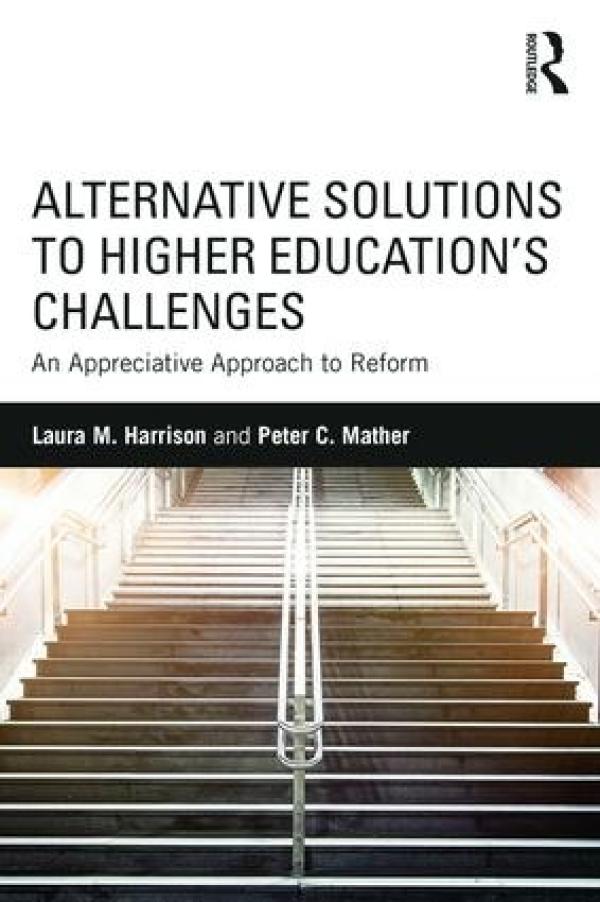
The crisis of the American higher education is no longer news. Rather than prosecuting the state of educational affairs with the dominant approach of “crisis zeitgeist” held among educationalists and analysts (65), Harrison and Mather examine the positive contributions of higher education and analyze problems through positive inquiry, alongside their critique as learners, professors, and administrators in the system. Throughout the eight chapters, the authors show how older and current research in theories, applications, and empirical data can strengthen the interdisciplinary and interconnected industry – both within and outside of itself (ch. 2). While mindful of the current commodification of education or the consumeristic mentality currently involved in reprogramming or (re)structuring education, the authors urge a more holistic evaluation of not just the value of higher education towards vocationalism but also its purpose for cultivating individuals, community life, and public service: to see that education as a means of vocationalism (career development, preparing learners for better paying jobs) is not more important than to embrace the intrinsic value of liberal arts education for nurturing knowledgeable citizens who will in time contribute to the democratic ideals of public society (chs. 3 and 5). The thrust of Harrison and Mather’s proposal is a hopeful, though realistic, imagination of “what can we create together” (46) not just with educators, but also with community engagement (50). Thus they recommend a shift from a pedagogy of “standardization testing” to cultivating attentiveness to the different “narratives” for “meaningful student learning” (ch. 4), and from a focus of merely cognitive and pragmatic (applicable) knowledge to building a holism of cognitive, affective, and other facets of learning, and developing the whole person (chs. 6 and 7). Accordingly, universities and community colleges need to learn to leverage what each offers best without denigrating one another (denigration happens when leaders wrongly conflate or differentiate vocational and remedial goals of education in both types of institutions). They need to create infrastructures that provide level-playing fields for learners of different economic and ethnic standings in matching institutions, curricula, and related discourses on the recipients and goals of education (59; 83-86). The volume does not only register theoretical concerns; the authors report positive efforts from select institutions that have redirected discourses and implementation for overcoming crisis. The selection includes well-known and lesser-known institutions, such as Ball State University, Berea College, College of Wooster, Columbia University, Denison University, Duke University, Emory University, Kentucky State University, Ohio University, Santa Clara University, St. Mary’s College, University of California Santa Cruz, University of North Carolina, Wake Forest University, and Western Governors’ University in the United States, and it even provides occasional reviews of institutions outside of North America, such as the Asheshi University in Ghana. Though discussions in the volume would resonate with colleagues in religious studies programs, the volume did not provide application for religious or theological studies programs. Various efforts by the Association of Theological Schools (ATS) to overhaul religious offerings (curriculum, faculty, student enrollment, and so forth), such as granting reduced M.A. and M.Div. curriculum to requesting member institutions have both helped and added to the challenges of re-envisioning religious studies programs in light of the current educational crisis. The search for better resolutions in the sea of analyses continues with no clear landing in sight.