Home » Resources » Scholarship on Teaching » Working Side by Side: Creating Alternative Breaks as Catalysts for Global Learning, Student Leadership, and Social Change
Scholarship
March 29, 2017
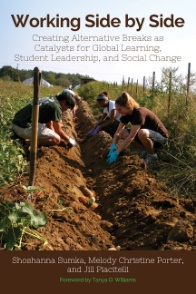
Working Side by Side: Creating Alternative Breaks as Catalysts for Global Learning, Student Leadership, and Social Change
- Author
- Sumka, Shoshanna; Porter, Melody Christine; and Piacitelli, Jill
- Publisher
- Stylus, Sterling, VA
- ISBN
- 9781620361245
- Table of Contents
-
Acknowledgements
Preface
Introduction
PART ONE: FOUNDATIONS
ch. 1 Alternative Breaks Defined
ch. 2 A Brief History of Alternative Breaks: The Beginnings of the Movement
ch. 3 Working Together for Justice: a Theoretical Framework
ch. 4 Developing Community Partnerships for Mutual Benefit
ch. 5 Alternative Breaks as Catalysts of Active Citizenship
PART TWO: KEY COMPONENTS OF ALTERNATIVE BREAKS
ch. 6 The Eight Components: Foundations of a Successful Alternative Break Program
ch. 7 Diversity and Social Justice: Addressing Power, Privilege, and Systems of Oppression
ch. 8 Education: Understanding Social Issues
ch. 9 Orientation: Learning about the Organization, Location, and Context
ch. 10 Training: Building Skills
ch. 11 Strong Direct Service: Working with Communities
ch. 12 Alcohol- and Drug-Free Programs: Practicing Full Engagement
ch. 13 Reflection: Synthesizing Learning and Experience
ch. 14 Reorientation: Active Citizens Reorganizing Locally
PART THREE: STUDENT LEADERSHIP, LEARNING, AND TRANSFORMATION
ch. 15 Student Leadership in Action
ch. 16 Program Structures and Leadership Roles
ch. 17 Training Student Leaders
ch. 18 Student Learning Outcomes, Assessment, and Evaluation
PART FOUR: DEVELOPING AND STRENGTHENING ALTERNATIVE BREAK PROGRAMS
ch. 19 Program Growth and Continual Improvement
ch. 20 Community Building
ch. 21 Recruiting Leaders and Participants
ch. 22 Budgeting, Finances, and Fundraising
ch. 23 Risk Management and Other Logistics
PART FIVE: GOING GLOBAL
ch. 24 The Complexities of International Alternative Breaks
ch. 25 Developing International Community Partnerships
ch. 26 Working with Intermediary Organizations
PART SIX: A SOCIETY OF ACTIVE CITIZENS
ch. 27 Working Collaboratively through Compacts and Collectives
ch. 28 The Power of Alternative Break Alumni
ch. 29 Vision for the Future of Alternative Breaks: A Call to Action
Appendices
Index
Click Here for Book Review
Abstract: This book constitutes a guide for student and staff leaders in alternative break (and other community engagement, both domestic and international) programs, offering practical advice, outlining effective program components and practices, and presenting the underlying community engagement and global learning theory.
Readers will gain practical skills for implementing each of the eight components of a quality alternative break program developed by Break Away, the national alternative break organization.
The book advances the field of student-led alternative breaks by identifying the core components of successful programs that develop active citizens. It demonstrates how to address complex social issues, encourage structural analysis of societal inequities, foster volunteer transformation, and identify methods of work in mutually beneficial partnerships. It emphasizes the importance of integrating a justice-centered foundation throughout alternative break programs to complement direct service activities, and promotes long-term work for justice and student transformation by offering strategies for post-travel reorientation and continuing engagement.
The authors address student leadership development, issue-focused education, questions of power, privilege, and diversity, and the challenges of working in reciprocal partnerships with community organizations. They offer guidance on fundraising, budget management, student recruitment, program structures, the nuts and bolts of planning a trip, risk management, health and safety, and assessment and evaluation. They address the complexities of international service-learning and developing partnerships with grassroots community groups, non-governmental and nonprofit organizations, and intermediary organizations.
For new programs, this book provides a starting point and resource to return to with each stage of development. For established programs, it offers a theoretical framework to reflect on and renew practices for creating active citizens and working for justice. (From the Publisher)
Abstract: This book constitutes a guide for student and staff leaders in alternative break (and other community engagement, both domestic and international) programs, offering practical advice, outlining effective program components and practices, and presenting the underlying community engagement and global learning theory.
Readers will gain practical skills for implementing each of the eight components of a quality alternative break program developed by Break Away, the national alternative break organization.
The book advances the field of student-led alternative breaks by identifying the core components of successful programs that develop active citizens. It demonstrates how to address complex social issues, encourage structural analysis of societal inequities, foster volunteer transformation, and identify methods of work in mutually beneficial partnerships. It emphasizes the importance of integrating a justice-centered foundation throughout alternative break programs to complement direct service activities, and promotes long-term work for justice and student transformation by offering strategies for post-travel reorientation and continuing engagement.
The authors address student leadership development, issue-focused education, questions of power, privilege, and diversity, and the challenges of working in reciprocal partnerships with community organizations. They offer guidance on fundraising, budget management, student recruitment, program structures, the nuts and bolts of planning a trip, risk management, health and safety, and assessment and evaluation. They address the complexities of international service-learning and developing partnerships with grassroots community groups, non-governmental and nonprofit organizations, and intermediary organizations.
For new programs, this book provides a starting point and resource to return to with each stage of development. For established programs, it offers a theoretical framework to reflect on and renew practices for creating active citizens and working for justice. (From the Publisher)