Home » Resources » Scholarship on Teaching » What They Didn't Teach You in Graduate School: 299 Helpful Hints for Success in Your Academic Career
Scholarship
March 29, 2017
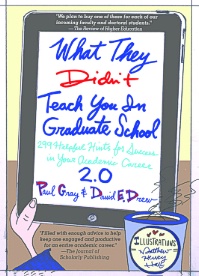
What They Didn’t Teach You in Graduate School: 299 Helpful Hints for Success in Your Academic Career
- Author
- Gray, Paul, and Drew, David E.
- Publisher
- Stylus Publishing, LLC, Sterling, VA
- ISBN
- 9781579226442
- Book Review Link
- http://onlinelibrary.wiley.com/doi/10.1111/teth.12111/abstract
- Table of Contents
-
Foreword 1 to the First Edition
Foreword 2 to the First Edition
Introduction
ch. 1 Basic Concepts
Gray’s Theorem of N + 2
Most academic fields are dominated by fewer than 100 powerful people
How to become known
Drew’s law on publishing papers
Make sure you have a mentor
Specialize. Get known for something
ch. 2 The PhD
Finish your PhD as early as possible
Be humble about your PhD
A PhD is primarily an indicator of survivorship
A PhD is a certification of research ability based on a sample of 1
A PhD is a license to reproduce
You must mave a PhD in hand
The key danger point is where you leave highly structured coursework
The PhD and part-time study
Avoid Watson’s syndrome
Celebrate your PhD!
ch. 3 The dissertation
Prelims
Finding a dissertation topic
Problem-solving mode
Put a lot of effort into writing your dissertation proposal
The range of your literature review
Selecting the dissertation advisory committee
The dissertation abstract
How long is too long for your dissertation?
The chain of references
Couple the likterature search closely with the discussion of results and the conclusion.
The risk of “not significant”results
The dissertation defense
ch. 4 Job Hunting
Job hunting is a research Project
Pick a place where you and your family want to live
When to apply for a faculty position
Find the best possible school for your first job
Change your career or move every seven years
Not-for-profit or for-profit for first or second job?
Exceptions to the previous hint
Build a Reference pool
Resumes are important
Dual careers
The short list
Jobs
Law of supply and demand
Research vs. teaching oriented institutions
The jobs may be at for profits
New programs
National rankings
Teaching in a community college
On-Line universities
The assistant dean strategy
Evaluate a postdoc carefully
Non-academic opportunities
Nonuniversity research organizations
Teaching Abroad for Fun and Profit
Interviewing
Tactics for interviewing
Dressing for the job interview
Don't be intimidated by the schools of those who interview you
Interview your potential bosses
Dealing with interviewers who published less than you did
Prepare an 'elevator speech"
Data Gathering
Determine the culture
Gather salary and tenure data
Obtaining tenure data is a little tricky
Ask about the retirement system
Parking
Determine real pay
Offers
Get the offer in writing, read it, and negotiate before you accept
Get the PhD bdefore you start the tenure track unless you are starving or homeless
Don’t take your first job at the school where you received your PhD
Choosing among offers
Hunting for the Next Job
Positioning for the next job
You become unemployed
ch. 5 Teaching and Service
Publications are the only form of portable wealth
Many colleges and universities value teaching
Teaching is a learned art
Being a mentor
Go to Toastmasters if needed
Meeting classes is paramount
Teaching can be a dangerous profession
Consider student costs when selecting textbooks.
Avoid serving on a committee where you are the technical expert
In The Classroom
Summaries lock in the material
Encourage questions
Enjoy your classes
Lecturing vs. facilitating
Teaching is not synonymous with lecturing
Lecture capture
Obtaining student responsesn through technology (clickers)
PowerPoint presentations
Teaching On-line
Distance education
Distance learning is a blessing. Distance learning is a threat
Students
Be wary of student excuses
Believe it or not, cheating is widespread
Teach every student
Teach to the student’s frame of reference
Distracted students
Undergraduates don’t remember more than 7 years back
Will this be on the final?
Grade inflation
Technobabble
Wikipedia and other web sources
Breaking the students' Wikipedia habit
Letters of reference for students
The student as customer mantra
ch. 6 Research
If you want a reserch career, make sure that the position you are offered allows you to actually do research
You can trade-off teaching load and research opportunities
Research requires both quantitative and qualitative skills. Learn grantsmanship
Don't be modest when writing a grant proposal
Protest if your brilliant grant proposal is declined
Build an advisory panel of nationally respected experts into your grant proposal
If you didn't build in an advisory panel it's not too late
Get the grant approval in writing
Get clearance before you study an organization
The institutional review board (IRB)
Academic trade journals are sources of higher education (and job) information
Collaborate and cooperate
Plagiarism is a No No
Back up, back up, back up your research
The “mode”of the number of publications is 0 followed closely by 1
ch. 7 Tenure
Tenure is the prize
Your promotion dossier
Why tenure is such a hurdle
If , by chance, you achieve tenure, never take another appolntment without it
Tenure, like reaserch support, can be negotiated on the way in
Tenure is tougher in cross-disciplinary fields
Tenure is forever (almost)
Tenure as we know it today may not be here forever
The number of tenured slots may decrease with time
The Mechanics of Tenure
The tenure clock is really four and a half years not seven
The Dreaded Impact Factor
Tenure committees look almost exclusively at refereed publications
Download counts
Multiple authored papers
Publication quality counts
Rolling reviews
ch. 8 Academic Rank
Being a tenured full professor is freedom
As a full professor you must be known for something
Avoid becoming the pitied “Permanent Associate Professor”
Promotion is an opportunity for a larger pay raise
ch. 9 Your Financial Life As An Academic
Academics are risk averse
Contracts are given to faculty for nine months
Salaries vary by field
Summer pay
The zero raise years
Retirement savings
Tax Deferral
Administrators make more
ch. 10 Life As An Academic
Good deans/bad deans
Never, ever choose sides in department politics
Don’t take a joint appointment
Join the faculty club
Office hours
Sabbaticals
Maintain collegiality
As an academic you are a public person
Freedom of speech
Attend Invited Lectures
Serving as an external reviewer
Keeping up with your field
You can go home again-retreat rights.
The board of trustees
Your Administrative Life
Secretaries are a scarce resource
Value your teaching assistants and graders
Grading
Your research assisstants require supervision.
Physical plant
Be careful what you delegate
Business cards
Your Digital Life
Learn the idiosyncracies of your institution's computer center
Electronic mail
The down side of e-mail
Don’t get on too many e-mail lists
Your students love e-mail, texting, and twitter
Keep up with computer developments
Meetings and digital publication
Interlibrary loan is quicker and more efficient than it used to be
Use digital libraries if they are available in your field
Telecommuting
Your web site
Your web visibility
The persistence of language
Institutional Citizen
Get to know the development people in your school and support them
Be responsive to your alumni office
When you do something noteworthy,m let your public relations department know
Communicating your field to the public
The faculty senate in most institutions provides a forum
Service
Department Chair
Never, never become a department chair unless you’re a tenured full professor
Be aware that the powers of a department chair are few
The role conflict in the job
Leadership
Dealing with student problems
Redeeming social values of being chair
Don’t stay in the chair position too long
Travel
Professional travel
Attend conferences
Choosing your conferen
* This irreverent, but serious, guide to what life in higher education institutions is really like, now enhanced by 100 new tips
* Invaluable advice that ranges from getting your Ph.D. to setting the course of your academic career
Just landed your first faculty position? Close to getting your Ph.D., and planning a career in academe? What will academic life be like? How do you discover its tacit rules? Develop the habits and networks needed for success? What issues will you encounter if you’re a person of color, or a woman? How is higher education changing?
Paul Gray and David E. Drew share their combined experience of many years as faculty and (recovering) administrators to offer even more insider advice—the kind that’s rarely taught or even talked about in graduate school – to help you succeed.
The 100 new hints expand sections on the dissertation process, job hunting, life in the classroom and on dealing with students, as well as on matters that affect readers’ careers, such as research, publication, and tenure. The book concludes with a tongue-in-cheek appendix on How to Become a Millionaire while an academic.
Already have the first edition? Give it to someone less fortunate than you, and take advantage of the new advice you will find in these pages. Too penurious to buy this book? Persuade a family member or friend to get it as a gift. (From the Publisher)
* Invaluable advice that ranges from getting your Ph.D. to setting the course of your academic career
Just landed your first faculty position? Close to getting your Ph.D., and planning a career in academe? What will academic life be like? How do you discover its tacit rules? Develop the habits and networks needed for success? What issues will you encounter if you’re a person of color, or a woman? How is higher education changing?
Paul Gray and David E. Drew share their combined experience of many years as faculty and (recovering) administrators to offer even more insider advice—the kind that’s rarely taught or even talked about in graduate school – to help you succeed.
The 100 new hints expand sections on the dissertation process, job hunting, life in the classroom and on dealing with students, as well as on matters that affect readers’ careers, such as research, publication, and tenure. The book concludes with a tongue-in-cheek appendix on How to Become a Millionaire while an academic.
Already have the first edition? Give it to someone less fortunate than you, and take advantage of the new advice you will find in these pages. Too penurious to buy this book? Persuade a family member or friend to get it as a gift. (From the Publisher)