Home » Resources » Scholarship on Teaching » What did you learn in the real world today?: The case of practicum in university educations
Scholarship
March 29, 2017
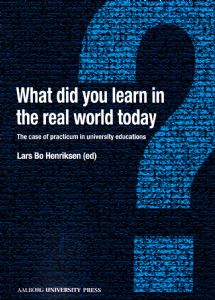
What did you learn in the real world today?: The case of practicum in university educations
- Author
- Henriksen, Lars Bo, ed.
- Publisher
- Aalborg University Press, Denmark
- ISBN
- 9788771120738
- Table of Contents
-
Preface
ch. 1 "What did you learn in the real world today?" (Lars Bo Henriksen, David O'Donnell)
ch. 2 Epistemology and learning in practice (Mogens Pahuus)
ch. 3 About the logic of practice (Jörg Zeller)
ch. 4 Praxis, PBL and the application of knowledge (Lars Bo Henriksen)
ch. 5 Embodiment as the existential soil of practice. Philosophical reflections on the concept of practice as "doing" (Ulla Th√∏gersen)
ch. 6 PBL and stories of body in the hospital world (Lars Botin)
ch. 7 Inquiry in the swampy lowland (Merete Wiberg)
ch. 8 Engineering students in the real world - on-campus PBL (Lars Bo Henriksen, Johan Askehave)
ch. 9 The Aalborg PBL model and employability (Lone Krogh)
ch. 10 Lessons from the Euronet-PBL project (Pekka Kämääinen, Ludger Deitmer)
ch. 11 About the authors
Click Here for Book Review
Abstract: Practice, praxis, traineeship, internship, or practicum - these are all names for the specific arrangements where students from universities engage in real life experiences; in arrangements where they leave the secure tranquility of the university and enter into the chaotic world of work. Practicum is a very good way of learning, and it can be very interesting for all parties involved. The students appreciate it, even if it is cumbersome, frustrating, and requires a lot of work - work that is different from what they know in their previous encounters with the education system. This book asks a simple question in relation to practicum, paraphrasing Tom Paxton's song: What Did You Learn in the Real World Today? The question is asked without the irony of Paxton's original one, in order to find out what is learned in the practicum. The chapters in this book shed some light on this simple question. The question is confronted from philosophical and pedagogical perspectives, while investigating a number of cases of students' learning experiences in the real world. (From the Publisher)
Abstract: Practice, praxis, traineeship, internship, or practicum - these are all names for the specific arrangements where students from universities engage in real life experiences; in arrangements where they leave the secure tranquility of the university and enter into the chaotic world of work. Practicum is a very good way of learning, and it can be very interesting for all parties involved. The students appreciate it, even if it is cumbersome, frustrating, and requires a lot of work - work that is different from what they know in their previous encounters with the education system. This book asks a simple question in relation to practicum, paraphrasing Tom Paxton's song: What Did You Learn in the Real World Today? The question is asked without the irony of Paxton's original one, in order to find out what is learned in the practicum. The chapters in this book shed some light on this simple question. The question is confronted from philosophical and pedagogical perspectives, while investigating a number of cases of students' learning experiences in the real world. (From the Publisher)