Home » Resources » Scholarship on Teaching » Voice & Vision: A Guide to Writing History and Other Serious Nonfiction
Scholarship
July 3, 2017
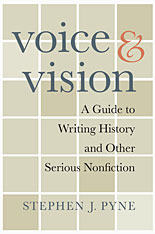
Voice & Vision: A Guide to Writing History and Other Serious Nonfiction
- Author
- Pyne, Stephen J.
- Publisher
- Harvard University Press, Cambridge, MA
- ISBN
- 9780674060425
- Table of Contents
-
Part I. Arts
1. In the Beginning, Words
2. Art and Craft
3. Rules of Engagement
4. Nonfiction as Writing
5. Voice…
6. …and Vision
7. Designing
8. Plotting
9. Transitioning
10. Dramatizing
11. Editing I
Part II. Crafts
12. Prose
13. Character
14. Setting
15. Point of View
16. Showing and Telling
17. Editing II
18. Figures of Speech
19. Technical Information
20. Questions of Scale
Part III. Doing It
21. Theory and Practice
22. Writing Lives
It has become commonplace these days to speak of “unpacking” texts. Voice and Vision is a book about packing that prose in the first place. While history is scholarship, it is also art—that is, literature. And while it has no need to emulate fiction, slump into memoir, or become self-referential text, its composition does need to be conscious and informed. Voice and Vision is for those who wish to understand the ways in which literary considerations can enhance nonfiction writing. At issue is not whether writing is scholarly or popular, narrative or analytical, but whether it is good. Fiction has guidebooks galore; journalism has shelves stocked with manuals; certain hybrids such as creative nonfiction and the new journalism have evolved standards, esthetics, and justifications for how to transfer the dominant modes of fiction to topics in nonfiction. But history and other serious or scholarly nonfiction have nothing comparable. Now this curious omission is addressed by Stephen Pyne as he analyzes and teaches the craft that undergirds whole realms of nonfiction and book-based academic disciplines. With eminent good sense concerning the unique problems posed by research-based writing and with a wealth of examples from accomplished writers, Pyne, an experienced and skilled writer himself, explores the many ways to understand what makes good nonfiction, and explains how to achieve it. His counsel and guidance will be invaluable to experts as well as novices in the art of writing serious and scholarly nonfiction. (From the Publisher)