Home » Resources » Scholarship on Teaching » Transforming Understandings of Diversity in Higher Education: Demography, Democracy, and Discourse
Scholarship
March 29, 2017
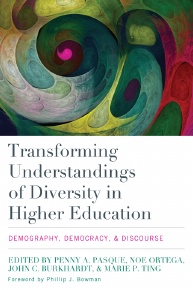
Transforming Understandings of Diversity in Higher Education: Demography, Democracy, and Discourse
- Author
- Pasque, Penny A.; Ortega, Noe; Burkhardt, John C.; Ting, and Marie P., eds.
- ISBN
- 9781620363768
- Table of Contents
-
Foreword (Phillip J. Bowman)
Acknowledgments
Introduction: Transforming Understandings of Diversity in Higher Education: History and Context (John C. Burkhardt, Christina Morton, Marie P. Ting, Penny A. Pasque, and Noe Ortega)
ch. 1 Color-Blind Ideology and the Disconnected Power-Analysis Frame Considerations for Historically Black Colleges and Universities’ Diversification (Uma M. Jayakumar and Annie S. Adamian)
ch. 2 An Interview With Uma M. Jayakumar: Social Agency and the Power of Resistance (Diane M. Back)
ch. 3 A Theory of Equity: A Social and Legal Analysis of College Access for Low-Income Students (Jarrett T. Gupton and Karen Miksch)
ch. 4 An Interview With Jarrett T. Gupton: The Value of Uncertainty and the Need for Nuance (Sheela Linstrum)
ch. 5 Lesbian, Gay, Bisexual, Transgender, and Queer Students on Campus: Fostering Inclusion Through Research, Policy, and Practice (Michael R. Woodford, Jessica Joslin, and Kristen A. Renn)
ch. 6 An Interview With Michael R. Woodford: Bringing Invisible Communities to Light: Disciplinary Norms, Collaboration and the Quest for Legitimacy (Timothy Hickey-LeClair)
ch. 7 Racially and Socioeconomically Diverse Students’ Pathways to College: An Exploration of Latin@ Students (Angela M. Locks, Dawn Person, Michelle Cuellar, Jeanette Maduena, and Melba Schneider Castro)
ch. 8 An Interview With Angela M. Locks: Understanding the Complexities of the College-Going Process (James M. Ellis)
ch. 9 Architecture of Diversity: Using the Lens and Language of Space to Examine Racialized Experiences of Students of Color on College Campuses (Michelle Samura)
ch. 10 An Interview With Michelle Samura: How the “Blue Wall” Changes Our Discourses on Race in Higher Education: Stepping Out of the Comfort Zone and Seeing Things in a Different Light (Jimin Kwon)
ch. 11 Including Disability in the Discourse: Extending and Advancing the Defi nition of Diversity in Higher Education (Allison Lombardi and Adam Lalor)
ch. 12 An Interview With Allison Lombardi: Including Disability in the Discourse (Lloyd Edward Shelton)
ch. 13 The Impact of Media Imagery on Academic Identity Development for Black Male Student Athletes (LaVar J. Charleston and Jerlando F. L. Jackson)
ch. 14 An Interview With Jerlando F. L. Jackson: An Instrumental Diversity Researcher (Carly Wegner)
ch. 15 Racialized and Gendered Experiences of African American Female Faculty at Public Community Colleges (Tamara Nichele Stevenson and Eboni M. Zamani-Gallaher)
ch. 16 An Interview With Tamara Nichele Stevenson, Surviving Racial Battle Fatigue: Cultivating Safe Spaces in Radicalized Environments (Tonya Kneff)
ch. 17 Unpacking the Mandate Rhetoric of Historically Black Colleges and Universities’ Diversity Discourses (Courtney Carter)
ch. 18 An Interview With Courtney Carter: Unpacking the Mandate Rhetoric of Historically Black Colleges and Universities’ Diversity Discourses (Demar F. Lewis IV)
ch. 19 Transforming Demography, Democracy, and Discourse Through Diversity in Education and Society (John C. Burkhardt and Marie P. Ting)
Contributors
Index
Click Here for Book Review
Abstract: This exciting new text examines one of the most important and yet elusive terms in higher education and society: What do we mean when we talk in a serious way about “diversity”?
A distinguished group of diversity scholars explore the latest discourse on diversity and how it is reflected in research and practice. The chapters trace how the discourse on diversity is newly shaped after many of the 20th century concepts of race, ethnicity, gender and class have lost authority. In the academic disciplines and in public discourse, perspectives about diversity have been rapidly shifting in recent years. This is especially true in the United States where demographic changes and political attitudes have prompted new observations - some which will clash with traditional frameworks.
This text brings together scholars whose research has opened up new ways to understand the complexities of diversity in higher education. Because the essential topic under consideration is changing so quickly, the editors of this volume also have asked the contributors to reflect on the paths their own scholarship has taken in their careers, and to see how they would relate their current conceptualization of diversity to one or more of three identified themes (demography, democracy and discourse). Each chapter ends with a candid graduate student interview of the author that provides an engaged picture of how the authors wrestle with one of the most complicated topics shaping them (and all of us) as individuals and as scholars. Of interest to anyone who is following the debates about diversity issues on our campuses, the book also offers a wonderful introduction to graduate students entering a discipline where critically important ideas are still very much alive for discussion. (From the Publisher)
Abstract: This exciting new text examines one of the most important and yet elusive terms in higher education and society: What do we mean when we talk in a serious way about “diversity”?
A distinguished group of diversity scholars explore the latest discourse on diversity and how it is reflected in research and practice. The chapters trace how the discourse on diversity is newly shaped after many of the 20th century concepts of race, ethnicity, gender and class have lost authority. In the academic disciplines and in public discourse, perspectives about diversity have been rapidly shifting in recent years. This is especially true in the United States where demographic changes and political attitudes have prompted new observations - some which will clash with traditional frameworks.
This text brings together scholars whose research has opened up new ways to understand the complexities of diversity in higher education. Because the essential topic under consideration is changing so quickly, the editors of this volume also have asked the contributors to reflect on the paths their own scholarship has taken in their careers, and to see how they would relate their current conceptualization of diversity to one or more of three identified themes (demography, democracy and discourse). Each chapter ends with a candid graduate student interview of the author that provides an engaged picture of how the authors wrestle with one of the most complicated topics shaping them (and all of us) as individuals and as scholars. Of interest to anyone who is following the debates about diversity issues on our campuses, the book also offers a wonderful introduction to graduate students entering a discipline where critically important ideas are still very much alive for discussion. (From the Publisher)