Home » Resources » Scholarship on Teaching » Transformative Conversations: A Guide to Mentoring Communities Among Colleagues in Higher Education
Scholarship
March 29, 2017
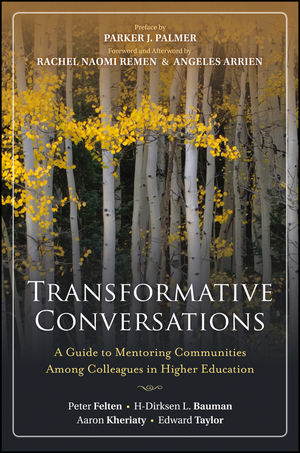
Transformative Conversations: A Guide to Mentoring Communities Among Colleagues in Higher Education
- Author
- Felton, Peter; Bauman, H-Kirksen L.; Kheriaty, Aaron; and Taylor, Edward
- Publisher
- John Wiley & Sons, San Francisco
- ISBN
- 9781118288276
- Table of Contents
-
Preface
Foreword: Rembering What The Ancients Knew
Introduction
Interlude: Finding the Time and Space for a More Meaningful Professional Life
ch. 1 What Is a Formation Mentoring Community?
Interlude: Message in a Bottle
ch. 2 Cultivating Growth: Conversation in Community
Interlude: Is There a Place for Me in a Formation Mentoring Community?
ch. 3 The Basics of Creating Formation Mentoring Communities on Your Campus
ch. 4 Collaborative Stewardship: Facilitating a Formation Mentoring Community
ch. 5 From Individual to Institutional Change: Ripples of Transformation
Afterword: Beyond The Small Group
Recommended Resources
Notes
Gratitudes
About the Authors
Index
Click Here for Book Review
Abstract: From the Inter-generational Mentoring Community project, which develops the next generation of academic leaders, comes formation mentoring, a process to enable faculty to recover, sustain, and further develop a sense of vocation, mission, and purpose. This book is a concise and practical guide to convening and sustaining these kinds of formation mentoring groups in higher education. It provides the necessary direction and structure to orient the process but is open-ended enough to apply across many settings and professional or educational disciplines. (From the Publisher)
Abstract: From the Inter-generational Mentoring Community project, which develops the next generation of academic leaders, comes formation mentoring, a process to enable faculty to recover, sustain, and further develop a sense of vocation, mission, and purpose. This book is a concise and practical guide to convening and sustaining these kinds of formation mentoring groups in higher education. It provides the necessary direction and structure to orient the process but is open-ended enough to apply across many settings and professional or educational disciplines. (From the Publisher)