Home » Resources » Scholarship on Teaching » The University Gets Religion: Religious Studies in American Higher Education
Scholarship
March 29, 2017
The University Gets Religion: Religious Studies in American Higher Education
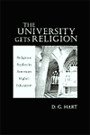
- Author
- D.G. Hart
- Publisher
- Johns Hopkins University Press, Baltimore, MD
- ISBN
- 801862108
- Table of Contents
-
Preface and Acknowledgments
Introduction: Why Study Religion?
Part I: The Age of the University, 1870-1925
ch. 1 Enlightened Christianity and the Founding of the University
ch. 2 Protestant Divinity in the Shadow of the University
ch. 3 The Emergence of a Pattern
Part II: The Age of the Protestant Establishment, 1925-1965
ch. 4 Religious Studies and the Humanities
ch. 5 Finding a Place for Theology
ch. 6 The Good Book for Tough Times
ch. 7 Church History for the Nation
Part III: The Age of the American Academy of Religion, 1965-Present
ch. 8 Religious Studies and the Failure of the Christian Academy
ch. 9 Religious Studies in Post-Protestant America
ch. 10 Religious Studies, the Would-be Discipline
Conclusion: Whither Religion in the University?
Notes
Bibliographical Essay
Index
In The University Gets Religion: Religious Studies in American Higher Education, historian D. G. Hart examines the rise of religion to its current place as one of the largest academic disciplines in contemporary higher education. Protestant ministers and faculty were especially influential in arguing for the importance of religion to a truly "liberal" education, staffing departments and designing curricula to reflect their own Protestant assumptions about the value of religion not just for higher education but for American culture in general. Though many educators originally found religion too sectarian and unscientific for colleges and universities, religious studies nevertheless emerged after World War II as a crucial element of a liberal education.
But the success of mainstream Protestantism in fostering the academic study of religion has become the field's greatest burden. Over the last twenty-five years, religion scholars have distanced themselves from traditional Protestant orientations while looking for topics better suited to America's cultural diversity. As a result, religion is in the awkward position of being one of the largest scholarly disciplines while simultaneously lacking a solid academic justification. It may be time, Hart argues, for academics to stop trying to secure a religion-friendly university.
The first sustained history of the academic study of religion at American universities, The University Gets Religion: Religious Studies in American Higher Education is a timely book that explores the present-day implications of religious studies' Protestant past. (From the Publisher)
But the success of mainstream Protestantism in fostering the academic study of religion has become the field's greatest burden. Over the last twenty-five years, religion scholars have distanced themselves from traditional Protestant orientations while looking for topics better suited to America's cultural diversity. As a result, religion is in the awkward position of being one of the largest scholarly disciplines while simultaneously lacking a solid academic justification. It may be time, Hart argues, for academics to stop trying to secure a religion-friendly university.
The first sustained history of the academic study of religion at American universities, The University Gets Religion: Religious Studies in American Higher Education is a timely book that explores the present-day implications of religious studies' Protestant past. (From the Publisher)