Home » Resources » Scholarship on Teaching » The Grace of Playing: Pedagogies for Leaning into God's New Creation
Scholarship
March 29, 2017
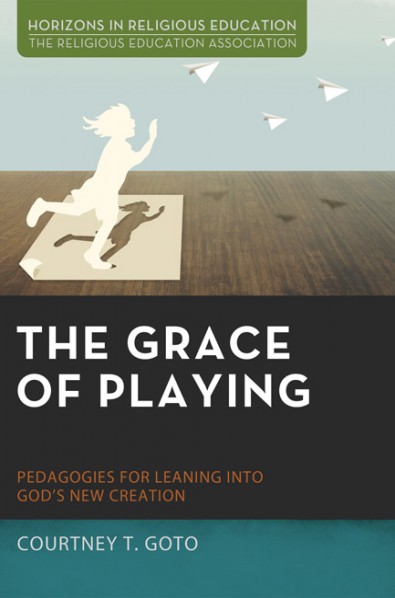
The Grace of Playing: Pedagogies for Leaning into God’s New Creation
- Author
- Goto, Courtney T.
- Publisher
- Wipf & Stock Publishers, Eugene, OR
- ISBN
- 9781498233002
- Table of Contents
-
Series Foreword (Dean Blevins)
Editors’ Preface (Jack L. Seymour and Elizabeth Caldwell)
Author’s Preface
ch. 1 Introduction
From Revelation to Revelatory Experiencing
The Need for the Language of Playing
Seeking the Grace of Playing
ch. 2 Playing Social Scientifically: The Meanings of Playing
A Characterization of Playing
Many Approaches to Playing and Learning
Creativity and Playing as Form of Engagement
How Christians Play
ch. 3 Playing Theologically: Learning into God’s New Creation
Moltmann Misunderstood
Assessing and Deconstructing Moltmann’s Theology of Play
Moltmann Revised: Spirit and Playing for Love’s Sake
Hide-and-Seek with the Holy Spirit
Christians Playing to Seek, Find, and Be Found
ch. 4 Playing Historically: Medieval Practices
Playing with Devotional Dolls
Playing by Pretense: Holy Fools
A Psychoanalytic Perspective
A Theological Perspective
Insights from Historic Cases of Revelatory Experiencing
ch. 5 Playing Aesthetically: Rethinking Our Grounds for Playing
Creating a Pretend Garden at a Japanese American Church
A Psychoanalytic Perspective
A Theological Perspective
A Historical Perspective
Insights from an Aesthetic Case of Revelatory Experiencing
Re-tilling Grounds for Playing
Playing with Renditions
Developing Local Practical Theological Aesthetics
Doing Theology by Playing Aesthetically
ch. 6 Towards a New Creation
Playing in a Detention Center
Analysis from Four Perspectives on Playing
Using the Tools, Finding Inspiration for Teaching
Forming Learners for Decentering and Re-centering
The Grace of Playing in Worlds in Need
A Commitment to Playing for Love’s Sake
Bibliography
Click Here for Book Review
Abstract: Believers and teachers of faith regularly know the in-breaking of God's Spirit in their midst, when revelatory experiencing unexpectedly shifts habits of thinking, feeling, and doing toward more life-giving ways of being and becoming. When the moment is right, Spirit breathes new life into dry bones. Though religious educators have much practical wisdom about facilitating learning that is creative and transformative, sharper concepts, cases, and theory can help them do it more critically and assist learners to practice openness to wonder, surprise, and authenticity. The Grace of Playing explains how we can create the conditions for revelatory experiencing by understanding it in light of playing. The notion of playing "as if" can be powerfully reclaimed from ecclesial ambivalence, casual speech, and commercial interests that often lead playing to be associated with childishness, frivolity, or entertainment. This book theorizes adults playing for the sake of faith, drawing on D. W. Winnicott's psychoanalytic theory, a revision of Jurgen Moltmann's theology of play, biblical texts, medieval devotional practices, as well as art and aesthetics that help local faith communities engage in theological reflection. Communal forms of playing in/at God's new creation provide insights into pedagogies in which learners are creating and are created anew. (From the Publisher)
Abstract: Believers and teachers of faith regularly know the in-breaking of God's Spirit in their midst, when revelatory experiencing unexpectedly shifts habits of thinking, feeling, and doing toward more life-giving ways of being and becoming. When the moment is right, Spirit breathes new life into dry bones. Though religious educators have much practical wisdom about facilitating learning that is creative and transformative, sharper concepts, cases, and theory can help them do it more critically and assist learners to practice openness to wonder, surprise, and authenticity. The Grace of Playing explains how we can create the conditions for revelatory experiencing by understanding it in light of playing. The notion of playing "as if" can be powerfully reclaimed from ecclesial ambivalence, casual speech, and commercial interests that often lead playing to be associated with childishness, frivolity, or entertainment. This book theorizes adults playing for the sake of faith, drawing on D. W. Winnicott's psychoanalytic theory, a revision of Jurgen Moltmann's theology of play, biblical texts, medieval devotional practices, as well as art and aesthetics that help local faith communities engage in theological reflection. Communal forms of playing in/at God's new creation provide insights into pedagogies in which learners are creating and are created anew. (From the Publisher)