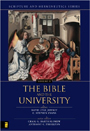
- Author
- Jeffrey, David Lyle, C. Stephen Evans and Craig G. Bartholomew, eds.
- Publisher
- Zondervan, Grand Rapids, MI
- ISBN
- 9780310234180
- Table of Contents
-
Preface
Contributors
Abbreviations
Introduction (David Lyle Jeffrey)
The Bible in Intellectual History
Authority and Wisdom
Authority and the Book
A Flourishing of the Disciplines
Ad Fontes Redivivus?
Postscript
ch. 1 The Bible, the University, and the God Who Hides (Dallas Willard)
Sources of Knowledge
The Bible as a Source of Knowledge
A Brief History of 'Knowledge'
Knowing vs. Not-Knowing
Knowledge of the God who Hides
The Task of the Christian Intellectual
ch. 2 The Place of Scripture in Christian Theology (William J. Abraham)
An Important Platitude
The Creation of Biblical Studies
The Unexpected Disaster
The Really Deep Problem
Retracing Our Steps
Back to the Crisis Again
Turning to the Future
ch. 3 No Longer Queen: The Theological Disciplines and Their Sisters (Al Wolters)
Foundational Assumptions in Biblical Scholarship
Bringing Scripture to Bear on Christian Scholarship
ch. 4 At the School of Truth: The Ecclesial Character of Theology and Exegesis in the Thought of Benedict XVI (Scott Hahn)
Truth, Freedom, and the Academy
The Critique of Academic Biblical Criticism
The Ecclesial Locus of Theology and Exegesis
Benedict's New Synthesis
ch. 5 The Spiritual Sense(s) Today (Glenn Olsen)
Recovering the Spiritual Sense(s)
Rethinking the 'Apostolic' Exegetical Tradition
Reconsidering Terminology: 'Allegory' and 'Typology'
Reclaiming the 'Historical' Sense
Restoring the Analogical Imagination
ch. 6 Situationism and the New Testament Psychology of the Heart (Robert C. Roberts)
Introduction
Situationism
Traits and Situations
The Psychology of the Heart
Application of the Psychology of the Heart to Situationism
Conclusion
ch. 7 The Bible, Positive Law, and the Legal Academy (Robert F. Cochran, Jr.)
The Bible and Positive Law
Jesus and the Positive Law
The Legal Academy
ch. 8 Biblical Imagery and Educational Imagination: Comenius and the Garden of Delight (David I. Smith)
Faith, Learning and Metaphor
The Garden of Delight as a School
The School as a Garden of Delight
The Garden of Delight Today
Coda: Of Math, Grammar and Reconciliation
ch. 9 Reading Habits, Scripture and the University (John Sullivan)
Scripture and Scholarship
Inhospitable Environments
Moving Forward in Hope
ch. 10 The Case for Empirical Assessment of Biblical Literacy in America (Byron Johnson)
Introduction
Are Christians and Non-Christians Different on Key Social Outcome Indicators?
Is America Becoming a Secular and Less Religious Society?
Data on Religion in America
Is Bible Literacy Low and Declining in America?
Conclusions
ch. 11 'As if God Were Dead': American Literature and the Question Of Scripture (Roger Lundin)
'As if God Were Dead': Emerson and Scriptural Authority
'The Secret of Our Paternity': Scripture in the School of Melville
'An Antique Volume': Dickinson and the Limits of Scripture
A Theological Response
ch. 12 Biblical Literacy, Academic Freedom, and Christian Liberty (David Lyle Jeffrey)
Eclipse of Biblical Narrative
Egotism and the Common Lot
The Bible and Academic Freedom
Afterword - The Bible and the Academy: Some Concluding Thoughts and Possible Future Directions (C. Stephen Evans)
University of Gloucestershire
The British and Foreign Bible Society
Baylor University
Redeemer University College
Scripture Index
Names Index
Subject Index
It is well known that the Western university gradually evolved from the monastic stadium via the cathedral schools of the twelfth century to become the remarkably vigorous and interdisciplinary European institutions of higher learning that transformed Christian intellectual culture in the thirteenth and fourteenth centuries. It is equally well known that subsequent disciplinary developments in higher education, including the founding and flourishing of many of the most prestigious of North American universities, owe equally to the Protestant and perhaps particularly Calvinist influence. But that the secularized modern university that descended from these developments is now in something of an identity crisis is becoming widely and often awkwardly apparent.
The reason most often given for the crisis is our general failure to produce a morally or spiritually persuasive substitute for the authority that undergirded the intellectual culture of our predecessors. This is frequently also a reason for the discomfort many experience in trying to address the problem, for it requires an acknowledgement, at least, that the secularization hypothesis has proven inadequate as a basis for the sustaining of coherence and general intelligibility in the university curriculum. Nowhere is this more apparent than in the disciplines of biblical studies and theology, which once were the anchor or common point of reference for theological thought, but which are now both marginalized in the curriculum and internally divided as to meaning and purpose, even where the Church itself is concerned.
In this final volume of the Scripture and Hermeneutic Series, a group of distinguished scholars havesought to understand the role of the Bible in relation to the disciplines in a fresh way. Offered in a spirit of humility and experimentally, the essays here consider the historic role of the Bible in the university, the status of theological reflection regarding Scripture among the disciplines today, the special role of Scripture in the development of law, the humanities and social sciences, and finally, the way the Bible speaks to issues of academic freedom, intellectual tolerance, and religious liberty.
Contributors Include:
Dallas Willard
William Abraham
Al Wolters
Scott Hahn
Glenn Olsen
Robert C. Roberts
Byron Johnson
Robert Cochran, Jr.
David I. Smith
John Sullivan
Robert Lundin
C. Stephen Evans
David Lyle Jeffrey
(From the Publisher)
The reason most often given for the crisis is our general failure to produce a morally or spiritually persuasive substitute for the authority that undergirded the intellectual culture of our predecessors. This is frequently also a reason for the discomfort many experience in trying to address the problem, for it requires an acknowledgement, at least, that the secularization hypothesis has proven inadequate as a basis for the sustaining of coherence and general intelligibility in the university curriculum. Nowhere is this more apparent than in the disciplines of biblical studies and theology, which once were the anchor or common point of reference for theological thought, but which are now both marginalized in the curriculum and internally divided as to meaning and purpose, even where the Church itself is concerned.
In this final volume of the Scripture and Hermeneutic Series, a group of distinguished scholars havesought to understand the role of the Bible in relation to the disciplines in a fresh way. Offered in a spirit of humility and experimentally, the essays here consider the historic role of the Bible in the university, the status of theological reflection regarding Scripture among the disciplines today, the special role of Scripture in the development of law, the humanities and social sciences, and finally, the way the Bible speaks to issues of academic freedom, intellectual tolerance, and religious liberty.
Contributors Include:
Dallas Willard
William Abraham
Al Wolters
Scott Hahn
Glenn Olsen
Robert C. Roberts
Byron Johnson
Robert Cochran, Jr.
David I. Smith
John Sullivan
Robert Lundin
C. Stephen Evans
David Lyle Jeffrey
(From the Publisher)