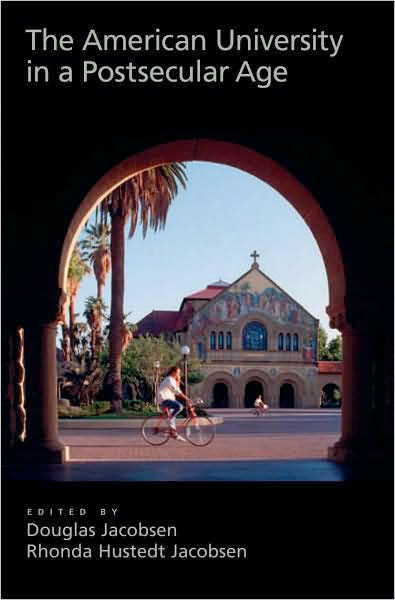
- Author
- Douglas Jacobsen and Rhonda Hustedt Jacobsen, eds.
- Publisher
- Oxford University Press, NY
- ISBN
- 9780195323443
- Table of Contents
-
Introduction
I. Postsecular America (Douglas Jacbosen, Rhonda Hustedt Jacobsen)
Part I Religion, Institutions, and Faculty Roles
ch. 2 The Religious Convictions of College and University Professors (Neil Gross, Solon Simmons)
ch. 3 Can Faith Be More Than a Sideshow in the Contemporary Academy? (Robert Wuthnow)
ch. 4 A Level Playing Field for Religion in Higher Education(John J. DiIulio, Jr.)
ch. 5 The Ideals and Diversity of Church-Related Higher Education (Douglas Jacobsen, Rhonda Hustedt Jacobsen)
ch. 6 Why Faculty Find It Difficult to Talk about Religion (Mark U. Edwards, Jr)
ch. 7 Faculty Priorities (R. Eugene Rice)
Part II Religion, the Curriculum, and Student Learning
ch. 8 The Religious and Spiritual Journeys of College Students (Larry A. Braskamp)
ch. 9 The Different Spiritualities of the Students We Teach (Robert J. Nash, DeMethra, LaSha Bradly)
ch. 10 Spirituality, Diversity, and Learner-Centered Teaching (Elizabeth J. Tisdell)
ch. 11 Taking Religion Seriously in Public Universities (Warren A. Nord)
ch. 12 Religious Pluralism, the Study of Religion, and "Postsecular" Culture (Amanda Poterfield)
ch. 13 Professing Understanding and Professing Faith (Lee S. Shulman)
Part III A Framework for Academic Conversation
ch. 14 Talking about Religion (Douglas Jacobsen, Rhonda Hustedt Jacobsen)
Notes
Index
For much of the twentieth century, it was assumed that higher education was and ought to be a secular enterprise, but that approach no longer suffices. The culture has shifted, and contemporary college and university students are increasingly bringing religious and spiritual questions to campus. In response, college and university leaders are exploring anew the relationship between religion and higher education.
The American University in a Postsecular Age grapples with key questions:
—How religious or irreligious are faculty and students today? What level of religious literacy should be expected from students?
—Can religion be allowed into the classroom without being disruptive?
—Should colleges and universities help students reflect on their own faith?
—Is religion antithetical to critical inquiry?
—Can religion have a positive role to play in higher education?
This is a state-of-the-art introduction to the national discussion about religion and higher education. Leading scholars and top educators express a wide spectrum of opinions that reflect the best current thinking. Introductory and concluding essays by the editors describe the postsecular character of our age and propose a comprehensive framework intended to facilitate ongoing conversation. (From the Publisher)
The American University in a Postsecular Age grapples with key questions:
—How religious or irreligious are faculty and students today? What level of religious literacy should be expected from students?
—Can religion be allowed into the classroom without being disruptive?
—Should colleges and universities help students reflect on their own faith?
—Is religion antithetical to critical inquiry?
—Can religion have a positive role to play in higher education?
This is a state-of-the-art introduction to the national discussion about religion and higher education. Leading scholars and top educators express a wide spectrum of opinions that reflect the best current thinking. Introductory and concluding essays by the editors describe the postsecular character of our age and propose a comprehensive framework intended to facilitate ongoing conversation. (From the Publisher)