Home » Resources » Scholarship on Teaching » Teaching the Whole Student - Engaged Learning With Heart, Mind, and Spirit
Scholarship
July 28, 2017
Teaching the Whole Student - Engaged Learning With Heart, Mind, and Spirit
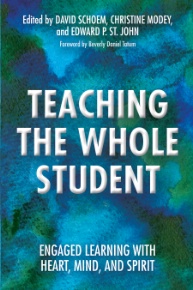
- Author
- Schoem, David; Modey, Christine; St. John, Edward P., eds.
- Publisher
- Stylus Publishing, LLC, Sterling, VA
- ISBN
- 9781620363041
- Table of Contents
-
Forward
Preface
Introduction
PART ONE: WHOLE STUDENT LEARNING APPROACHES
ch. 1. The Whole Student Approach as a Retention Model (Jerry A. Pattengale)
ch. 2. Incorporating Social Justice into Teaching - An Integrative Pedagogy Approach (Kathleen Manning)
PART TWO: ENGAGED LEARNING AND TEACHING IN PRACTICE
ch. 3. Learning Community Classrooms and Educating For Critical Hope (Gillies Malnarich)
ch. 4. Relational Teaching and Learning - The Classroom as Community and the Community as Classroom (David Schoem)
ch. 5. Toward a New Pedagogy to Help Create a Sustainable Future (James Crowfoot)
ch. 6. Experiential and Dialogic Pedagogy in a Religious and Ethnic Conflict Course (Adrienne B. Dessel)
ch. 7. Service Learning and Integrative Pedagogy for Engaging the Whole Student (Joseph A Galura)
PART THREE: INTEGRATIVE PEDAGOGY
ch. 8. Teaching and Learning that make a Difference (James L. Heft)
ch. 9. Integrative Approaches for Sustained Diversity Engagement in the Early Years of College (Angela M. Locks)
ch. 10. Assessment - Rethinking the Role of Integrative Pedagogies (Kimberly A. Kline; Edward P. St. John; Annie E. Connors)
ch. 11. Teaching the Whole Student (Christine Modey; David Schoem; Edward P. St. John)
Editors and Contributors
Index
Click Here for Book Review
Teaching the Whole Student is a compendium of engaged teaching approaches by faculty across disciplines. These inspiring authors offer models for instructors who care deeply about their students, respect and recognize students’ social identities and lived experiences, and are interested in creating community and environments of openness and trust to foster deep-learning, academic success, and meaning-making.
The authors in this volume stretch the boundaries of academic learning and the classroom experience by seeking to identify the space between subject matter and a student's core values and prior knowledge. They work to find the interconnectedness of knowledge, understanding, meaning, inquiry and truth. They appreciate that students bring their full lives and experiences—their heart and spirit—into the classroom just as they bring their minds and intellectual inquiry.
These approaches contribute to student learning and the core academic purposes of higher education, help students find meaning and purpose in their lives, and help strengthen our diverse democracy through students’ active participation and leadership in civic life. They also have a demonstrated impact on critical and analytical thinking, student retention and academic success, personal well-being, commitments to civic engagement, diversity, and social justice.
Topics discussed:
• Teacher-student relationships and community building
• How teaching the whole student increases persistence and completion rates
• How an open learning environment fosters critical understanding
• Strategies for developing deep social and personal reflection in experiential education and service learning
The authors of this book remind us in poignant and empirical ways of the importance of teaching the whole student, as the book's title reflects. (From the Publisher)
Teaching the Whole Student is a compendium of engaged teaching approaches by faculty across disciplines. These inspiring authors offer models for instructors who care deeply about their students, respect and recognize students’ social identities and lived experiences, and are interested in creating community and environments of openness and trust to foster deep-learning, academic success, and meaning-making.
The authors in this volume stretch the boundaries of academic learning and the classroom experience by seeking to identify the space between subject matter and a student's core values and prior knowledge. They work to find the interconnectedness of knowledge, understanding, meaning, inquiry and truth. They appreciate that students bring their full lives and experiences—their heart and spirit—into the classroom just as they bring their minds and intellectual inquiry.
These approaches contribute to student learning and the core academic purposes of higher education, help students find meaning and purpose in their lives, and help strengthen our diverse democracy through students’ active participation and leadership in civic life. They also have a demonstrated impact on critical and analytical thinking, student retention and academic success, personal well-being, commitments to civic engagement, diversity, and social justice.
Topics discussed:
• Teacher-student relationships and community building
• How teaching the whole student increases persistence and completion rates
• How an open learning environment fosters critical understanding
• Strategies for developing deep social and personal reflection in experiential education and service learning
The authors of this book remind us in poignant and empirical ways of the importance of teaching the whole student, as the book's title reflects. (From the Publisher)