Home » Resources » Scholarship on Teaching » Teaching Information Literacy Threshold Concepts: Lesson Plans for Librarians
Scholarship
March 29, 2017
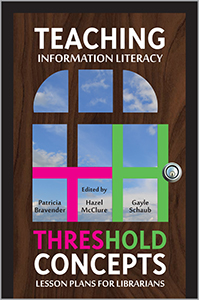
Teaching Information Literacy Threshold Concepts: Lesson Plans for Librarians
- Author
- Bravemder, Patricia; McClure, Hazel; and Schaub, Gayle, eds.
- Publisher
- Association of College & Research Libraries, Chicago, IL
- ISBN
- 9780838987711
- Table of Contents
-
Editors’ Preface
Introduction
 
ch. 1 Scholarship as Conversation
The Conversational Nature of Sources (Andrea Baer)
Using Information as a Springboard to Research (Emily Frigo & Jessalyn Richter)
Mapping Scholarly Conversation (Kathleen Anne Langan)
Crafting a Credible Message (Debbie Morrow)
Starting Points: The Role of Blogs in Scholarly Conversation (Brandon West)
ch. 2 Research as Inquiry
Flawed Questions: Tools for Inquiry (Smita Avasthi)
Crime Scene Investigation as an Analogy for Scholarly Inquiry (Robert Farrell)
The Research Discussion (Charissa Jefferson)
Developing a Research Question: Topic Selection Lesson Plan (Kevin Michael Klipfel)
The Connection between Personal and Academic Research (Sarah Naumann & Sami Lange)
ch. 3 Authority is Constructed and Contextual
Evaluating Information Sources (Robert Farrell)
Determining the Relevance and Reliability of Information Sources (Nancy Fawley)
Establishing Evaluation Criteria (Steven Hoover)
Non-Scholarly Formats as Research Tools (Rachel M. Minkin)
Scholarly/Non-Scholarly (Jo Angela Oehrli & Emily Hamstra)
ch. 4 Information Creation as a Process
Using Sources to Support a Claim (Dani Brecher)
Information Life Cycle (Toni M. Carter & Todd Aldridge)
Tracing Information over Time (Xan Goodman)
ch. 5 Searching as Strategic Exploration
From Nothing to Something: Transforming the “Failed” Search (Ika Datig)
Context through Citation (Jenny Fielding)
What is a Database? (Samantha Godbey, Sue Wainscott & Xan Goodman)
Who Cares?  Understanding the Human Production of Information (Rebecca Kuglitsch)
Password: Keyword Edition (Melissa Langridge)
Approaching Problems Like a Professional (Melissa Mallon)
Databases vs. Search Engines Game (Elizabeth Martin & Rebecca Daly)
Keywording (Cate Calhoun Oravet)
Framing a Topic for Library Research (Melissa Browne, Caitlin Plovnick, Cathy Palmer, & Richard Caldwell)
Systems of Organization (Pete Ramsey & Stephen “Mike” Kiel)
ch. 6 Information Has Value
Gray Areas in Plagiarism Cases (Smita Avasthi)
The Who, What, and Why of the Creative Commons (Rebecca Bliquez & Jane Van Galen)
Recognizing Plagiarism (Patricia Bravender & Gayle Schaub)
Plagiarism v. Copyright Infringement (Patricia Bravender)
Louder than Words: Using Infographics to Teach the Value of Information And Authority (Hazel McClure & Christopher Toth)
Ethical Use of Information in Presentations (Debbie Morrow)
Lessons with Overlapping Information Literacy Threshold Concepts
Appendix
Lesson Handouts
ACRL Framework for Information Literacy for Higher Education
About the Editors
Contributors
Recommended Reading
Teaching Information Literacy Threshold Concepts: Lesson Plans for Librarians is a collection designed by instruction librarians to promote critical thinking and engaged learning. It provides teaching librarians detailed, ready-to-use, and easily adaptable lesson ideas to help students understand and be transformed by information literacy threshold concepts. The lessons in this book, created by teaching librarians across the country, are categorized according to the six information literacy frames identified in the ACRL Framework for Information Literacy in Higher Education (2015). This volume offers concrete and specific ways of teaching the threshold concepts that are central to the ACRL Framework and is suitable for all types of academic libraries, high school libraries, as well as a pedagogical tool for library and information schools. (From the Publisher)